A sharp criterion and complete classification of global-in-time solutions and finite time blow-up of solutions to a chemotaxis system in supercritical dimensions
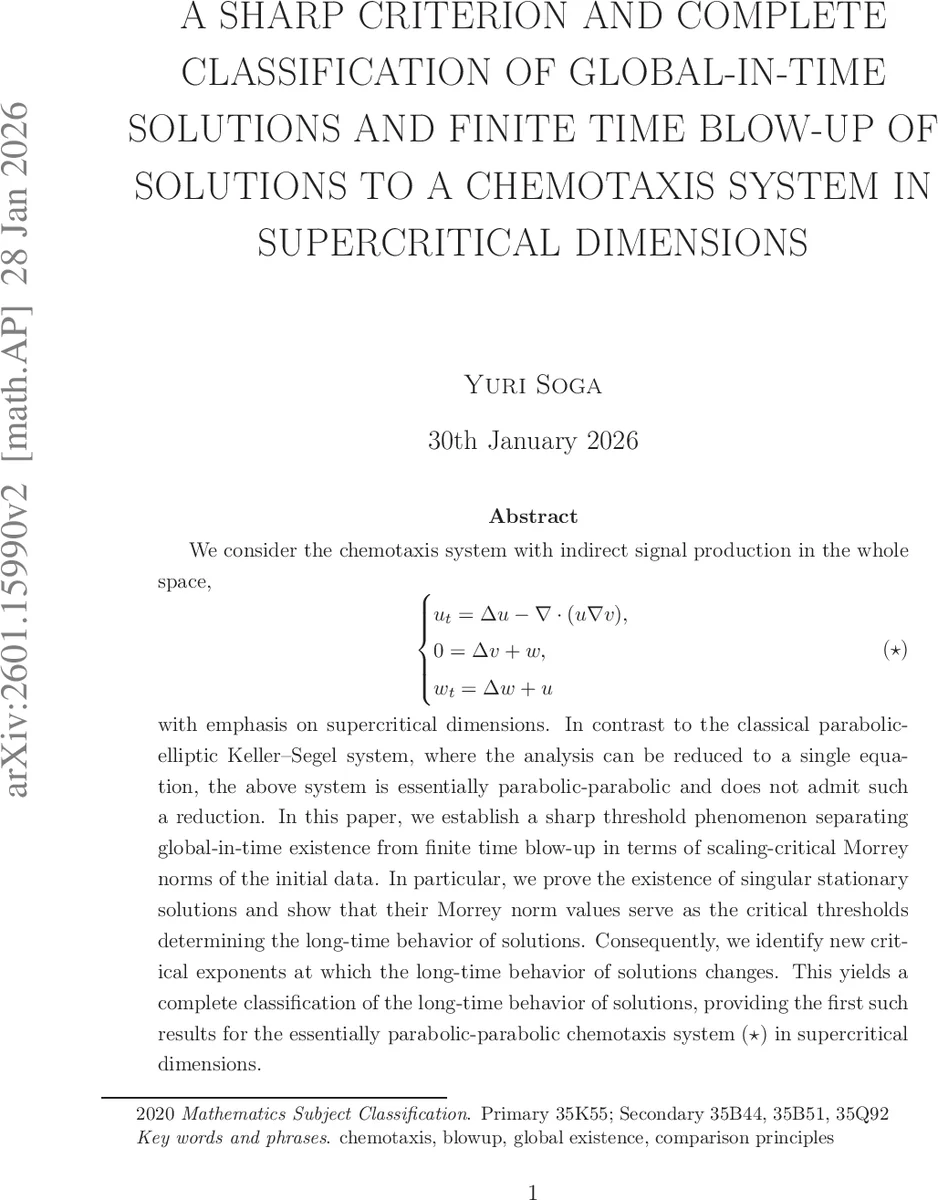
We consider the chemotaxis system with indirect signal production in the whole space, \begin{equation}\label{abst:p}\tag{$\star$} \begin{cases} u_t = Δu - \nabla \cdot (u\nabla v),\ 0 = Δv + w,\ w_t = Δw + u \end{cases} \end{equation} with emphasis on supercritical dimensions. In contrast to the classical parabolic-elliptic Keller–Segel system, where the analysis can be reduced to a single equation, the above system is essentially parabolic-parabolic and does not admit such a reduction. In this paper, we establish a sharp threshold phenomenon separating global-in-time existence from finite time blow-up in terms of scaling-critical Morrey norms of the initial data. In particular, we prove the existence of singular stationary solutions and show that their Morrey norm values serve as the critical thresholds determining the long-time behavior of solutions. Consequently, we identify new critical exponents at which the long-time behavior of solutions changes. This yields a complete classification of the long-time behavior of solutions, providing the first such results for the essentially parabolic-parabolic chemotaxis system \eqref{abst:p} in supercritical dimensions.
💡 Research Summary
The paper investigates a chemotaxis system with indirect signal production on the whole space ℝⁿ for dimensions d ≥ 5, i.e. in the super‑critical regime. The model consists of three coupled equations: a parabolic equation for the cell density u, an elliptic Poisson equation for the chemoattractant potential v driven by an intermediate variable w, and a second parabolic equation for w driven by u. Unlike the classical parabolic‑elliptic Keller–Segel system, this system cannot be reduced to a single scalar equation; it remains essentially parabolic‑parabolic.
A key observation is that the natural scaling
u_λ(x,t)=λ⁴u(λx,λ²t), v_λ(x,t)=v(λx,λ²t), w_λ(x,t)=λ²w(λx,λ²t)
leaves the equations invariant. Under this scaling the critical Morrey spaces are M_{d/4}(ℝᵈ) for u and M_{d/2}(ℝᵈ) for w. These spaces are scaling‑invariant and, in the radial setting, their norms reduce to simple supremum formulas involving weighted averages over balls.
The authors first construct a family of singular stationary solutions (u_C, v_C, w_C) given by
u_C(x)=8(d−4)(d−2)|x|^{−4}, w_C(x)=4(d−2)|x|^{−2}, v_C(x)=−4 log|x|+C.
These satisfy the stationary version of the system and, after eliminating v, reduce to the fourth‑order elliptic equation Δ²φ=e^{φ} with φ=log u_C. The Morrey norms of these singular states are computed explicitly:
‖u_C‖{M{d/4}}=6(d−2)σ_d, ‖w_C‖{M{d/2}}=3σ_d,
where σ_d denotes the surface area of the unit sphere in ℝᵈ. The authors argue that these values constitute sharp thresholds for the dynamics.
The main global‑existence theorem (Theorem 1.3) states that if the radially symmetric, non‑negative initial data (u₀,w₀) belong to the critical Morrey spaces (with a slight additional regularity in a homogeneous Morrey subspace) and satisfy
‖u₀‖{M{d/4}} < 6(d−2)σ_d, ‖w₀‖{M{d/2}} < 3σ_d,
then a unique global solution exists. The solution remains uniformly bounded in the same Morrey norms for all t ≥ 0, and the chemoattractant v is recovered via the convolution v=E_d∗w, where E_d is the fundamental solution of the Laplacian. The proof combines a comparison principle adapted to the fully coupled system, delicate maximal‑function estimates in Morrey spaces, and a mass‑function technique that exploits radial symmetry.
Conversely, the paper establishes blow‑up results (Theorems 1.5, 1.8). If the initial data exceed the critical Morrey norm, or if they decay more slowly at infinity than the singular stationary profile (e.g. lim inf_{|x|→∞}|x|⁴u₀(x) > 8(d−4)(d−2)), then the solution cannot remain global. Two mechanisms are identified: (i) finite‑time blow‑up driven by a comparison with a supersolution that dominates the singular stationary state, and (ii) infinite‑time blow‑up where the solution grows without bound as t→∞ but never becomes singular in finite time. The authors construct explicit sub‑ and supersolutions using the stationary profile and employ energy‑type inequalities to bound the blow‑up time from above.
A substantial part of the work is devoted to the analysis of the stationary problem. By eliminating v, the system reduces to Δ²v=u with u≈e^{v}. The authors study the radial fourth‑order ODE Δ²φ=e^{φ} and prove existence, uniqueness, and precise asymptotics of solutions φ(r) as r→∞: φ(r)=−4 log r+log
Comments & Academic Discussion
Loading comments...
Leave a Comment