An uncertainty relation in the case of four observables
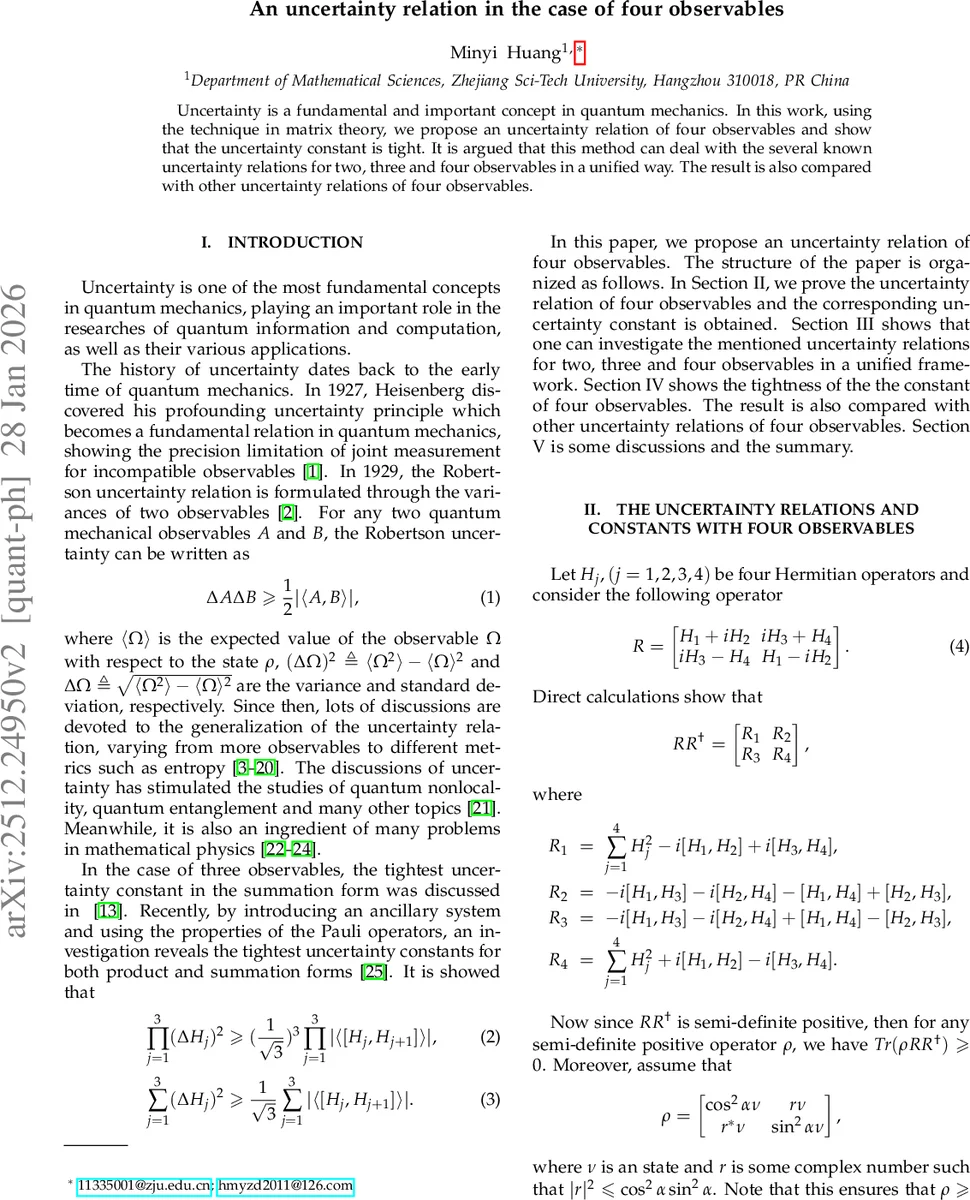
Uncertainty is a fundamental and important concept in quantum mechanics. In this work, using the technique in matrix theory, we propose an uncertainty relation of four observables and show that the uncertainty constant is tight. It is argued that this method can deal with the several known uncertainty relations for two, three and four observables in a unified way. The result is also compared with other uncertainty relations of four observables.
💡 Research Summary
The paper presents a unified matrix‑theoretic derivation of uncertainty relations for two, three, and four quantum observables, and establishes a tight lower bound for the four‑observable case. Starting from the well‑known Robertson–Heisenberg inequality for two observables, the authors construct a 2×2 block matrix
(R=\begin{pmatrix} H_{1}+iH_{2} & iH_{3}+H_{4}\ iH_{3}-H_{4} & H_{1}-iH_{2}\end{pmatrix})
where (H_{j}) are Hermitian operators. Because (RR^{\dagger}) is positive semidefinite, for any positive operator (\rho) one has (\operatorname{Tr}(\rho RR^{\dagger})\ge0). By choosing (\rho) as a tensor product (\mu\otimes\nu) that depends on two scalar parameters (\alpha) (real) and (r) (complex) with the constraint (|r|^{2}\le\cos^{2}\alpha\sin^{2}\alpha), the trace can be expanded into a sum of four real quantities (R_{1},\dots,R_{4}) containing the squares of the observables and their commutators.
Through careful selection of (\alpha) and (r) the terms involving the commutators can be made non‑positive, allowing the use of the Schwarz inequality and the quadratic‑mean inequality to bound the remaining expression. The authors obtain
\
Comments & Academic Discussion
Loading comments...
Leave a Comment