Quantum Hall correlations in tilted extended Bose-Hubbard chains
We demonstrate characteristics of a bosonic fractional quantum Hall (FQH) state in a one-dimensional extended Bose-Hubbard model (eBHM) with a static tilt. In the large tilt limit, quenched kinetic energy leads to emergent dipole moment conservation, enabling mapping to a model generating FQH states. Using exact diagonalization, density matrix renormalization group, and an analytical transfer matrix approach, we analyze energy and entanglement properties to reveal FQH correlations. Our findings set the stage for the use of quenched kinetics in simple time-reversal invariant eBHMs to explore emergent phenomena.
💡 Research Summary
In this work the authors demonstrate that a one‑dimensional extended Bose‑Hubbard model (eBHM) subjected to a strong static tilt can host correlations identical to those of a bosonic fractional quantum Hall (FQH) state. Starting from the conventional eBHM Hamiltonian, they perform a Schrieffer‑Wolff transformation in the limit Δ≫J, U (Δ is the tilt, J the hopping, U the on‑site interaction). The resulting effective Hamiltonian ˆH_g conserves the electric dipole moment operator ˆP=∑_j j n_j (mod N_s) and also commutes with the lattice translation operator ˆT. Because ˆU=exp(2πi ˆP/N_s) and ˆT satisfy the non‑commuting algebra ˆU ˆT=exp(2πi ν_L) ˆT ˆU with ν_L=1/2, the ground‑state sector is two‑fold degenerate, exactly mirroring the topological degeneracy of a ν_QH=1/2 Laughlin state on a torus.
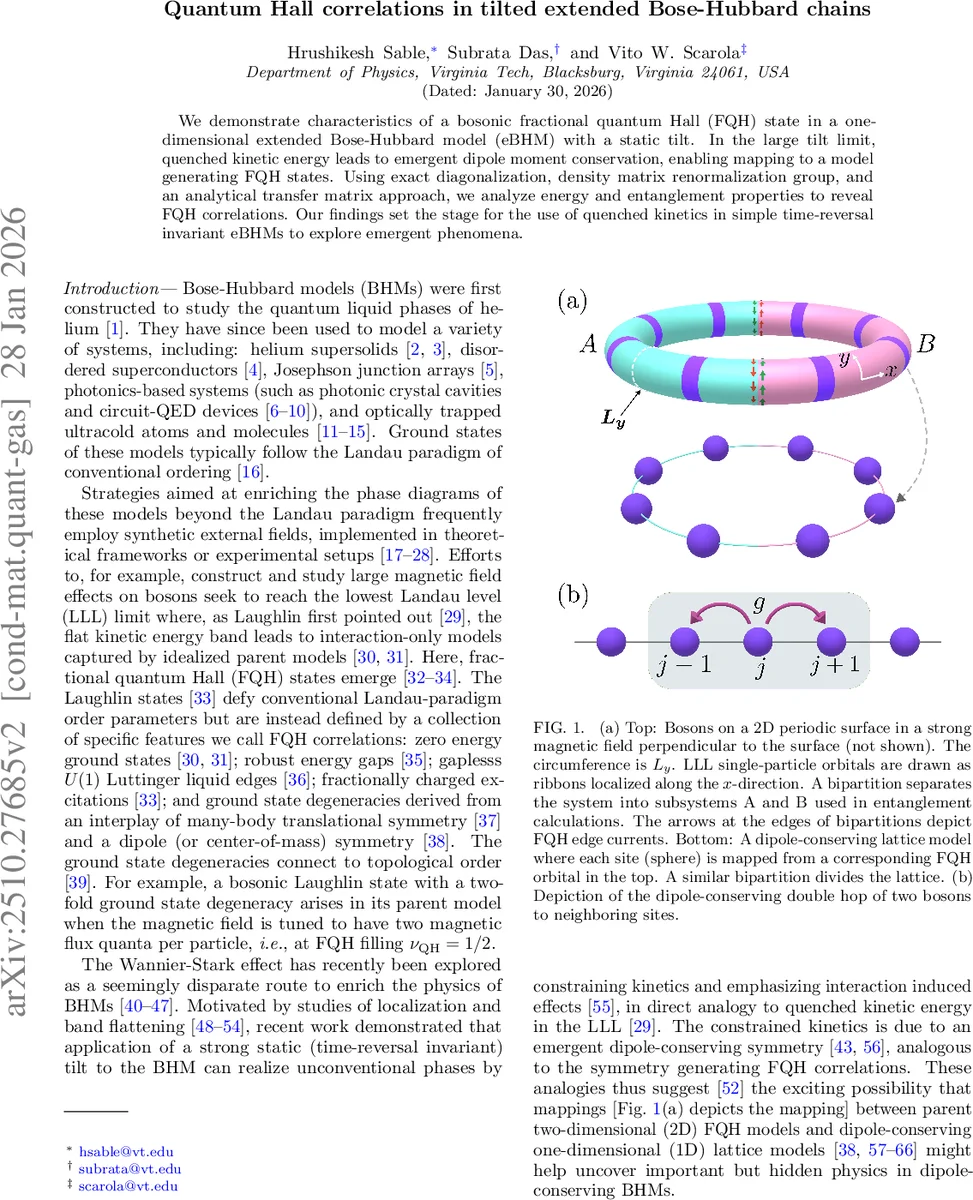
The authors then construct a 2D lowest‑Landau‑level (LLL) bosonic FQH model ˆH_QH on a thin cylinder of circumference L_y. Its matrix elements are exponentially suppressed as exp(−4π²/L_y²). By matching the lowest‑order terms of ˆH_g and ˆH_QH they identify the correspondence g≈2 exp(−4π²/l²), where g is the dipole‑hopping amplitude in ˆH_g and l is an artificial length scale that plays the role of L_y. Numerical exact diagonalisation (ED) and density‑matrix renormalisation group (DMRG) calculations show that for g≈0.8 the overlap between the ground states of the two models exceeds 90 %, confirming that ˆH_g reproduces the Laughlin wavefunction up to a gauge transformation.
Spectral analysis reveals two zero‑energy ground states separated from excited levels by a robust gap for small g; the gap persists as g increases, although a higher‑order term (∝g²) slightly lifts the ground‑state energy. The entanglement spectrum (ES) of ˆH_g exhibits a characteristic four‑level “diamond” structure. Analytic matrix‑product‑state (MPS) treatment yields the low‑energy eigenvalues ξ₁∼g², ξ₂=ξ₃∼ln 2−2 ln g+2g², and ξ₄∼2 ln 2−4 ln g+3g². This pattern matches the conformal tower of edge excitations in a chiral Tomonaga‑Luttinger liquid, i.e., the edge theory of a Laughlin state. Consequently, the entanglement entropy behaves as S(g)=g²
Comments & Academic Discussion
Loading comments...
Leave a Comment