A number of properties enjoyed by two specially constructed topologies on $C(X)$
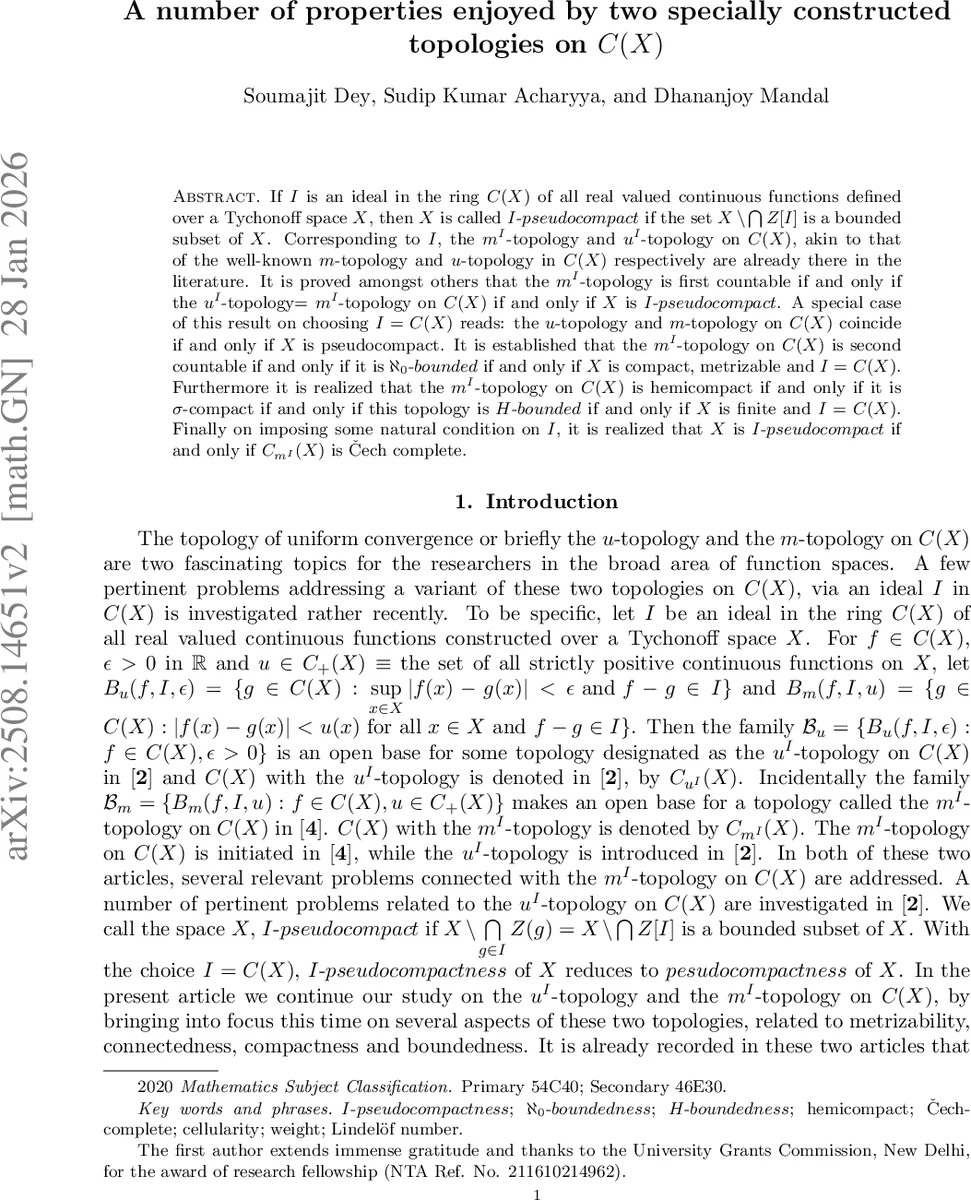
If $I$ is an ideal in the ring $C(X)$ of all real valued continuous functions defined over a Tychonoff space $X$, then $X$ is called $I$-$pseudocompact$ if the set $X\setminus \bigcap Z[I]$ is a bounded subset of $X$. Corresponding to $I$, the $m^I$-topology and $u^I$-topology on $C(X)$, generalizing the well-known $m$-topology and $u$-topology in $C(X)$ respectively are already there in the literature. It is proved amongst others that the $m^I$-topology is first countable if and only if the $u^I$-topology= $m^I$-topology on $C(X)$ if and only if $X$ is $I$-$pseudocompact$. A special case of this result on choosing $I=C(X)$ reads: the $u$-topology and $m$-topology on $C(X)$ coincide if and only if $X$ is pseudocompact. It is established that the $m^I$-topology on $C(X)$ is second countable if and only if it is $\aleph_0$-$bounded$ if and only if $X$ is compact, metrizable and $I=C(X)$. Furthermore it is realized that the $m^I$ topology on $C(X)$ is hemicompact if and only if it is $σ$-compact if and only if this topology is $H$-$bounded$ if and only if $X$ is finite and $I=C(X)$.
💡 Research Summary
The paper investigates two families of topologies on the ring C(X) of real‑valued continuous functions on a Tychonoff space X, obtained by fixing an ideal I⊂C(X). The classical uniform (u‑) topology and the pointwise (m‑) topology are generalized to the uⁱ‑ and mⁱ‑topologies respectively. For f∈C(X), ε>0 and u∈C⁺(X) (strictly positive continuous functions) the basic neighbourhoods are
Bᵤ(f,I,ε)= {g∈C(X): supₓ|f(x)−g(x)|<ε and f−g∈I}
Bₘ(f,I,u)= {g∈C(X): |f(x)−g(x)|<u(x) for all x and f−g∈I}.
The paper introduces the notion of I‑pseudocompactness: X is I‑pseudocompact if the set X\⋂_{g∈I}Z(g) is bounded (i.e., every real‑valued continuous function is bounded on it). When I=C(X) this reduces to ordinary pseudocompactness.
The main results can be grouped as follows:
-
First‑countability and coincidence of the two topologies.
Theorem 2.2 proves the equivalence of three statements:
(a) The mⁱ‑topology on C(X) is first countable;
(b) The uⁱ‑ and mⁱ‑topologies coincide;
(c) X is I‑pseudocompact.
Earlier work required I to be convex; the present proof removes that restriction, showing that convexity is unnecessary. Consequently, the first‑countability of the finer mⁱ‑topology exactly characterises I‑pseudocompactness of the underlying space. -
Second‑countability (ℵ₀‑boundedness) and compact metrizability.
Theorem 4.3 establishes that the mⁱ‑topology is second countable (equivalently ℵ₀‑bounded) if and only if X is compact, metrizable, and I=C(X). The ℵ₀‑boundedness condition means that for every neighbourhood V of the identity there exists a countable set A with X=A·V. The proof shows that such a global countable base can exist only when the ideal is the whole ring, forcing the underlying space to be compact metric. -
Hemicompactness, σ‑compactness and H‑boundedness.
In Section 5 the authors prove that the following are equivalent:
– The mⁱ‑topology is hemicompact;
– It is σ‑compact;
– It is H‑bounded (every sequence of neighbourhoods of the identity eventually covers each point).
Moreover, these conditions hold precisely when X is a finite set and I=C(X). The H‑boundedness condition is very strong; the paper shows that it forces the function space to be essentially discrete. -
Cardinal invariants.
The character, weight, density, cellularity and Lindelöf number of Cₘⁱ(X) are all shown to coincide with the dominating number of the set X\⋂_{g∈I}Z(g). When I=C(X) this recovers known results for the classical m‑topology (e.g., Theorem 3.1 of
Comments & Academic Discussion
Loading comments...
Leave a Comment