Sylow subgroups for distinct primes and intersection of nilpotent subgroups
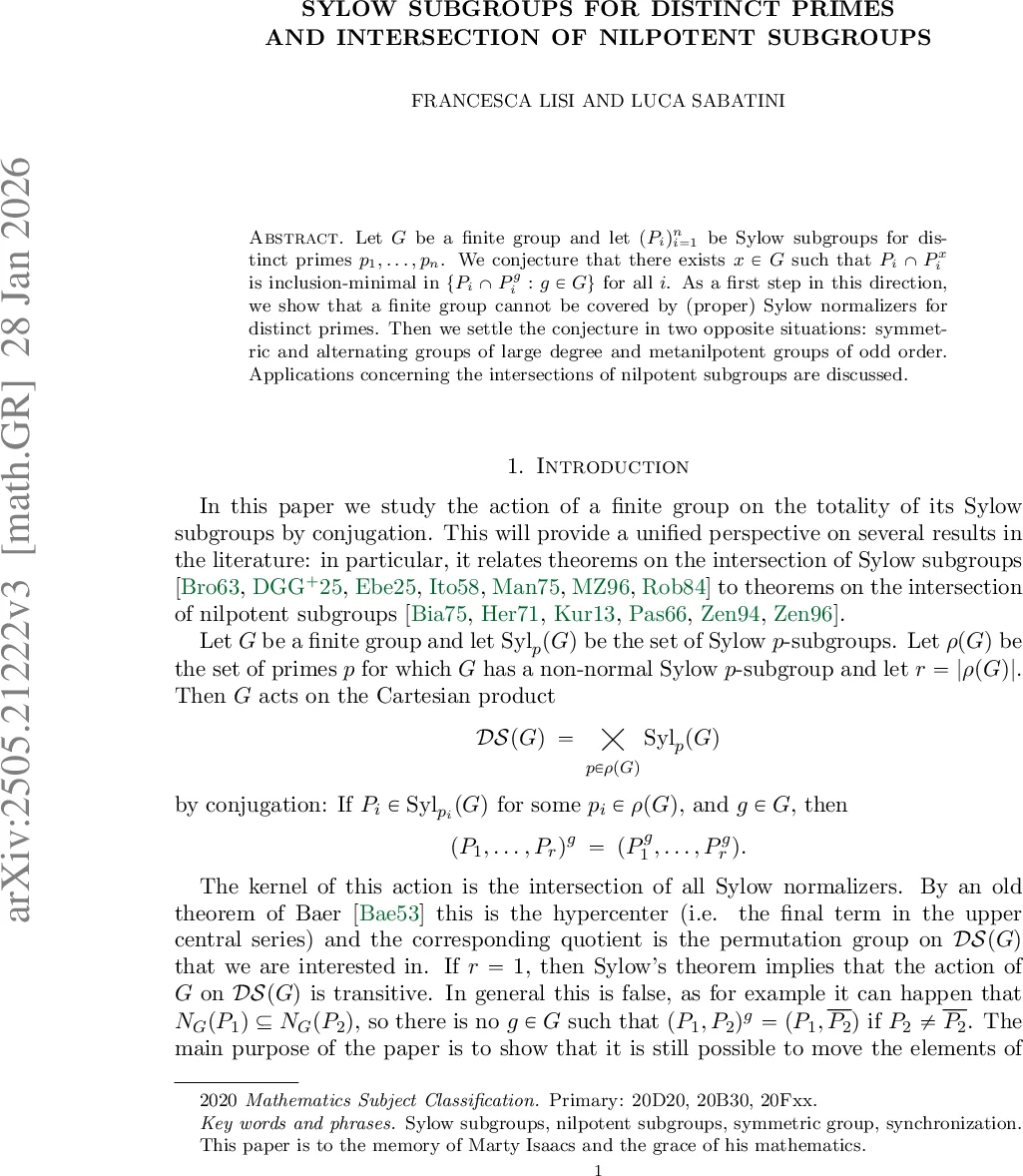
Let $G$ be a finite group and let $(P_i)_{i=1}^n$ be Sylow subgroups for distinct primes $p_1,\ldots,p_n$. We conjecture that there exists $x \in G$ such that $P_i \cap P_i^x$ is inclusion-minimal in ${ P_i \cap P_i^g : g \in G}$ for all $i$. As a first step in this direction, we show that a finite group cannot be covered by (proper) Sylow normalizers for distinct primes. Then we settle the conjecture in two opposite situations: symmetric and alternating groups of large degree and metanilpotent groups of odd order. Applications concerning the intersections of nilpotent subgroups are discussed.
💡 Research Summary
The paper investigates a synchronization problem for Sylow subgroups in a finite group (G). Given distinct primes (p_{1},\dots ,p_{n}) and Sylow subgroups (P_{i}\in\mathrm{Syl}{p{i}}(G)), the authors conjecture (Conjecture A) that there exists a single element (x\in G) such that each intersection (P_{i}\cap P_{i}^{x}) is inclusion‑minimal among all conjugates of (P_{i}). In the strongest form (Conjecture B) the minimal intersection is required to be the (p_{i})-core (O_{p_{i}}(G)); for groups of odd order a still weaker statement (Conjecture C) asks that for any nilpotent subgroup (H) one can find (x) with (H\cap H^{x}\le F(G)), the Fitting subgroup.
The first major result (Theorem 1.2) shows that a finite group cannot be covered by the normalizers of non‑normal Sylow subgroups belonging to distinct primes. The proof uses a minimal counter‑example argument together with a lemma of Bryce‑Fedri‑Serena: if a family of proper subgroups covers a group redundantly, then all (p)-elements for a sufficiently large prime (p) lie in every member of the family. From this one constructs a normal (q)-subgroup (K) generated by all (q)-elements; the existence of such a non‑trivial (K) forces a contradiction with the non‑normality of the Sylow subgroups. Consequently, the union of distinct Sylow normalizers never equals the whole group, a fact that underpins the later synchronization arguments.
The paper then proves Conjecture A in two “extreme’’ families of groups.
-
Symmetric and alternating groups. For (G=\mathrm{Sym}(n)) or (\mathrm{Alt}(n)) with (n) sufficiently large, the authors show that each Sylow subgroup (P) possesses a large set (\Gamma_{G}(P)={x\mid P\cap P^{x}\text{ is minimal}}). For odd primes (p) they obtain a linear lower bound (|\Gamma_{G}(P)|\ge c n); for (p=2) they obtain a polynomial bound. Using a probabilistic method (essentially a refined version of Dolfi‑Guralnick‑Guralnick’s theorem), they prove that the intersection (\bigcap_{i}\Gamma_{G}(P_{i})) is non‑empty, yielding an element (x) with (P_{i}\cap P_{i}^{x}=1) for all (i). This settles Conjecture A for large symmetric and alternating groups (Theorem 1.4). The argument also refines earlier work of Dolfi‑Guralnick‑Guralnick and incorporates results of Ebbecke on odd primes.
-
Metanilpotent groups of odd order. A metanilpotent group (G) has a normal nilpotent subgroup (F(G)) (the Fitting subgroup) such that (G/F(G)) is nilpotent. Assuming (|G|) is odd, the authors prove (Theorem 1.5) that there exists (x\in F(G)) with (P_{i}\cap P_{i}^{x}=O_{p_{i}}(G)) for every Sylow subgroup (P_{i}). The proof proceeds by induction on (|G|). The base case uses Ito’s theorem that every odd‑order group satisfies the (p)-star property ((p^{\star})). For the inductive step they consider the action of (G) on the set of Sylow subgroups, reduce to the quotient (G/F(G)), and then lift a suitable element from the quotient back to (F(G)). A key technical observation is that if two commuting elements (a,b) satisfy (P\cap P^{a}=1) and (P\cap P^{b}=1) then also (P\cap P^{ab}=1). This allows the construction of a single element that simultaneously minimizes all intersections. The result thus verifies Conjecture B for this important class of groups.
The paper also connects these Sylow‑intersection results with the broader literature on intersections of nilpotent subgroups. If (H) is nilpotent, it decomposes as a direct product of its Sylow components (H_{p_i}). Applying the Sylow synchronization to each component shows that (H\cap H^{x}) is contained in the Fitting subgroup (F(G)). This unifies earlier theorems of Bialostocki (nilpotent Hall subgroups of odd‑order groups), Mann (injectors), and Zenko (abelian subgroups). In particular, Conjecture C (the odd‑order analogue of Vdovin’s conjecture) follows from the established cases of Conjecture A.
Finally, the authors discuss open problems. While Conjecture A is proved for groups with at most two distinct prime divisors (Theorem 1.1), for symmetric/alternating groups, and for metanilpotent odd‑order groups, the general case remains open. They suggest that further analysis of the interaction among distinct Sylow normalizers—perhaps via regular orbit methods or deeper counting arguments—could lead to a full resolution.
In summary, the paper introduces a unifying “synchronization’’ viewpoint for Sylow and nilpotent subgroup intersections, proves that distinct Sylow normalizers cannot cover a group, and establishes the conjectured minimal‑intersection element in several significant families of finite groups, thereby linking and extending a substantial body of classical results in finite group theory.
Comments & Academic Discussion
Loading comments...
Leave a Comment