Towards Scalable Braiding: Topological Superconductivity Unlocked under Arbitrary Magnetic Field Directions in Curved Planar Josephson Junctions
The non-Abelian statistics of Majorana zero modes (MZMs) are central to fault-tolerant topological quantum computing. Planar Josephson junctions provide a particularly versatile platform for realizing robust topological superconductivity hosting MZMs over a broad parameter space. However, it is generally believed that such topological superconductivity is restricted to a narrow range of in-plane magnetic field orientations, posing a major obstacle to scalable and noncollinear junction-network architectures. Here, we uncover that the apparent suppression of MZMs under misaligned fields does not arise from the destruction of topological superconductivity itself, but instead originates from emergent shifted bulk states at other momenta that obscure the global excitation gap and MZMs. By introducing spatial modulations along the junction to scatter and gap out these bulk states, we restore a global topological gap and recover MZMs for arbitrary in-plane magnetic field orientations. Remarkably, such modulations can be naturally realized by transforming a straight junction into a curved geometry, rendering the topological gap robust against field misalignment and enabling MZMs survival in complex junction networks. Building on this robustness, we propose a scalable protocol for MZMs braiding and fusion using gate or superconducting-phase control, opening new routes toward scalable topological quantum computing.
💡 Research Summary
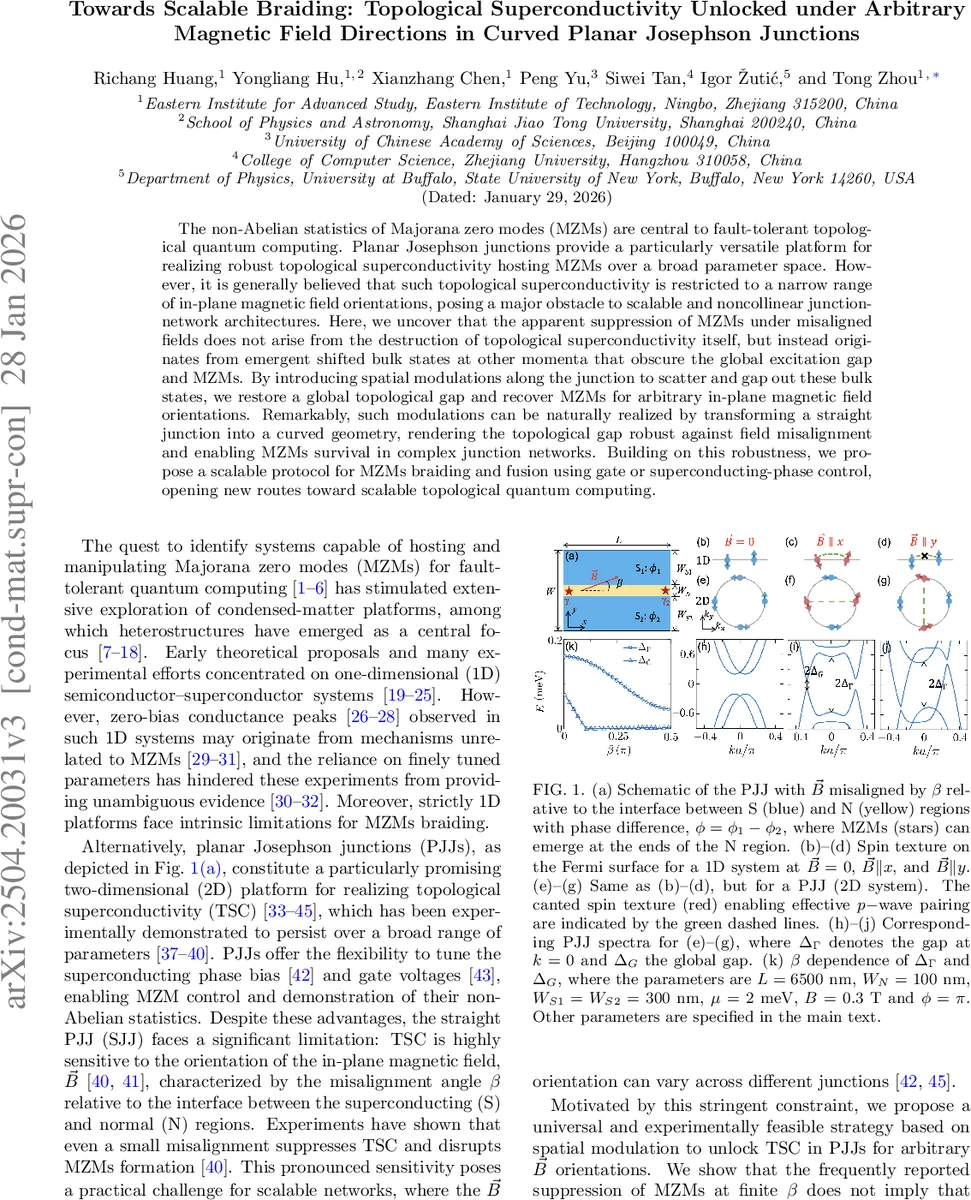
The paper addresses a long‑standing obstacle in planar Josephson junction (PJJ) platforms for topological quantum computing: the apparent fragility of topological superconductivity (TSC) to the orientation of an in‑plane magnetic field. Experiments have shown that even a modest misalignment angle β between the field and the junction interface quickly suppresses Majorana zero modes (MZMs), seemingly limiting scalable, non‑collinear junction networks. The authors demonstrate that this suppression does not stem from the destruction of the topological phase itself. Using a Bogoliubov‑de Gennes (BdG) model and scattering theory, they show that the Z₂ invariant and the k = 0 gap ΔΓ remain robust for any β; however, breaking reflection symmetry tilts the bulk bands and brings additional finite‑momentum states down to low energy, closing the global excitation gap ΔG while leaving the local gap at k = 0 intact. These shifted bulk modes mask the MZMs in spectroscopy and transport measurements.
To recover a true global topological gap, the authors propose engineering spatial modulations that selectively gap out the unwanted finite‑k states without affecting the k = 0 topology. Two mechanisms are identified: (i) a periodic electrostatic potential that Bragg‑scatters spin‑less bulk modes, opening a gap at the crossing momentum k₀ when the modulation period l₀ = π/k₀; (ii) a spatially varying magnetic texture β(x) that mixes spin and therefore gaps spinful bulk modes. Rather than fabricating separate gate arrays and magnetic coils, the authors show that a single geometric modification—curving the normal channel of the junction—naturally provides both types of modulation. The curvature creates an effective periodic potential for the charge carriers and, because the applied uniform magnetic field now has a locally varying projection onto the junction, it generates a periodic β(x) texture.
Numerical simulations of a curved Josephson junction (CJJ) confirm that for β = π/2 (field perpendicular to the junction) the global gap ΔG reopens and MZMs reappear at the ends of the normal region. The gap remains finite for all intermediate angles, as illustrated by a polar plot of ΔG(β). Moreover, standard topological signatures—critical‑current minima accompanied by a π phase jump—persist in the CJJ for both β = 0 and β = π/2, providing experimentally accessible diagnostics of the restored TSC.
Building on this robust platform, the authors design two scalable braiding protocols. The first is a gate‑controlled T‑junction where three arms of a CJJ are independently tuned between topological (V⁺) and trivial (V⁻) regimes using mini‑gates. By adiabatically moving the chemical potential landscape, Majorana modes γ₁ and γ₂ are transferred among the arms in a three‑step sequence that implements a full braid. Energy spectra during the process show the system remaining within the reopened global gap, guaranteeing adiabaticity. The second protocol exploits the superconducting phase bias as the control knob. In a cross‑shaped CJJ, a sequence of phase‑tuning steps swaps the Majoranas without any gate voltage changes. Because the CJJ’s topological gap is insensitive to field orientation, the global magnetic field no longer limits network geometry, enabling truly non‑collinear braiding and fusion operations essential for topological quantum computation.
Finally, the authors argue that the curvature‑induced modulation strategy is platform‑agnostic. It can be applied to Josephson junctions based on topological insulators, semimetals, or materials with unconventional spin‑orbit coupling (e.g., cubic Rashba in Ge). In all cases, unwanted finite‑momentum states that close the global gap can be eliminated by appropriate geometric design, making the approach a universal tool for stabilizing TSC in two‑dimensional junction networks.
In summary, the work overturns the belief that planar Josephson junctions require precise magnetic‑field alignment, introduces a practical geometric solution to restore a global topological gap, and provides concrete gate‑ and phase‑based braiding schemes that pave the way toward scalable, fault‑tolerant topological quantum computers.
Comments & Academic Discussion
Loading comments...
Leave a Comment