Non-invertible symmetries of two-dimensional Non-Linear Sigma Models
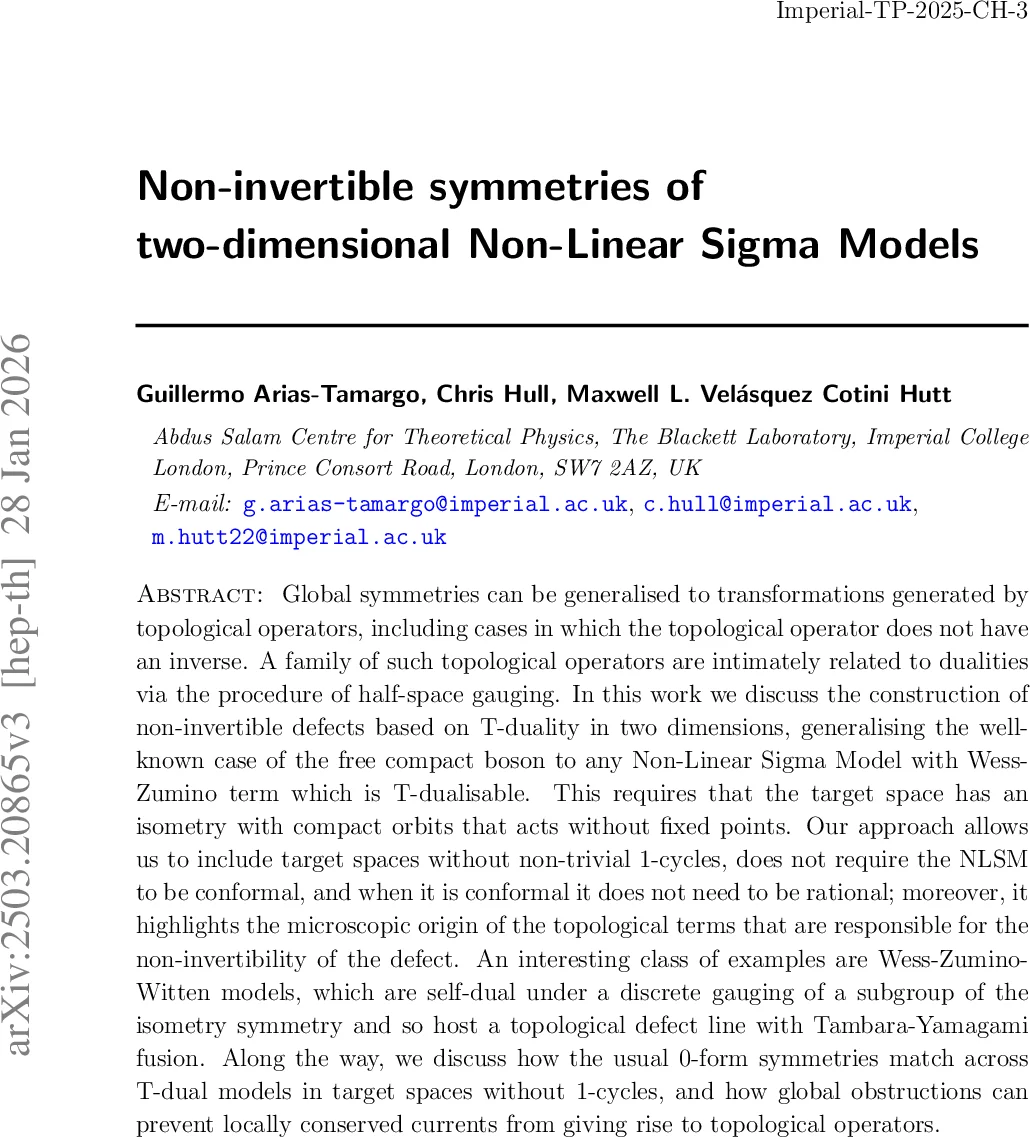
Global symmetries can be generalised to transformations generated by topological operators, including cases in which the topological operator does not have an inverse. A family of such topological operators are intimately related to dualities via the procedure of half-space gauging. In this work we discuss the construction of non-invertible defects based on T-duality in two dimensions, generalising the well-known case of the free compact boson to any Non-Linear Sigma Model with Wess-Zumino term which is T-dualisable. This requires that the target space has an isometry with compact orbits that acts without fixed points. Our approach allows us to include target spaces without non-trivial 1-cycles, does not require the NLSM to be conformal, and when it is conformal it does not need to be rational; moreover, it highlights the microscopic origin of the topological terms that are responsible for the non-invertibility of the defect. An interesting class of examples are Wess-Zumino-Witten models, which are self-dual under a discrete gauging of a subgroup of the isometry symmetry and so host a topological defect line with Tambara-Yamagami fusion. Along the way, we discuss how the usual 0-form symmetries match across T-dual models in target spaces without 1-cycles, and how global obstructions can prevent locally conserved currents from giving rise to topological operators.
💡 Research Summary
The paper investigates the emergence of non‑invertible symmetries in two‑dimensional non‑linear sigma models (NLSMs) by exploiting T‑duality through a half‑space gauging construction. The authors begin by revisiting the well‑known example of the free compact boson, where gauging a finite Zₚ subgroup of the momentum U(1) symmetry on one half of the worldsheet produces a topological defect line that is non‑invertible. The key observation is that after gauging, a topological quantum field theory (TQFT) lives on the interface γ separating the gauged and ungauged regions; this TQFT is responsible for the non‑trivial fusion rules, which take the form of a Tambara‑Yamagami fusion category rather than a group.
Building on this insight, the authors generalize the construction to arbitrary NLSMs that possess a freely acting U(1) isometry with compact orbits and may include a Wess‑Zumino (WZ) term. The target space must admit an isometry without fixed points, ensuring that the discrete subgroup can be gauged without obstruction. By coupling a background gauge field for the isometry and adding a Lagrange multiplier, the standard Buscher procedure yields a “doubled” action. Integrating out the gauge field in the bulk reproduces the original model, while integrating it out first leads to the T‑dual model. When the gauged half‑space theory is identified with the original theory, a self‑duality condition emerges. This condition relates the length of the isometry orbit, the coefficient of the B‑field (or H‑flux), and the integer p defining the discrete subgroup; explicit formulas are given in equations (4.44)–(4.45). For multiple commuting U(1) isometries, a product of Z_{p(m)} subgroups can be gauged simultaneously, with a generalized self‑duality condition shown in (4.49).
A crucial technical point is the treatment of the WZ term on worldsheets with boundary. To preserve gauge invariance, the authors introduce target‑space one‑form gauge fields that cancel potential ’t Hooft anomalies and modify the boundary conditions accordingly. The resulting boundary contribution is a topological term localized on γ; this term encodes a (1+1)‑dimensional TQFT whose state space determines the fusion of defect lines. Consequently, the defect line is non‑invertible: fusing two such lines yields a sum of the trivial line and a non‑trivial topological sector, exactly the structure of a Tambara‑Yamagami category.
The paper then provides a series of concrete examples. The 3‑sphere with H‑flux is analyzed using its Hopf fibration, illustrating how the isometry along the fiber leads to a self‑dual defect. Odd‑dimensional spheres, lens spaces, and nilfolds are treated similarly, demonstrating that the construction works even when the target has no non‑trivial 1‑cycles. The most striking application is to Wess‑Zumino‑Witten (WZW) models. For SU(N)_k WZW theories, gauging a discrete subgroup of the left‑moving isometry yields a self‑dual theory at any level k. The associated defect line again obeys Tambara‑Yamagami fusion, providing a new family of non‑invertible symmetries that are distinct from the familiar Verlinde lines. This result highlights that non‑invertible symmetries are not limited to rational CFTs; they appear in generic conformal (and even non‑conformal) sigma models.
In the concluding section, the authors discuss open questions such as the classification of possible topological terms on defects, extensions to higher dimensions, and the interplay between non‑invertible defects and modular invariance or boundary conformal field theory. Overall, the work offers a systematic, geometric framework for constructing non‑invertible defects in a broad class of two‑dimensional sigma models, clarifying the role of T‑duality, discrete gauging, and boundary topological actions in generating generalized symmetries.
Comments & Academic Discussion
Loading comments...
Leave a Comment