Achievable Rate Regions for Multi-terminal Quantum Channels via Coset Codes
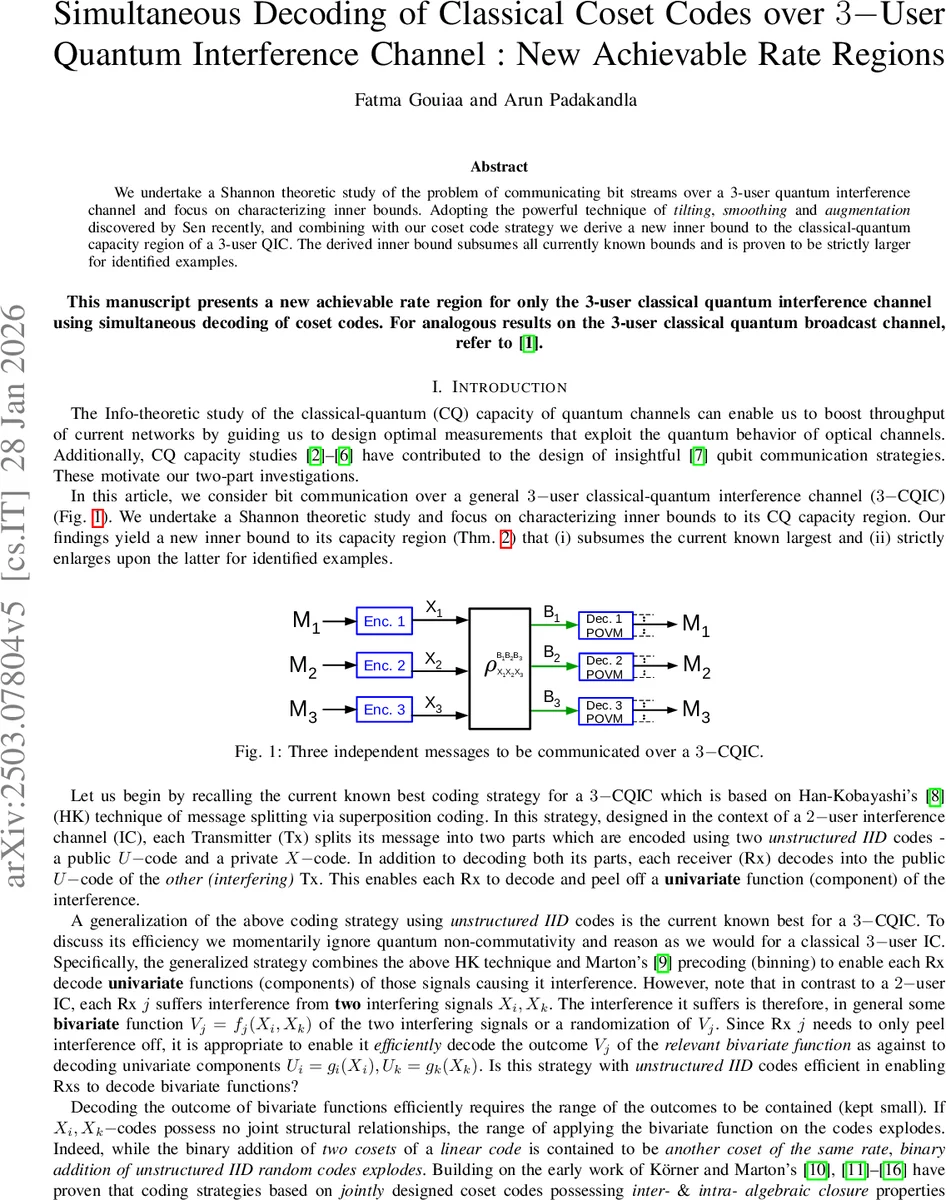
We undertake a Shannon theoretic study of the problem of communicating bit streams over a 3-user quantum interference channel (QIC) and focus on characterizing inner bounds. Adopting the powerful technique of tilting, smoothing, and augmentation discovered by Sen recently, and combining with our coset code strategy, we derive a new inner bound to the classical-quantum capacity region of a 3-user QIC. The derived inner bound subsumes all currently known bounds and is proven to be strictly larger for identified examples.
💡 Research Summary
This paper investigates the classical‑quantum (CQ) capacity region of a three‑user quantum interference channel (3‑CQIC) and proposes a novel inner bound that strictly improves upon all previously known bounds. The authors combine the recent “tilting, smoothing, and augmentation” (TSA) technique introduced by Sen with a coset‑code (group‑code) strategy to enable simultaneous decoding of both structured (coset) and unstructured i.i.d. codebooks.
The classical Han‑Kobayashi (HK) approach, which splits each transmitter’s message into a public and a private part and uses independent i.i.d. random codes, works well for two‑user interference channels but becomes suboptimal for three users. In a 3‑user setting each receiver must cope with interference generated by two other transmitters, which is naturally expressed as a bivariate function Vj = fj(Xi, Xk). Decoding such a function efficiently requires the output alphabet of fj to be small; however, with unstructured i.i.d. codes the range of fj explodes, making simultaneous decoding infeasible.
Coset codes provide algebraic closure: if two users employ cosets of the same linear code, the sum (or any linear combination) of their codewords lies in another coset of the same rate. This property keeps the range of the bivariate function bounded, allowing a receiver to decode only the function value (e.g., X2⊕X3) without learning the individual codewords. The paper extends this idea to non‑additive functions (e.g., logical OR) by carefully designing nested coset codes (NCC) and employing binning together with a likelihood encoder to match arbitrary input distributions while preserving the algebraic structure.
A central technical contribution is the construction of new POVMs that “pin down” only the function of the codewords rather than the codewords themselves. By adapting Sen’s TSA, the authors modify the tilting subspaces so that the decoder’s measurement projects onto subspaces associated with the desired function (such as a sum or OR) while remaining agnostic to the underlying pair of codewords. This enables true simultaneous decoding of multiple codebooks—both coset and i.i.d.—in a single quantum measurement.
The paper presents the results in three pedagogical steps.
Step I introduces a simple example (Ex. 0) where two interferers use the same linear code; the receiver decodes the sum coset and achieves rates unattainable by any HK‑type scheme.
Step II (Theorem 2) generalizes to the full 3‑user scenario, employing a collection of NCCs that handle all possible bivariate interferences. The derived inner bound subsumes the best known unstructured‑code bound (Remark 5).
Step III (Theorem 3) further enlarges the region by allowing additional i.i.d. codebooks alongside the coset structure, thus achieving the final inner bound.
Two concrete channel models illustrate the advantage. Example 1 is an “additive” quantum interference channel where the output for Receiver 1 is a rotated qubit depending on X1⊕X2⊕X3; the coset strategy yields a strictly larger achievable triple (C1, C2, C3) than any known unstructured scheme. Example 2 is a “non‑additive” channel where Receiver 1 observes X1⊕(X2∨X3); despite the logical OR being non‑linear, the nested coset construction together with binning still restricts the effective interference alphabet, again outperforming unstructured codes.
The authors also discuss practical considerations such as cost constraints (Hamming weight) on the inputs, the need for pairwise independence of coset codewords, and the challenges of over‑counting in the analysis, which are overcome by the likelihood‑encoder approach.
In summary, the paper delivers a comprehensive framework that merges algebraic coding (coset/NCC) with advanced quantum measurement techniques (TSA) to achieve a new inner bound for 3‑user CQ interference channels. This bound strictly contains all previously known inner bounds and is provably larger for both additive and non‑additive quantum interference examples. The work opens avenues for further research on multi‑user quantum networks, including extensions to more users, continuous‑variable channels, and experimental implementations of the proposed POVMs.
Comments & Academic Discussion
Loading comments...
Leave a Comment