Large deviations of density in the non-equilibrium steady state of boundary-driven diffusive systems
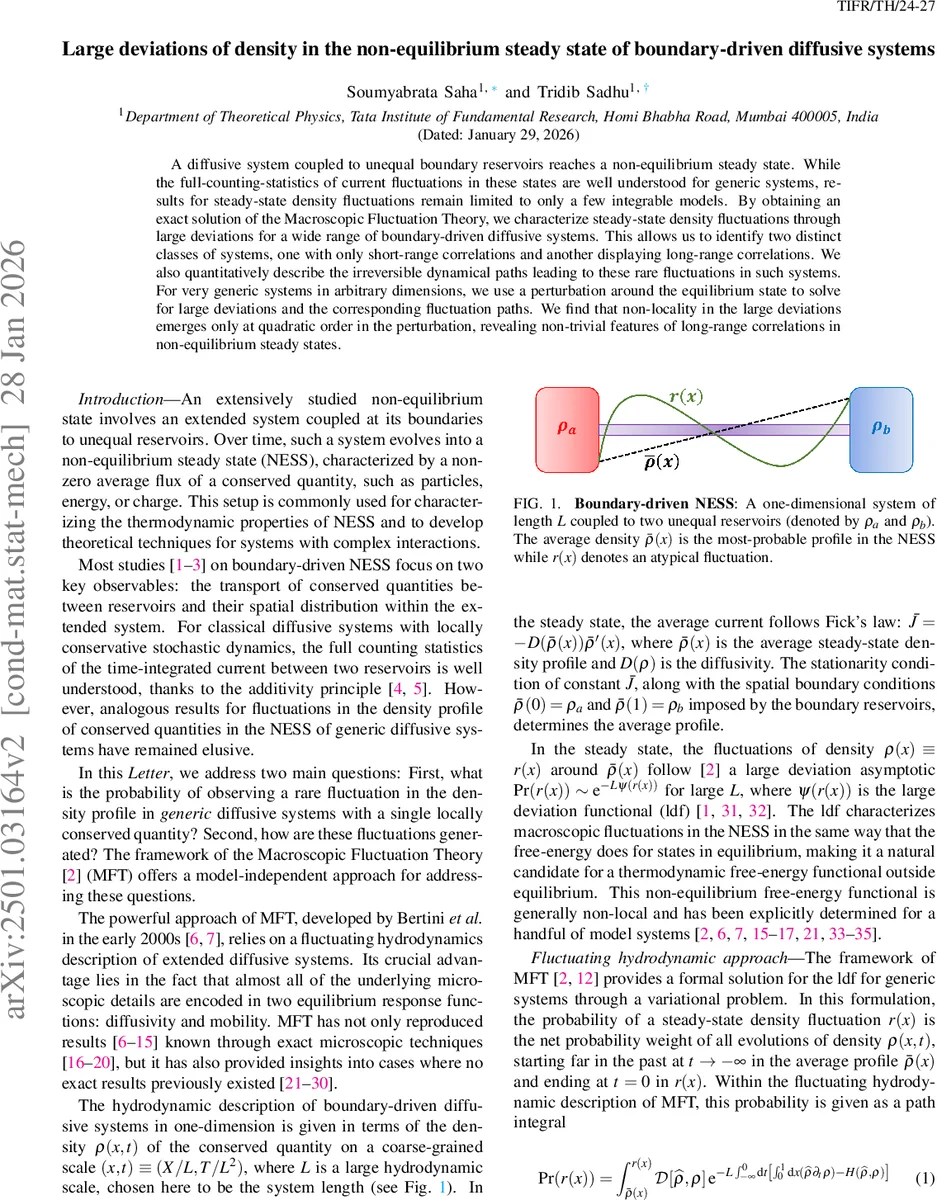
A diffusive system coupled to unequal boundary reservoirs reaches a non-equilibrium steady state. While the full-counting-statistics of current fluctuations in these states are well understood for generic systems, results for steady-state density fluctuations remain limited to only a few integrable models. By obtaining an exact solution of the Macroscopic Fluctuation Theory, we characterize steady-state density fluctuations through large deviations for a wide range of boundary-driven diffusive systems. This allows us to identify two distinct classes of systems, one with only short-range correlations and another displaying long-range correlations. We also quantitatively describe the irreversible dynamical paths leading to these rare fluctuations in such systems. For very generic systems in arbitrary dimensions, we use a perturbation around the equilibrium state to solve for large deviations and the corresponding fluctuation paths. We find that non-locality in the large deviations emerges only at quadratic order in the perturbation, revealing non-trivial features of long-range correlations in non-equilibrium steady states.
💡 Research Summary
The paper investigates the probability of observing atypical density profiles in boundary‑driven diffusive systems that have settled into a non‑equilibrium steady state (NESS). While the full‑counting statistics of time‑integrated currents in such systems are well understood through the additivity principle and Macroscopic Fluctuation Theory (MFT), the statistics of the density field itself have remained largely unexplored except for a few integrable models. By employing the MFT framework, the authors formulate the large‑deviation principle for the density field: the probability of a macroscopic profile r(x) scales as Pr
Comments & Academic Discussion
Loading comments...
Leave a Comment