An Elementary Proof of a Remarkable Relation Between the Squircle and Lemniscate
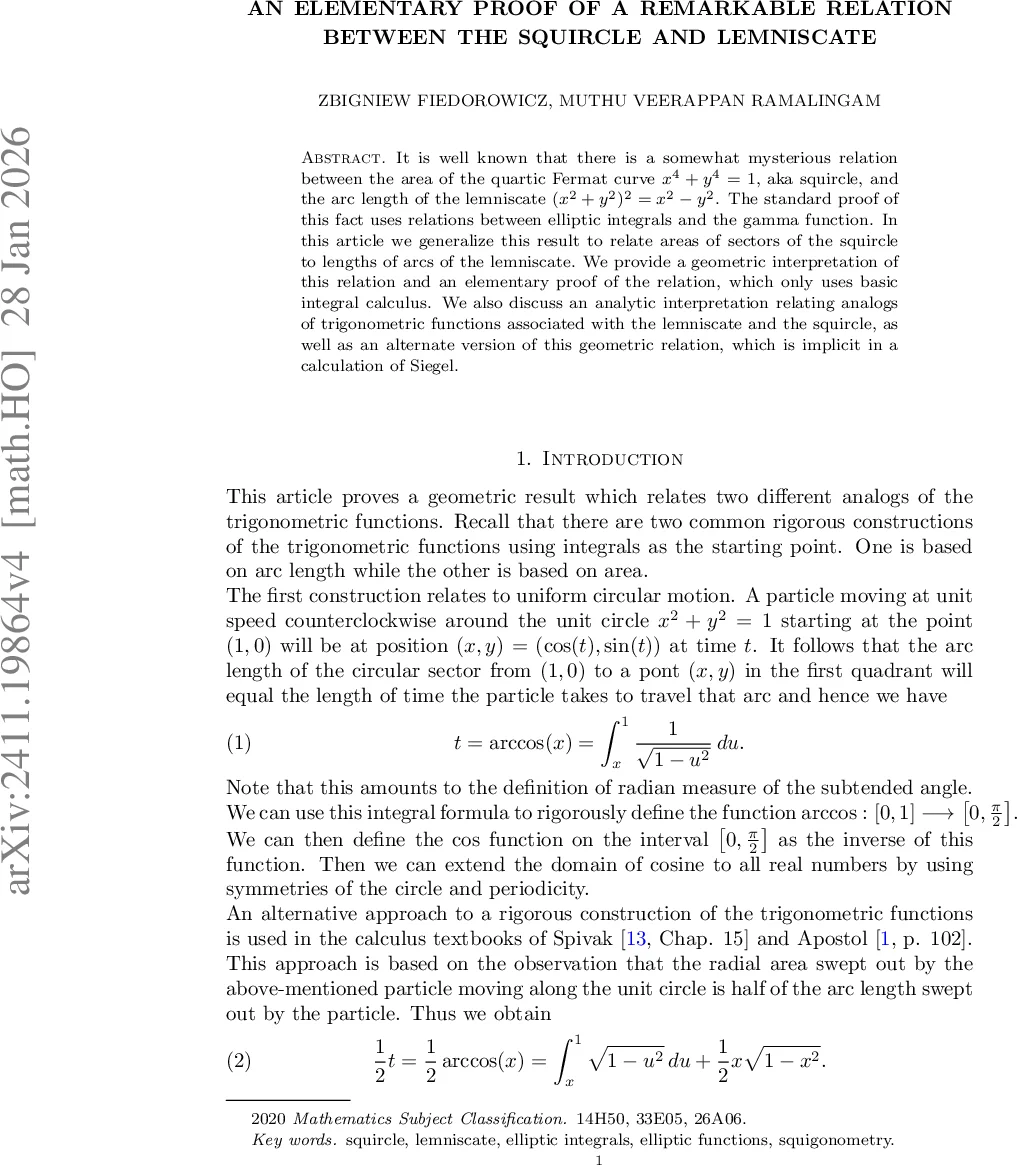
It is well known that there is a somewhat mysterious relation between the area of the quartic Fermat curve $x^4+y^4=1$, aka squircle, and the arc length of the lemniscate $(x^2+y^2)^2=x^2-y^2$. The standardproof of this fact uses relations between elliptic integrals and the gamma function. In this article we generalize this result to relate areas of sectors of the squircle to arc lengths of segments of the lemniscate. We provide a geometric interpretation of this relation and an elementary proof of the relation, which only uses basic integral calculus. We also discuss an alternate version of this kind of relation, which is implicit in a calculation of Siegel.
💡 Research Summary
The paper revisits a classical but somewhat mysterious relationship between the area of the quartic Fermat curve (x^{4}+y^{4}=1) (the “squircle”) and the arc length of the lemniscate ((x^{2}+y^{2})^{2}=x^{2}-y^{2}). Historically this connection has been proved using elliptic integrals and the Gamma function. The authors extend the result from a global equality (total lemniscate perimeter equals (\sqrt{2}) times the squircle area) to a point‑wise correspondence between sectors of the squircle and arcs of the lemniscate.
The introduction recalls two standard constructions of the ordinary trigonometric functions: one based on unit‑speed motion along the unit circle (arc‑length definition) and one based on Kepler’s second law (area‑swept definition). Both approaches can be generalized to other planar curves, giving rise to “analog” trigonometric functions. For the lemniscate, the arc‑length definition leads to the lemniscate cosine (\operatorname{cl}(t)) via the integral (t=\int_{0}^{x}\frac{du}{\sqrt{1-u^{4}}}). For the (p)-norm unit “circle” (|x|^{p}+|y|^{p}=1) the area‑swept definition yields the functions (\cos_{p}) and (\sin_{p}). The case (p=4) gives the squircle, and the corresponding area‑time integral reads (\frac12 t=\int_{0}^{x}\frac{4,du}{\sqrt{1-u^{4}}}+\frac12 x\sqrt{1-x^{4}}).
A classical identity due to Legendre and Dirichlet, \
Comments & Academic Discussion
Loading comments...
Leave a Comment