On the generalised Saxl graphs of permutation groups
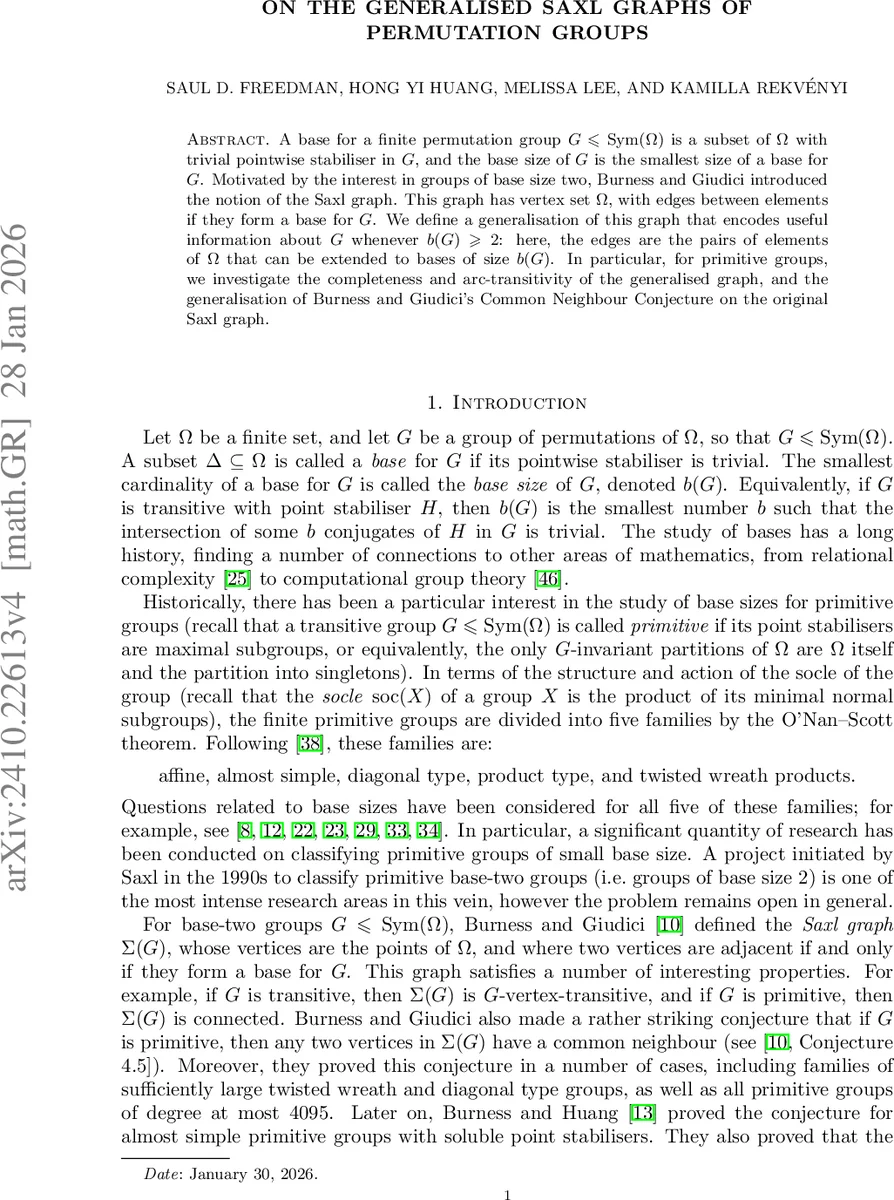
A base for a finite permutation group $G \le \mathrm{Sym}(Ω)$ is a subset of $Ω$ with trivial pointwise stabiliser in $G$, and the base size of $G$ is the smallest size of a base for $G$. Motivated by the interest in groups of base size two, Burness and Giudici introduced the notion of the Saxl graph. This graph has vertex set $Ω$, with edges between elements if they form a base for $G$. We define a generalisation of this graph that encodes useful information about $G$ whenever $b(G) \ge 2$: here, the edges are the pairs of elements of $Ω$ that can be extended to bases of size $b(G)$. In particular, for primitive groups, we investigate the completeness and arc-transitivity of the generalised graph, and the generalisation of Burness and Giudici’s Common Neighbour Conjecture on the original Saxl graph.
💡 Research Summary
The paper introduces a natural generalisation of the Saxl graph for any finite permutation group G ≤ Sym(Ω) with base size b(G) ≥ 2. In the original Saxl graph (defined only for groups of base size two) two points are adjacent precisely when they form a base. The authors extend this by declaring two points α, β adjacent in the generalized Saxl graph Σ(G) if the unordered pair {α, β} can be extended to a full base of size b(G). When b(G)=2 the construction coincides with the classical Saxl graph, but for larger base sizes it provides a new combinatorial object that encodes information about the action of G.
The paper is organised around three central problems concerning primitive groups: (i) a “Common Neighbour Conjecture” (CNC) asserting that any two vertices of Σ(G) have a common neighbour; (ii) the question of when Σ(G) is a complete graph, which leads to the notion of a semi‑Frobenius group (any two points lie in a common minimal base); and (iii) the relationship between the number of regular orbits of G on Ω^{b(G)} and the arc‑transitivity of Σ(G). The authors treat each problem for several O’Nan‑Scott families—diagonal, almost simple, affine, and product type—providing a fairly complete picture.
Key technical contributions include:
- Lemma 2.4–2.5: Σ(G) is a union of orbital graphs; for primitive G it is connected, and if all orbital graphs have diameter ≤2 then the CNC holds automatically.
- Definition 1.4 of semi‑Frobenius groups and the observation that Σ(G) is complete iff G is semi‑Frobenius. Any 2‑transitive group is semi‑Frobenius.
- Theorem 1.5 (Diagonal type): Gives precise conditions on the top group P ≤ S_k and the parameter k for Σ(G) to be complete. In particular, when k=2, Σ(G) is complete for P=1, for T=A_n (n≥7), or when T is a sporadic simple group. For k≥3 the theorem delineates three mutually exclusive regimes depending on the size of k relative to |T|^ℓ and the nature of P.
- Theorem 1.3 and 1.6 (Almost simple groups): Prove the CNC for almost simple primitive groups when either (i) b(G)≥3 and the socle is sporadic, or (ii) the point stabiliser is soluble. Theorem 1.6 gives a full classification of semi‑Frobenius almost simple groups with socle L₂(q); the only non‑semi‑Frobenius cases are b(G)=2 or when the stabiliser is of type GL₂(q^{1/2}) with q≥16 and |G:G₀| even.
- Theorem 1.7 and Corollary 1.8 (Diagonal type arc‑transitivity): Show that Σ(G) is G‑arc‑transitive only for the exceptional diagonal groups T=A₅, k∈{3,57}, with G=T^k·(Out(T)×S_k) and b(G)=2. Consequently reg(G)=1 occurs only in these cases.
- Theorem 1.9 (Almost simple L₂(q) groups): Provides an exhaustive list of primitive L₂(q) actions for which Σ(G) is G‑arc‑transitive, excluding a single difficult case. The list includes point stabilisers of type P₁, several small exceptional pairs (e.g., (L₂(11),A₅)), the sharply 3‑transitive actions, and a few b(G)=2 cases.
- Section 2.2 introduces probabilistic methods (the Q(G,k) bound) to estimate the likelihood that a random k‑tuple fails to be a base, which underpins many of the existence arguments.
- Section 6 analyses product‑type primitive groups, showing that the CNC reduces to a condition on the orbits of point stabilisers, mirroring earlier work on diagonal groups.
The authors also discuss alternative generalisations based on irredundant bases (Section 7) and provide numerous computational examples (using Magma) illustrating that Σ(G) can have arbitrarily many connected components when G is imprimitive.
Overall, the paper succeeds in extending the theory of Saxl graphs to all primitive groups with base size at least two, establishing when the generalized graph is complete, when it satisfies the common‑neighbour property, and when it is arc‑transitive. The results give a clear classification for diagonal and almost simple families, and lay groundwork for further investigation of affine and product‑type actions. The blend of combinatorial graph theory, probabilistic methods, and deep knowledge of the O’Nan‑Scott classification makes this work a substantial contribution to the study of bases in permutation groups.
Comments & Academic Discussion
Loading comments...
Leave a Comment