AI Cap-and-Trade: Efficiency Incentives for Accessibility and Sustainability
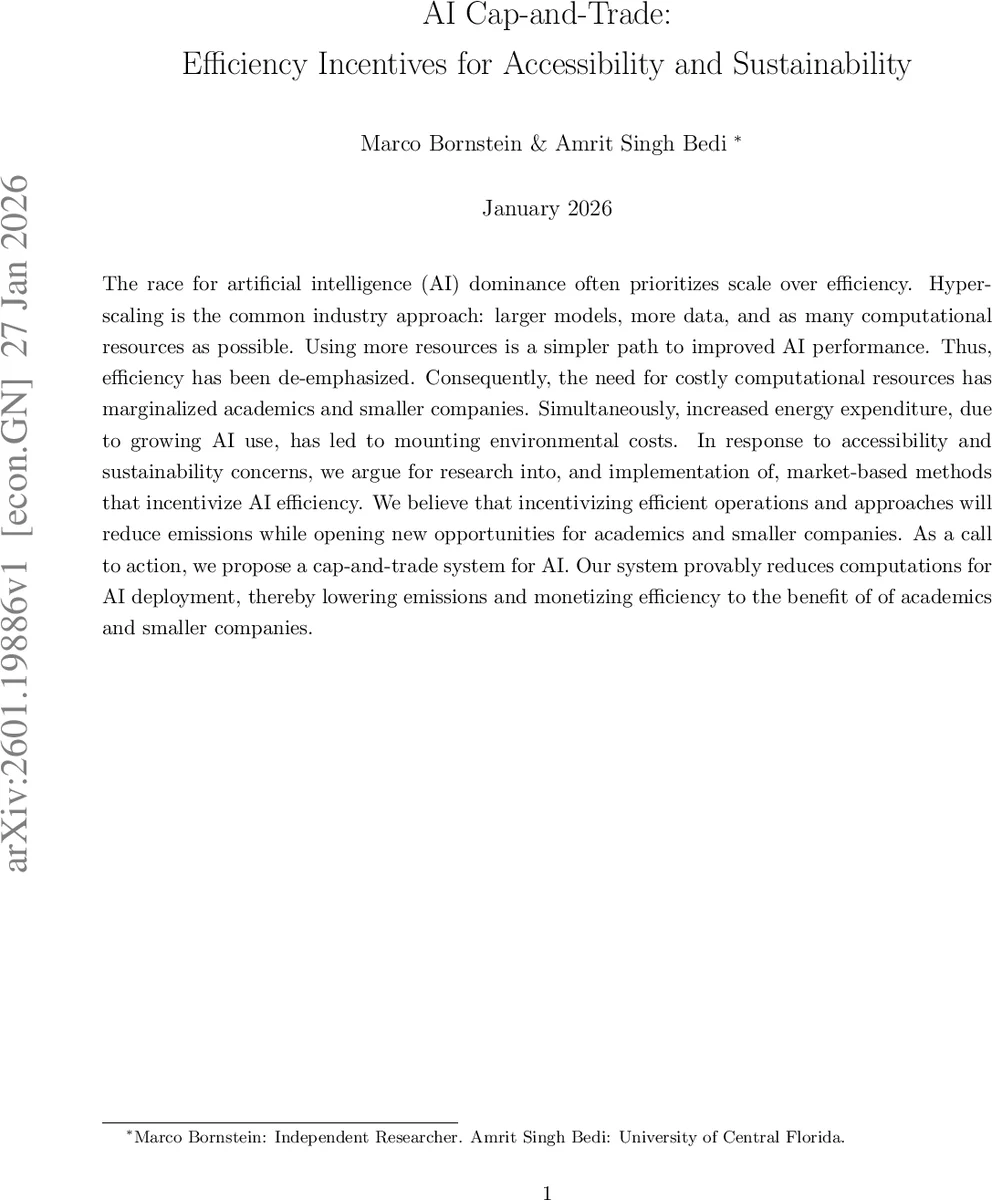
The race for artificial intelligence (AI) dominance often prioritizes scale over efficiency. Hyper-scaling is the common industry approach: larger models, more data, and as many computational resources as possible. Using more resources is a simpler path to improved AI performance. Thus, efficiency has been de-emphasized. Consequently, the need for costly computational resources has marginalized academics and smaller companies. Simultaneously, increased energy expenditure, due to growing AI use, has led to mounting environmental costs. In response to accessibility and sustainability concerns, we argue for research into, and implementation of, market-based methods that incentivize AI efficiency. We believe that incentivizing efficient operations and approaches will reduce emissions while opening new opportunities for academics and smaller companies. As a call to action, we propose a cap-and-trade system for AI. Our system provably reduces computations for AI deployment, thereby lowering emissions and monetizing efficiency to the benefit of of academics and smaller companies.
💡 Research Summary
The paper “AI Cap‑and‑Trade: Efficiency Incentives for Accessibility and Sustainability” diagnoses a critical tension in contemporary artificial‑intelligence development: the relentless pursuit of larger models, more data, and ever‑greater compute—often termed “hyper‑scaling”—has created two intertwined problems. First, the sheer magnitude of compute required to train and serve state‑of‑the‑art large language models (LLMs) places a prohibitive financial barrier on academic labs and start‑ups, effectively concentrating AI capability in the hands of a few well‑capitalized corporations. Second, the energy and water consumption associated with these massive compute workloads generate substantial carbon emissions, turning AI into a growing environmental externality.
Quantitatively, the authors note that training a cutting‑edge LLM now approaches a ronna‑FLOP (10^27 floating‑point operations), and inference at the scale of OpenAI’s daily 2.5 billion prompts consumes roughly the same order of magnitude each year. Translating FLOPs into hardware costs yields billions of dollars in GPU purchases and operating expenses, while the associated electricity use translates into hundreds of tons of CO₂ per day. The paper also highlights that data‑center electricity demand is projected to grow 15 % annually, potentially doubling global consumption by 2030, and that water use will follow a similar trajectory.
To address these twin challenges, the authors propose a market‑based governance mechanism inspired by emissions‑trading schemes: an “AI cap‑and‑trade” system. Under this framework, a regulatory authority (national or international) would set an annual cap on total AI compute (or equivalently on CO₂ emissions derived from that compute). Each firm would receive an allocation of tradable permits—essentially a quota of allowable FLOPs or carbon credits. Firms that operate below their allocation can sell excess permits, turning efficiency gains into direct revenue. Firms that exceed their quota must purchase additional permits on a market, internalizing the cost of inefficiency. This creates a price signal for compute efficiency, encouraging research into sparsity, model compression, low‑precision arithmetic, and other techniques that reduce FLOPs without sacrificing performance.
The authors develop a formal model showing that, given a sufficiently high permit price, the equilibrium total compute converges to the cap, overall emissions fall, and firms that invest in efficiency achieve higher expected profits than those that rely on brute‑force scaling. They also discuss complementary policies: Pigouvian taxes on electricity or carbon, user‑fee structures (e.g., token taxes), and credit/subsidy programs for clean‑energy use or FLOP‑reduction milestones. The paper cites the “DeepSeek” case study, where Chinese developers, constrained by export‑control‑driven compute scarcity, innovated with mixture‑of‑experts and multi‑head latent attention to match frontier performance at a fraction of the compute cost—demonstrating that external pressure can indeed spark efficiency‑driven growth.
Implementation challenges are acknowledged. Accurate, standardized measurement of FLOPs, energy use, and emissions is prerequisite; the authors point to recent disclosures by Google, Mistral, and others as early steps. They argue for a hybrid approach that combines cap‑and‑trade with credits for renewable‑energy adoption, ensuring that firms with greener power sources are not penalized unduly. International coordination is deemed essential because AI services cross borders; a fragmented system would risk “leakage” where firms shift workloads to jurisdictions with looser caps.
Beyond environmental benefits, the authors contend that cap‑and‑trade can mitigate the oligopolistic concentration of AI power. By lowering the compute barrier for efficient models, smaller players can compete, preserving diversity of research and reducing the risk that a handful of firms dominate the path toward artificial general intelligence (AGI). In an oligopoly, the first entity to achieve AGI could wield disproportionate influence, raising safety and governance concerns. A more distributed, efficiency‑driven ecosystem, the paper argues, aligns economic incentives with broader societal goals.
In conclusion, the paper makes a compelling case that a well‑designed AI cap‑and‑trade system can simultaneously curb carbon emissions, democratize access to advanced AI capabilities, and foster a healthier competitive landscape. By turning computational efficiency into a tradable asset, the proposal leverages market forces—rather than blunt regulation—to align corporate behavior with environmental sustainability and equitable innovation. The authors call for interdisciplinary collaboration among AI researchers, economists, policymakers, and industry stakeholders to flesh out the technical standards, legal frameworks, and governance structures needed to launch such a system.
Comments & Academic Discussion
Loading comments...
Leave a Comment