Visual Generation Unlocks Human-Like Reasoning through Multimodal World Models
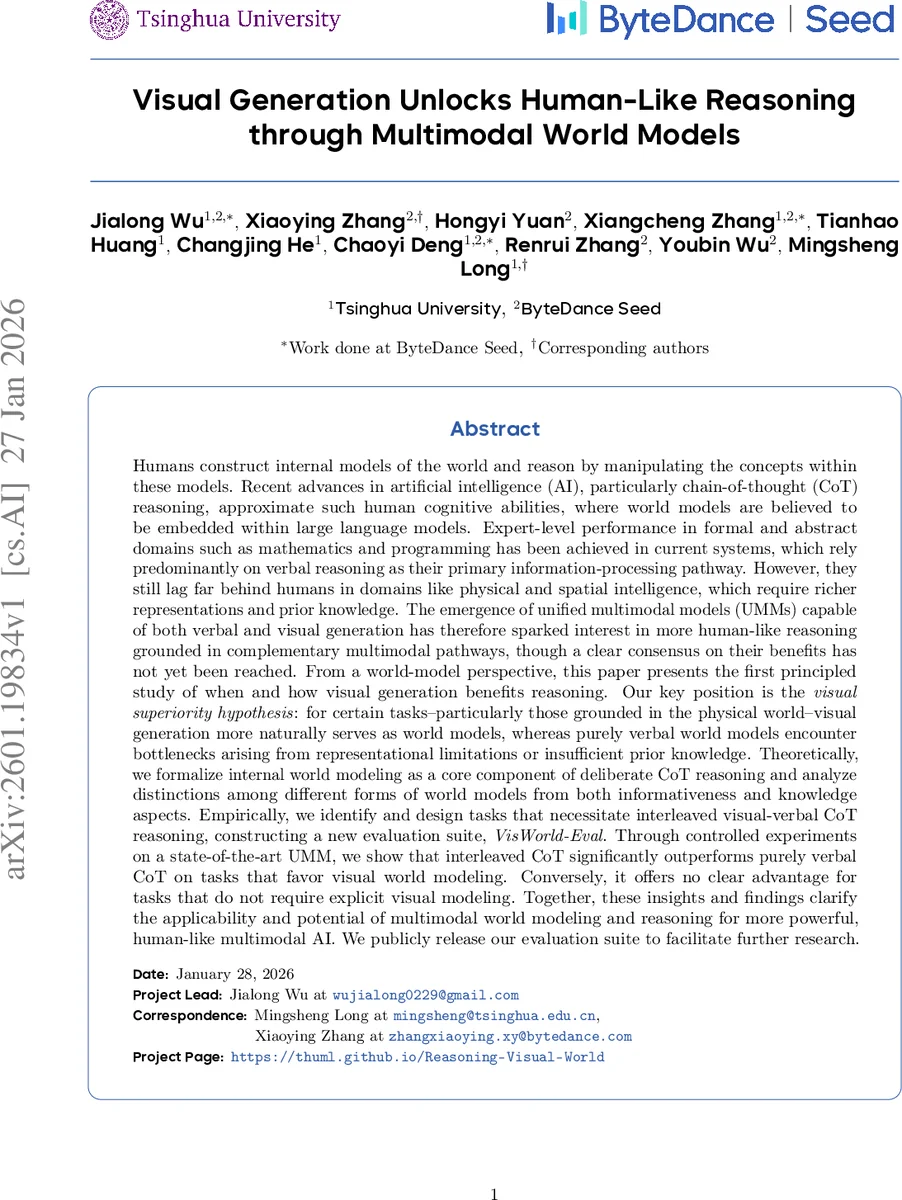
Humans construct internal world models and reason by manipulating the concepts within these models. Recent advances in AI, particularly chain-of-thought (CoT) reasoning, approximate such human cognitive abilities, where world models are believed to be embedded within large language models. Expert-level performance in formal and abstract domains such as mathematics and programming has been achieved in current systems by relying predominantly on verbal reasoning. However, they still lag far behind humans in domains like physical and spatial intelligence, which require richer representations and prior knowledge. The emergence of unified multimodal models (UMMs) capable of both verbal and visual generation has therefore sparked interest in more human-like reasoning grounded in complementary multimodal pathways, though their benefits remain unclear. From a world-model perspective, this paper presents the first principled study of when and how visual generation benefits reasoning. Our key position is the visual superiority hypothesis: for certain tasks–particularly those grounded in the physical world–visual generation more naturally serves as world models, whereas purely verbal world models encounter bottlenecks arising from representational limitations or insufficient prior knowledge. Theoretically, we formalize internal world modeling as a core component of CoT reasoning and analyze distinctions among different forms of world models. Empirically, we identify tasks that necessitate interleaved visual-verbal CoT reasoning, constructing a new evaluation suite, VisWorld-Eval. Controlled experiments on a state-of-the-art UMM show that interleaved CoT significantly outperforms purely verbal CoT on tasks that favor visual world modeling, but offers no clear advantage otherwise. Together, this work clarifies the potential of multimodal world modeling for more powerful, human-like multimodal AI.
💡 Research Summary
This paper investigates how visual generation can enhance chain‑of‑thought (CoT) reasoning in unified multimodal models (UMMs) from a world‑model perspective. Human cognition relies on internal “world models” that integrate verbal (symbolic) and visual (imagery) representations to simulate actions and predict outcomes. Recent AI systems achieve expert‑level performance in abstract domains (math, programming) using primarily verbal CoT, yet they fall short on physical and spatial tasks that demand richer, multimodal representations.
The authors propose the “visual superiority hypothesis”: for tasks grounded in the physical world, visual generation serves as a more natural form of world modeling, overcoming representational bottlenecks and knowledge gaps inherent in purely verbal models. To formalize this, they model a task as a multi‑observable Markov decision process (MOMDP) and define two core capabilities of a world model—construction (building an internal representation) and simulation (predicting future states). Three reasoning formulations are introduced: (1) implicit verbal CoT (world model hidden in text), (2) explicit verbal CoT (external knowledge but no visual pathway), and (3) interleaved visual‑verbal CoT, where intermediate images are generated and used as explicit visual world models.
A new benchmark suite, VisWorld‑Eval, is created to isolate the need for visual world modeling. It comprises seven tasks spanning synthetic and real‑world domains, including physical simulations (object movement, cooking), spatial planning (trip budgeting), and visual perception (locating an object in a photo). Each task is designed to stress either world‑construction, world‑simulation, or both.
Experiments are conducted with a state‑of‑the‑art UMM (BAGEL) across the suite. Results show that interleaved visual‑verbal CoT significantly outperforms purely verbal CoT on tasks that require physical reasoning, achieving 12–18 percentage‑point gains on average. The visual steps act as compact state representations that reduce information loss and allow the model to leverage innate physical priors (gravity, collision). Conversely, on purely logical or abstract tasks such as maze navigation and Sokoban, visual generation provides no measurable benefit and even incurs extra computational cost. Additional analysis reveals that standard LLMs sometimes develop implicit visual reasoning, but this is limited, task‑specific, and does not generalize as well as explicit visual world modeling.
The paper concludes that human‑like reasoning in AI demands flexible integration of verbal and visual pathways. Visual generation is especially valuable for grounding world models in the physical world, while verbal reasoning remains dominant for abstract symbolic domains. Future work should focus on (a) automatic optimization of interleaved CoT steps, (b) higher‑resolution and more efficient visual generators for complex simulations, and (c) incorporating meta‑cognitive mechanisms that allow models to self‑evaluate and adjust their reasoning strategies. By providing both a theoretical framework and empirical evidence, this study clarifies when and how multimodal world models can bridge the performance gap between current AI systems and human cognition.
Comments & Academic Discussion
Loading comments...
Leave a Comment