Comment on "Multidimensional arrow of time" (arXiv:2601.14134)
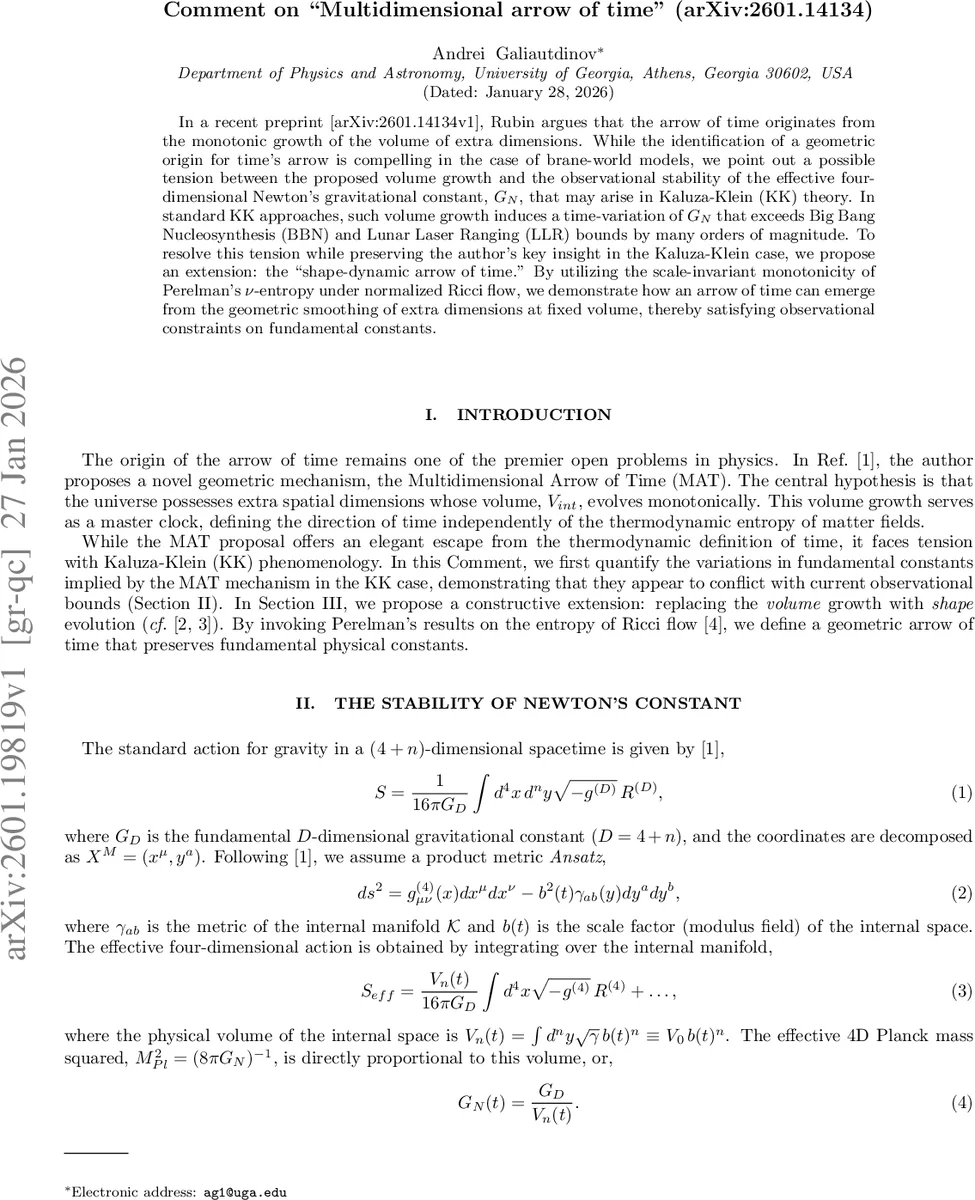
In a recent preprint [arXiv:2601.14134v1], Rubin argues that the arrow of time originates from the monotonic growth of the volume of extra dimensions. While the identification of a geometric origin for time’s arrow is compelling in the case of brane-world models, we point out a possible tension between the proposed volume growth and the observational stability of the effective four-dimensional Newton’s gravitational constant, G, that may arise in Kaluza-Klein (KK) theory. In standard KK approaches, such volume growth induces a time-variation of G that exceeds Big Bang Nucleosynthesis (BBN) and Lunar Laser Ranging (LLR) bounds by many orders of magnitude. To resolve this tension while preserving the author’s key insight in the Kaluza-Klein case, we propose an extension: the “shape-dynamic arrow of time”. By utilizing the scale-invariant monotonicity of Perelman’s nu-entropy under normalized Ricci flow, we demonstrate how an arrow of time can emerge from the geometric smoothing of extra dimensions at fixed volume, thereby satisfying observational constraints on fundamental constants.
💡 Research Summary
The comment by Andrei Galiautdinov critically examines Sergey Rubin’s recent pre‑print “Multidimensional Arrow of Time” (arXiv:2601.14134). Rubin proposes that the universe possesses extra spatial dimensions whose total internal volume (V_{\text{int}}(t)) grows monotonically. This growth is taken as a universal “master clock” that defines the direction of time independently of thermodynamic entropy. While the idea is attractive in brane‑world contexts, the author points out a serious phenomenological tension when the proposal is embedded in a conventional Kaluza‑Klein (KK) framework.
In a (4 + n)‑dimensional theory the effective four‑dimensional Newton constant is (G_{N}=G_{D}V_{n}(t)). Consequently any non‑zero (\dot V_{n}/V_{n}) directly translates into a fractional variation (\dot G_{N}/G_{N}=-\dot V_{n}/V_{n}). Current experimental limits from Lunar Laser Ranging ((|\dot G/G|\lesssim10^{-13},\text{yr}^{-1})) and from Big‑Bang Nucleosynthesis (a few percent change at (z\sim10^{9})) are many orders of magnitude tighter than the growth rates required for Rubin’s volume‑based arrow to be operational on cosmological timescales. If the volume growth is suppressed to satisfy these bounds, the arrow becomes effectively static; if it is allowed to be large enough to distinguish past from future, the variation of (G) would be ruled out. This logical conflict is the central criticism of the comment.
To resolve the conflict while preserving the spirit of a geometric time arrow, the author introduces the “shape‑dynamic arrow of time”. The key modification is to keep the internal volume exactly constant and let only the shape (conformal geometry) of the extra dimensions evolve. This evolution is governed by the volume‑normalized Ricci flow
\
Comments & Academic Discussion
Loading comments...
Leave a Comment