Widely tunable SNAP microresonators via translation of side-coupled optical fibers
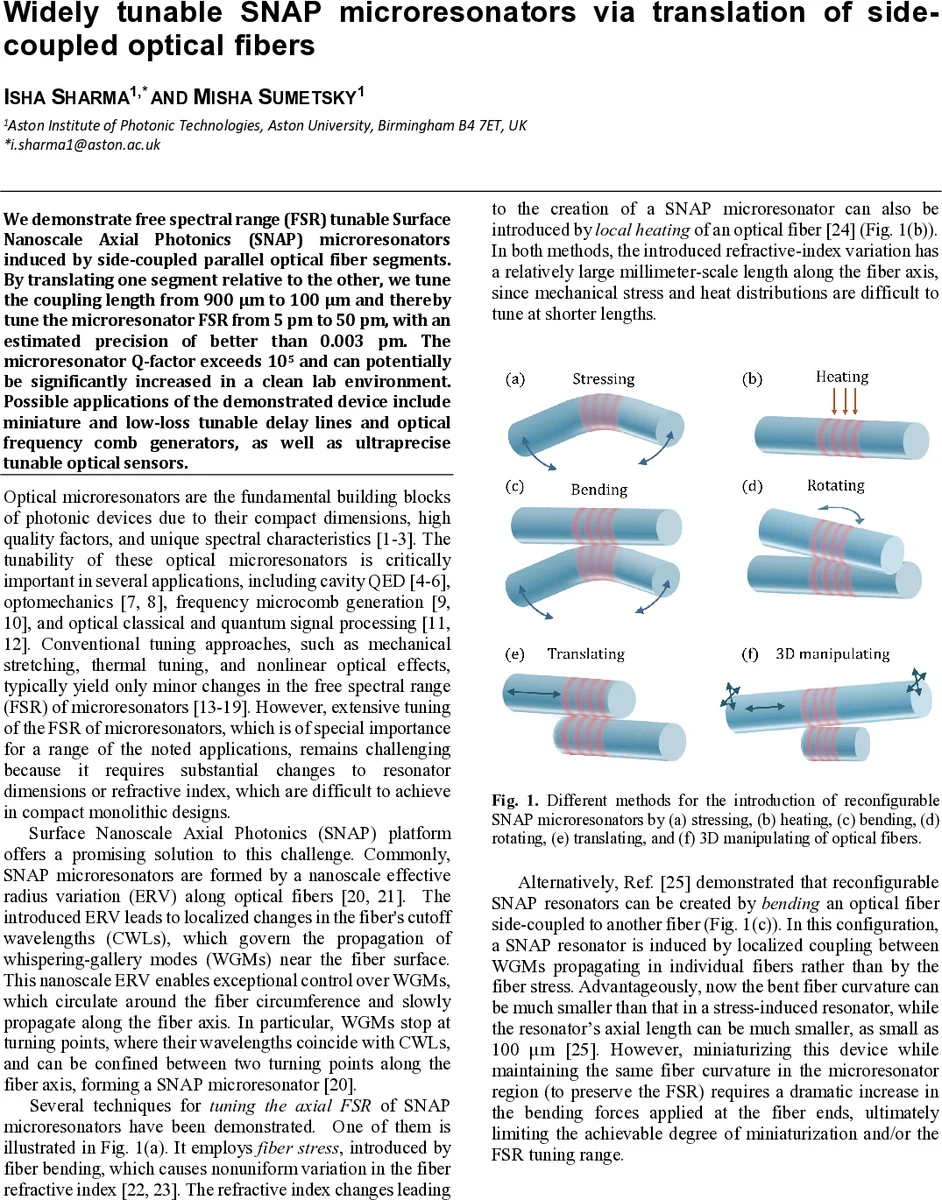
We demonstrate free spectral range (FSR) tunable Surface Nanoscale Axial Photonics (SNAP) microresonators induced by side-coupled parallel optical fiber segments. By translating one segment relative to the other, we tune the coupling length from $900μ$m to $100μ$m and thereby tune the microresonator FSR from $5$ pm to $50$ pm, with an estimated precision of better than $0.003$ pm. The microresonator Q-factor exceeds $10^5$ and can potentially be significantly increased in a clean lab environment. Possible applications of the demonstrated device include miniature and low-loss tunable delay lines and optical frequency comb generators, as well as ultraprecise tunable optical sensors.
💡 Research Summary
In this work the authors present a novel method for achieving wide‑range, ultra‑precise tuning of the free spectral range (FSR) of Surface Nanoscale Axial Photonics (SNAP) microresonators by translating one of two side‑coupled parallel silica fibers. By moving the “movable” fiber relative to a fixed fiber, the length of the coupling region (L) can be varied continuously from 900 µm down to 100 µm in 100 µm steps. This geometric change directly modifies the effective radius variation (ERV) that defines the axial potential for whispering‑gallery modes (WGMs) propagating along the fiber surface. The ERV manifests as a rectangular quantum‑well‑like shift of the cutoff wavelength (CWL) of about Δλ ≈ 0.2 nm in the coupling region, creating a set of confined axial eigenstates whose number N follows the WKB quantization rule N ≈ Δλ·√(R_eff)/L, where R_eff ≈ 33.5 µm is the effective radius derived from the fiber geometry and material index (n = 1.44).
Experimentally, the authors launch light into the fixed fiber using a Luna‑5000 Optical Vector Analyzer coupled through a transverse microfiber taper. By scanning the microfiber along the fiber axis with 2 µm spatial resolution, they acquire two‑dimensional spectrograms of transmission versus position and wavelength. As L is reduced, the spectrograms show a clear increase in the axial FSR, ranging from ~5 pm at L = 900 µm to ~50 pm at L = 100 µm, in excellent agreement with the analytical expression Δλ_FSR = Δλ·√(R_eff)/L. The measured quality factor reaches Q ≈ 3 × 10⁵, limited primarily by imperfect facet cleaving, direct contact between the input‑output microfiber and the fibers, and surface contamination in an uncontrolled laboratory environment. The authors argue that with tapered fiber ends, sub‑micron gaps, and operation in a cleanroom, Q‑factors approaching 10⁸—typical for high‑performance silica microresonators—should be attainable.
A key advantage of the translation‑based scheme is its tuning precision. Assuming a translation stage resolution of δL ≈ 0.1 µm, the resulting uncertainty in the FSR is δ(Δλ_FSR) ≈ Δλ·√(R_eff)·δL/L², which evaluates to better than 0.003 pm for a resonator length of 500 µm. This precision is roughly two orders of magnitude better than the previously reported rotating‑fiber configuration (Ref.
Comments & Academic Discussion
Loading comments...
Leave a Comment