Cramer-Rao Bound for Arbitrarily Constrained Sets
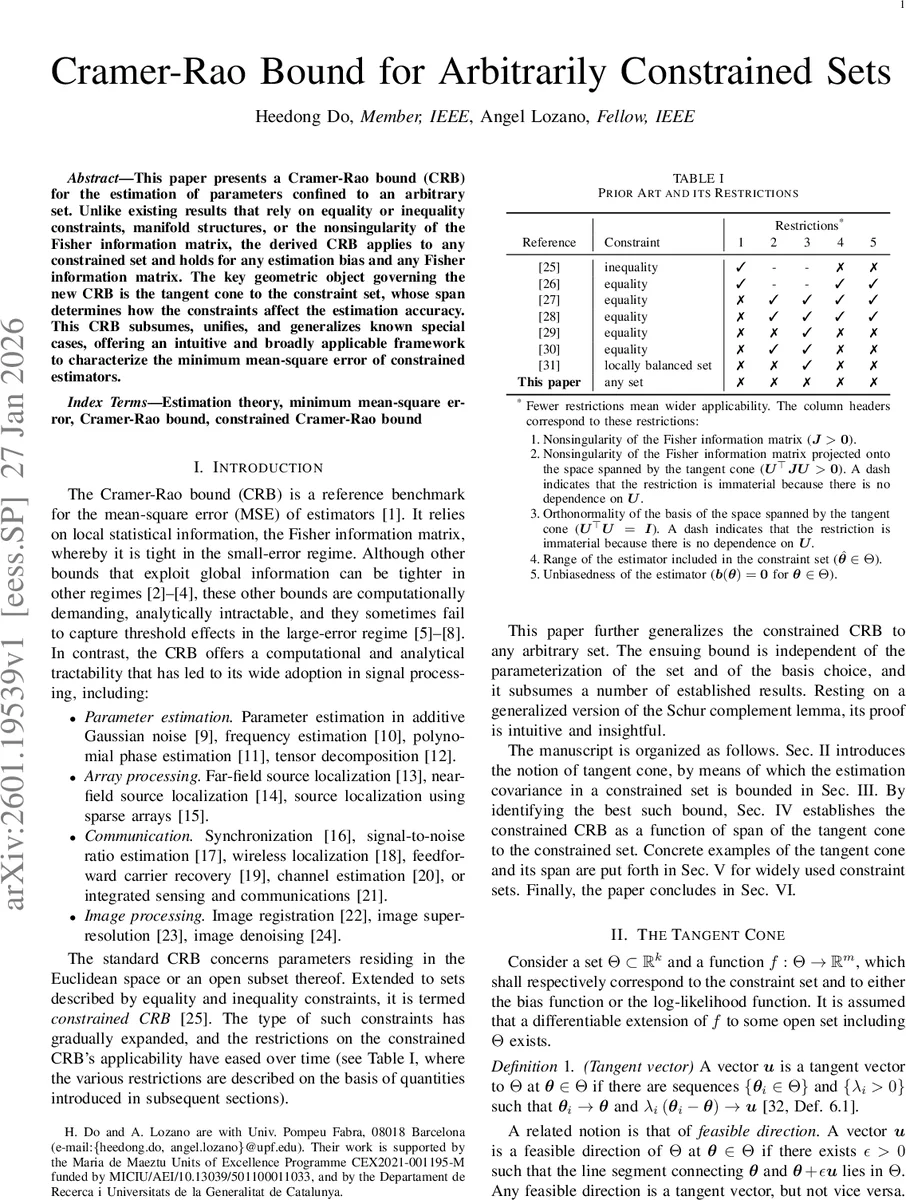
This paper presents a Cramer-Rao bound (CRB) for the estimation of parameters confined to an arbitrary set. Unlike existing results that rely on equality or inequality constraints, manifold structures, or the nonsingularity of the Fisher information matrix, the derived CRB applies to any constrained set and holds for any estimation bias and any Fisher information matrix. The key geometric object governing the new CRB is the tangent cone to the constraint set, whose span determines how the constraints affect the estimation accuracy. This CRB subsumes, unifies, and generalizes known special cases, offering an intuitive and broadly applicable framework to characterize the minimum mean-square error of constrained estimators.
💡 Research Summary
The paper introduces a fundamentally new Cramér‑Rao bound (CRB) that applies to the estimation of parameters constrained to any set Θ⊂ℝᵏ, without requiring the set to be a smooth manifold, to be described by equality/inequality constraints, or to satisfy any regularity condition on the Fisher information matrix (FIM). The central geometric construct is the tangent cone TΘ(θ) at a point θ∈Θ, defined as the set of all limit directions of sequences staying inside Θ. While a tangent cone need not be a linear subspace, its span (the smallest linear subspace containing the cone) is always well‑defined. The authors show that the span of the tangent cone fully determines how the constraints affect estimation accuracy.
Key technical developments
-
General constrained covariance inequality (Theorem 2). For any matrix U whose columns lie in TΘ(θ), the estimator covariance Cθ satisfies
Cθ ≥ (I+∂b/∂θ) U (Uᵀ J U)† Uᵀ (I+∂b/∂θ)ᵀ,
where b is the bias, J the Fisher information matrix, and † denotes the Moore‑Penrose pseudoinverse. This inequality reduces to the classical constrained CRB when U is chosen as the Jacobian of equality constraints, but here U can be any collection of feasible tangent directions. -
Identification of the optimal bound. Lemma 1 guarantees the existence of a basis {v₁,…,v_d} for span TΘ(θ). Forming V=
Comments & Academic Discussion
Loading comments...
Leave a Comment