Rethinking Intelligence: Brain-like Neuron Network
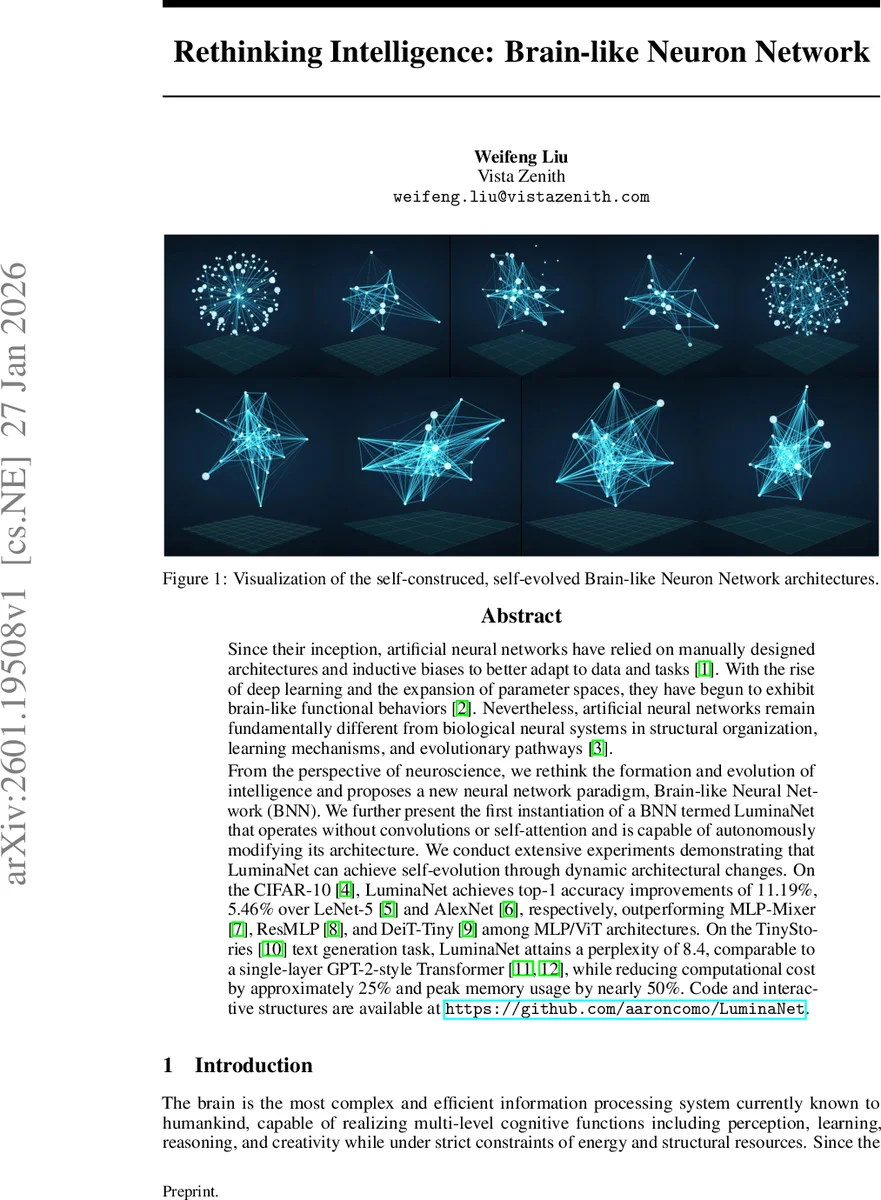
Since their inception, artificial neural networks have relied on manually designed architectures and inductive biases to better adapt to data and tasks. With the rise of deep learning and the expansion of parameter spaces, they have begun to exhibit brain-like functional behaviors. Nevertheless, artificial neural networks remain fundamentally different from biological neural systems in structural organization, learning mechanisms, and evolutionary pathways. From the perspective of neuroscience, we rethink the formation and evolution of intelligence and proposes a new neural network paradigm, Brain-like Neural Network (BNN). We further present the first instantiation of a BNN termed LuminaNet that operates without convolutions or self-attention and is capable of autonomously modifying its architecture. We conduct extensive experiments demonstrating that LuminaNet can achieve self-evolution through dynamic architectural changes. On the CIFAR-10, LuminaNet achieves top-1 accuracy improvements of 11.19%, 5.46% over LeNet-5 and AlexNet, respectively, outperforming MLP-Mixer, ResMLP, and DeiT-Tiny among MLP/ViT architectures. On the TinyStories text generation task, LuminaNet attains a perplexity of 8.4, comparable to a single-layer GPT-2-style Transformer, while reducing computational cost by approximately 25% and peak memory usage by nearly 50%. Code and interactive structures are available at https://github.com/aaroncomo/LuminaNet.
💡 Research Summary
The paper introduces a new paradigm called Brain‑like Neural Network (BNN) that seeks to bridge the gap between artificial neural networks and biological brains by abandoning manually designed architectures and static learning mechanisms. BNN is defined by four core properties: (1) architectures emerge autonomously through adaptive or self‑organizing processes rather than human design; (2) structural constraints mirror those of the brain, such as limited resources and multi‑scale plasticity; (3) the system can evolve autonomously, adjusting depth, width, and connectivity while preserving or improving performance; and (4) the resulting topologies are highly interpretable in terms of structural evolution, data flow, and information propagation.
To instantiate this paradigm, the authors propose LuminaNet, the first self‑architectural‑evolving network that operates without convolutions, self‑attention, or hand‑crafted inductive biases. The only manually constructed building block is the Neuron Cluster (NC), which consists of an Input Layer (IL) that embeds raw inputs and a Neuron Layer (NL) that performs feature extraction. NCs communicate through a dedicated Communication Layer (CL) that carries feed‑forward, feedback, and recurrent connections, thereby emulating synaptic communication.
LuminaNet’s evolution is driven by four elementary operations applied probabilistically during training:
- Splitting – a cluster’s weights are halved and the second half becomes a new cluster, reducing over‑fitting and redistributing capacity.
- Growth – horizontal expansion of a cluster’s neuron count, increasing its expressive power.
- Connection – creation of linear transformations from other clusters, weighted by a learned matrix, mimicking synaptic strength.
- Pruning – removal of connections whose Frobenius norm falls below a threshold, analogous to synaptic elimination.
Selection of which operation to apply to a given cluster is based on the variance of its activation (v). High‑variance clusters (top 10 %) are split or used as sources for new connections; low‑variance clusters (bottom 40 %) are grown. Connections are formed directionally: if a source cluster has higher variance than a target, a feed‑forward link is added; otherwise a feedback link is created. Pruning uses a global intensity factor (θ = 0.9).
A novel “Two‑Pass Forward” scheme enables dynamic formation of recurrent circuitry. In Pass‑1 the network traverses clusters sequentially, aggregating only already‑available feed‑forward signals. In Pass‑2, when a cluster is visited, it incorporates any newly computed feed‑forward outputs as well as existing feedback signals, allowing the architecture to evolve its computational graph on‑the‑fly. The final output aggregates all valid cluster outputs by averaging.
Experimental validation is performed on two domains.
-
Image classification: Using CIFAR‑10, several LuminaNet variants (10, 32, 64, 84, 128) are compared against classic CNNs (LeNet‑5, AlexNet, ResNet‑18), Vision Transformers (MobileViT, DeiT‑Tiny) and MLP‑style models (MLP‑Mixer, ResMLP, gMLP). Despite having far fewer parameters (e.g., LuminaNet‑10 with 0.36 M parameters), the model surpasses LeNet‑5 and AlexNet by 11.19 % and 5.46 % in Top‑1 accuracy, respectively, and competes with modern MLP/ViT architectures. The medium‑size LuminaNet‑128 (3.16 M parameters) reaches Top‑1 72.84 % and Top‑5 98.09 %, close to MobileViT (5.33 M) and far below ResNet‑18 (11.69 M).
-
Text generation: On the TinyStories benchmark, a single‑layer LuminaNet achieves a perplexity of 8.4 and a Top‑1 accuracy of 53.38 %, essentially matching a single‑layer GPT‑2‑style Transformer (PPL 8.08, Top‑1 53.29 %). Importantly, LuminaNet reduces computational cost by ~25 % and peak memory consumption by ~50 % because it eliminates convolutional kernels and attention matrices.
Ablation studies explore three configurations: (A) only the initial clusters remain, all connections removed; (B) initial clusters plus their original connections retained; (C) all clusters kept but all connections removed. Performance drops dramatically in (A) and (C), while (B) yields the best results, confirming that the emergent complex connectivity—not merely the number of clusters—is essential for high performance.
Evolutionary trajectory analysis shows that all models start with 12 seed clusters and, through repeated splitting, growth, and connection events, expand to thousands of neurons and tens of thousands of connections. Metrics such as topological depth, maximum in‑degree, number of cycles, and neuron count (min/avg/max) are reported, illustrating how self‑organized recurrent structures naturally arise.
Contributions and implications:
- A formal definition of BNN that aligns artificial networks with brain‑like developmental principles.
- The first concrete, self‑evolving architecture (LuminaNet) that operates without traditional hand‑crafted biases.
- Empirical evidence that autonomous architectural evolution can yield competitive or superior performance with far fewer parameters and resources.
- Insight that complex, dynamically formed topologies are the key driver of performance, echoing biological observations of synaptic plasticity and network re‑wiring.
The work opens a new research direction where future AI systems may continuously adapt their structure during training, reducing reliance on human design and potentially achieving greater efficiency, robustness, and interpretability—qualities long associated with the biological brain.
Comments & Academic Discussion
Loading comments...
Leave a Comment