Multiple charge carrier species as a possible cause for triboelectric cycles
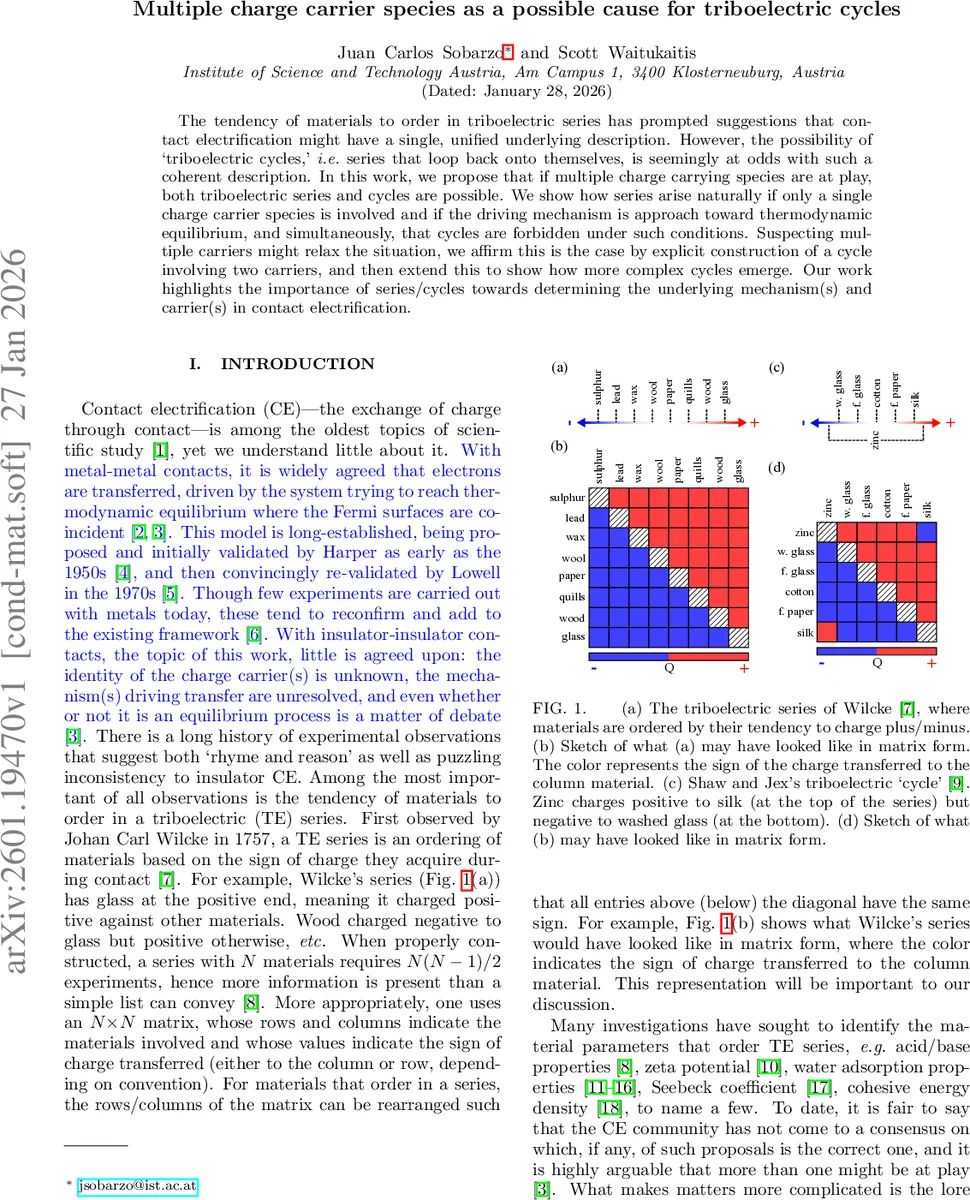
The tendency of materials to order in triboelectric series has prompted suggestions that contact electrification might have a single, unified underlying description. However, the possibility of triboelectric cycles, i.e. series that loop back onto themselves, is seemingly at odds with such a coherent description. In this work, we propose that if multiple charge carrying species are at play, both triboelectric series and cycles are possible. We show how series arise naturally if only a single charge carrier species is involved and if the driving mechanism is approach toward thermodynamic equilibrium, and simultaneously, that cycles are forbidden under such conditions. Suspecting multiple carriers might relax the situation, we affirm this is the case by explicit construction of a cycle involving two carriers, and then extend this to show how more complex cycles emerge. Our work highlights the importance of series/cycles towards determining the underlying mechanism(s) and carrier(s) in contact electrification.
💡 Research Summary
The paper addresses a long‑standing puzzle in contact electrification (CE): why many insulating materials can be ordered into a triboelectric (TE) series, yet some experimental reports describe “triboelectric cycles” where the ordering loops back on itself. The authors propose that the apparent contradiction can be resolved by considering the number of charge‑carrying species involved.
First, they construct a minimal “toy model” for a single charge carrier (electron or ion). Each material i is characterized by an energetic well depth ε_i and a neutral carrier count n_i (the number of carriers present when the surface is electrically neutral). When two materials contact, carriers may move between the merged wells; the probability of occupying a given well follows a Boltzmann factor exp(−ε/kT). By treating the two‑well system as a canonical ensemble, they derive the equilibrium average carrier number on material j (Eq. 1) and the net transferred charge q_ij = \bar n_{ij} – n_j. The sign of q_ij is governed by the inequality n_j < n_i exp
Comments & Academic Discussion
Loading comments...
Leave a Comment