Higher dimensional visual proofs, Nicomachus' 4D Theorem and the mysterious irreducible factor $(3n^2+3n-1)$ in the sum of fourth powers
Sums of powers $S_p(n)=\sum_{k=1}^n k^p$ can be described by Faulhaber’s formula in terms of the Bernoulli numbers. The first cases of this formula admit visual proofs of various kinds, which lead to factorized Faulhaber polynomials. In this article we present a technique that yields higher-dimensional visual proofs for these factorized formulas, providing a geometric interpretation of the roots that appear. In particular, we prove Nicomachus’s Theorem in four dimensions, and we visually explain the appearance, in dimension five, of the irreducible factor $(3n^2 +3n-1)$ in the polynomial ring over the rational numbers.
💡 Research Summary
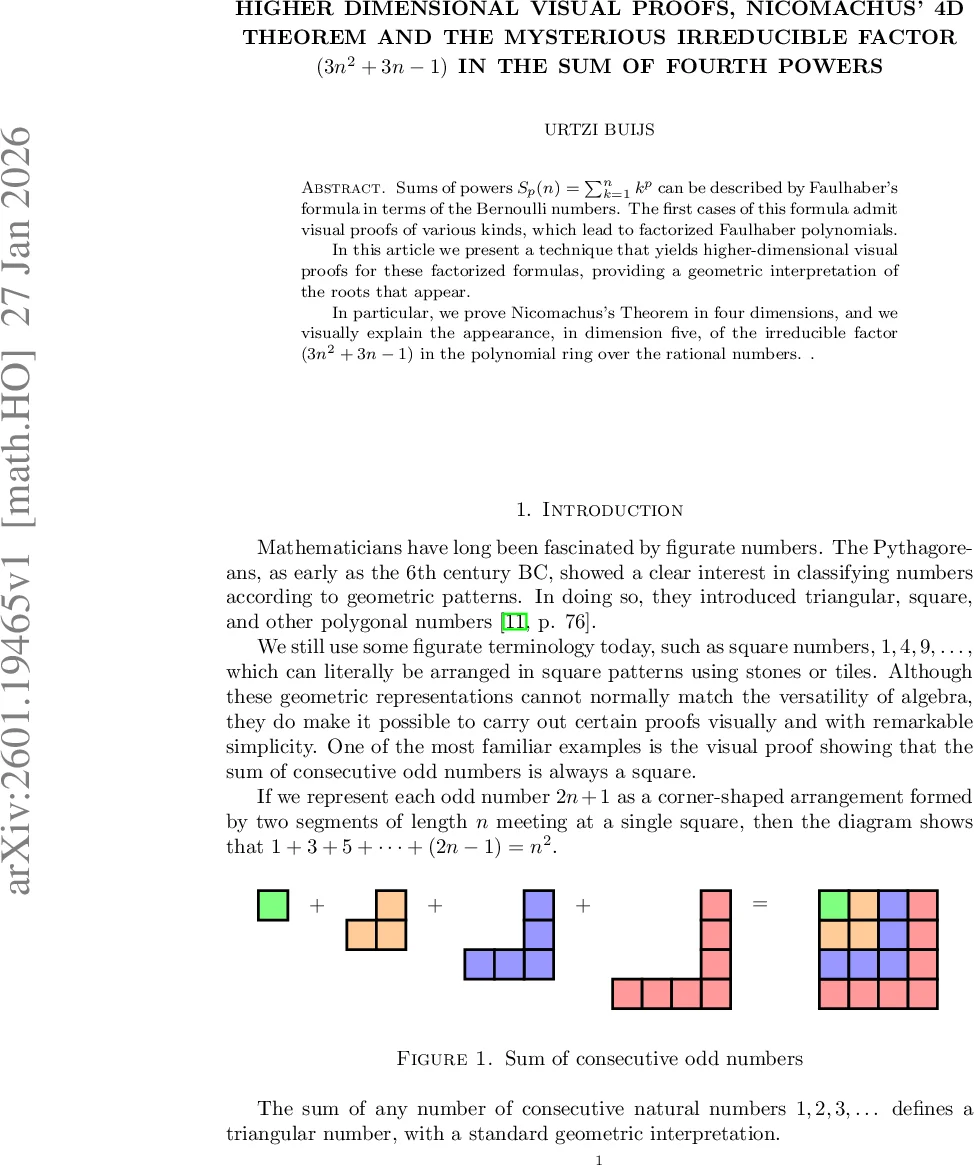
The paper revisits the classic visual proofs for sums of integers, squares, and cubes and extends the underlying ideas to higher dimensions, thereby offering a geometric explanation for the factorization patterns that appear in Faulhaber’s formulas. After a brief historical overview, the authors recall the well‑known 2‑dimensional proof that the sum of the first (n) odd numbers forms an (n\times n) square, the triangular‑number proof that doubles a triangle to obtain a rectangle, and the three‑dimensional construction where three square‑based pyramids are rearranged into a rectangular block. In each case the denominator of the resulting formula equals the number of pieces used, which coincides with the dimension of the visual argument, while the numerator factors correspond to the side lengths of the assembled block.
Section 2 introduces the “section” technique: a high‑dimensional solid is examined through its lower‑dimensional slices (X‑rays). By projecting a square‑based pyramid onto the plane in two different ways—principal sections that count squares directly and profile sections that count truncated triangular numbers—the authors obtain Lemma 2.1, an identity that equates a sum of ((p+1))‑st powers with a double sum of (p)‑th powers. This lemma shows that the visual rearrangement has an exact algebraic counterpart and works for any non‑negative integer (p).
In Section 3 the authors tackle Nicomachus’s theorem, (\sum_{k=1}^{n}k^{3} = \bigl(\sum_{k=1}^{n}k\bigr)^{2}), in four dimensions. They assemble four 4‑dimensional pyramids (hyper‑pyramids) into a 4‑dimensional rectangular block whose edge lengths are (n), (n+1), (\frac{n(n+1)}{2}) and (\frac{n(n+1)}{2}). The volume of this block is (n^{2}(n+1)^{2}), exactly the right‑hand side of Nicomachus’s identity. The construction is then reduced to three‑dimensional slices and finally to a two‑dimensional puzzle, demonstrating that the visual proof does not require actual four‑dimensional drawings.
Section 4 addresses the “mysterious” irreducible quadratic factor (3n^{2}+3n-1) that appears in the Faulhaber polynomial for the sum of fourth powers: \
Comments & Academic Discussion
Loading comments...
Leave a Comment