Words have Weight: Comparing the use of pressure and weight as a metaphor in a User Interface in Virtual Reality
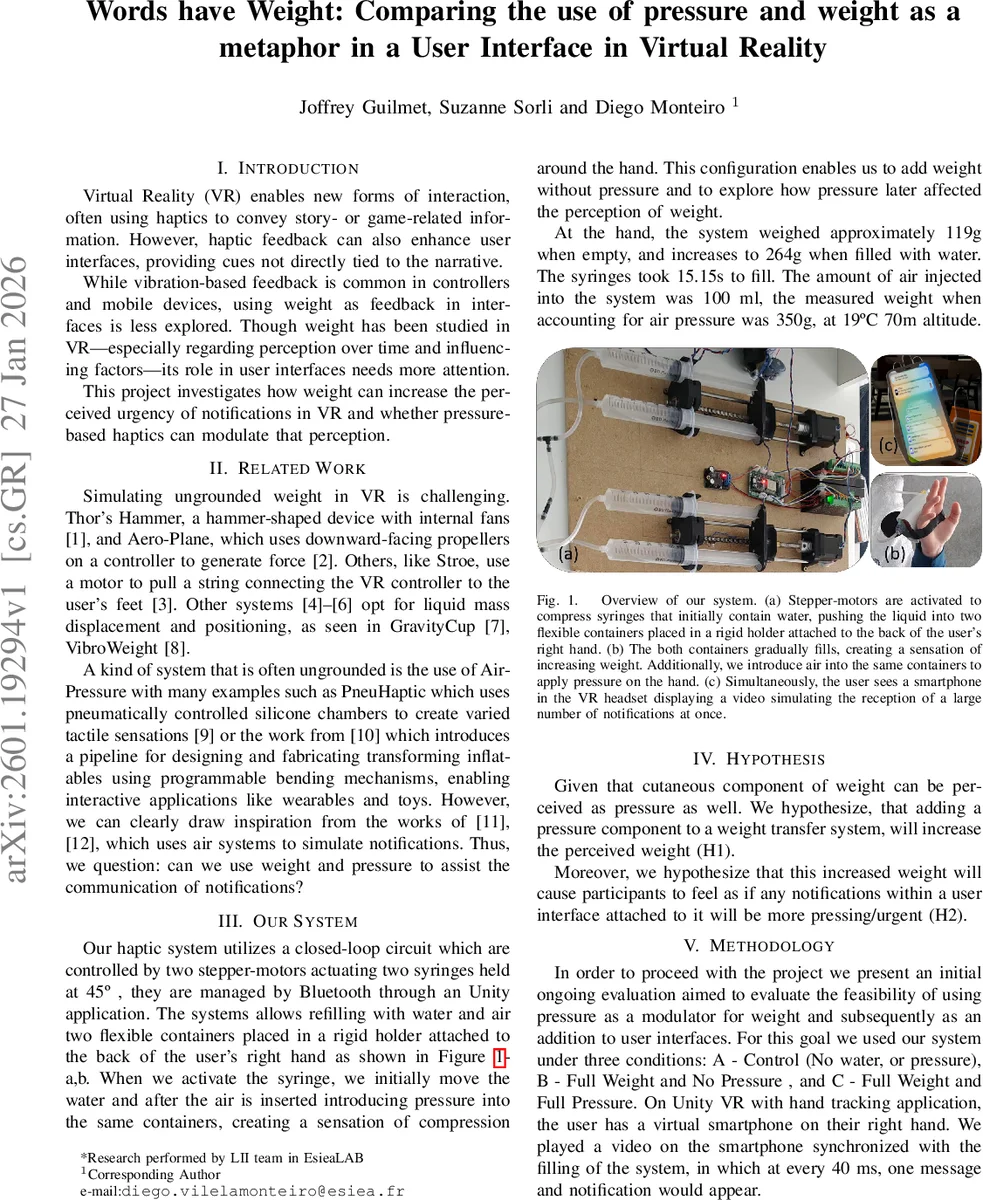
This work investigates how weight and pressure can function as haptic metaphors to support user interface notifications in Virtual Reality (VR). While prior research has explored ungrounded weight simulation and pneumatic feedback, their combined role in conveying information through UI elements remains underexplored. We developed a wearable haptic device that transfers liquid and air into flexible containers mounted on the back of the user’s hand, allowing us to independently manipulate weight and pressure. Through an initial evaluation using three conditions-no feedback, weight only, and weight combined with pressure-we examined how these signals affect perceived heaviness, coherence with visual cues, and the perceived urgency of notifications. Our results validate that pressure amplifies the perception of weight, but this increased heaviness does not translate into higher perceived urgency. These findings suggest that while pressure___enhanced weight can enrich haptic rendering of UI elements in VR, its contribution to communicating urgency may require further investigation, alternative pressure profiles, or different types of notifications.
💡 Research Summary
This paper investigates whether the tactile metaphors of weight and pressure can be used to convey information in virtual‑reality (VR) user‑interface (UI) notifications. The authors built a low‑cost wearable that sits on the back of the right hand and contains two flexible pouches connected to syringes driven by stepper motors. By pumping water into the pouches they increase the hand’s load (weight); by subsequently injecting a fixed volume of air they create internal compression (pressure). The system can therefore present three feedback conditions: (A) no haptic feedback, (B) weight only, and (C) weight plus pressure.
In a controlled user study, eight participants (aged 20‑32, two women) experienced a VR scene in which a virtual smartphone displayed a rapid stream of notifications (one every 40 ms). While the notification stream played, the haptic device was driven to the “fully activated” state for each condition. After each condition participants answered four self‑report items: (1) an estimate of the hand’s weight in grams, (2) a 0‑10 rating of visual‑tactile coherence, (3) a 0‑10 rating of perceived urgency, and (4) a 0‑10 rating of perceived heaviness of the messages. They also ranked the three conditions in terms of overall weight, preference, and coherence.
Statistical analysis (Friedman test, Wilcoxon signed‑rank, Kendall’s W) showed that condition C (weight + pressure) was perceived as significantly heavier than condition B (weight only), and both were heavier than the control. Visual‑tactile coherence was higher for C than for A, but not significantly different from B. Importantly, perceived urgency did not differ across any condition, indicating that the added pressure, while amplifying the sensation of weight (supporting hypothesis H1), did not make the notifications feel more urgent (rejecting hypothesis H2). Preference data showed a modest tilt toward the weight‑plus‑pressure condition, but the small sample size limits generalisation.
The discussion interprets these findings in light of prior work on ungrounded weight simulation (e.g., Thor’s Hammer, Aero‑Plane, GravityCup) and pneumatic compression (e.g., PneuHaptic, Squeezeback). The authors argue that pressure is interpreted by users as part of the weight cue, confirming the first hypothesis. However, the lack of urgency effect may stem from the experimental design: the notification stream already conveyed a high baseline urgency, leaving little room for haptic modulation; the pressure profile was fixed (single air volume) and may not map onto urgency cues; and the participant pool was limited.
Future work is outlined as follows: (1) vary pressure magnitude and temporal patterns to explore non‑linear weight‑pressure relationships, (2) design notification scenarios with graded urgency levels (e.g., low‑priority alerts vs. critical warnings) to test whether pressure can modulate urgency perception, (3) expand the participant pool and include a calibration procedure for different hand sizes, and (4) explore other UI content types (progress bars, error messages, confirmations) to assess the generality of the weight‑pressure metaphor.
In conclusion, the study demonstrates that pressure can enhance the perceived weight of a haptic UI element in VR, enriching the tactile experience. However, this enhanced weight does not automatically translate into higher perceived urgency for notifications. The findings suggest that while weight‑pressure cues are promising for creating richer haptic feedback, designers must carefully align the haptic parameters with the semantic meaning of UI elements, possibly by varying pressure profiles or by pairing them with visual and auditory cues that together convey urgency.
Comments & Academic Discussion
Loading comments...
Leave a Comment