Reevaluating Bluetooth Low Energy for Ingestible Electronics
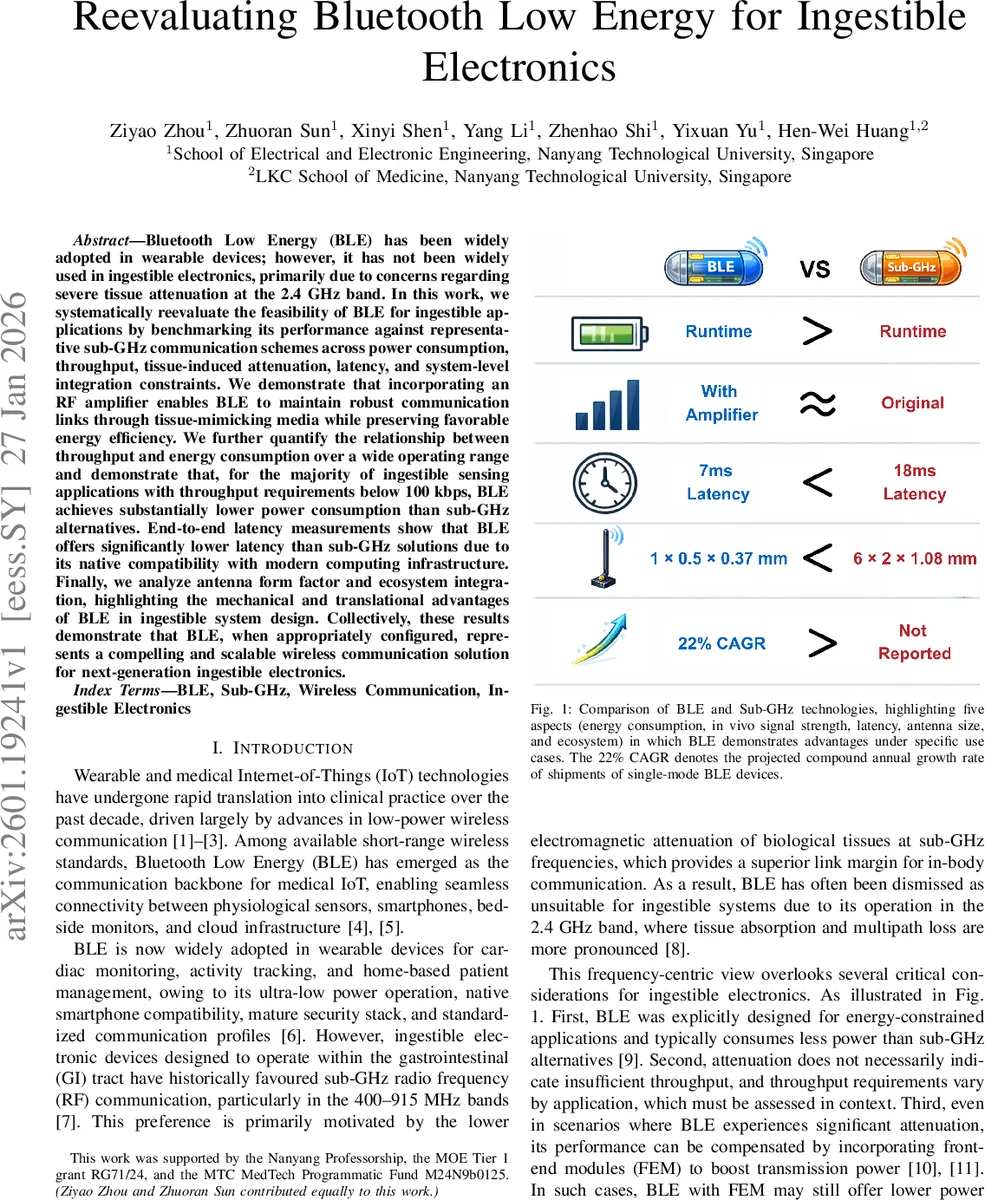
Bluetooth Low Energy (BLE) has been widely adopted in wearable devices; however, it has not been widely used in ingestible electronics, primarily due to concerns regarding severe tissue attenuation at the 2.4 GHz band. In this work, we systematically reevaluate the feasibility of BLE for ingestible applications by benchmarking its performance against representative sub-GHz communication schemes across power consumption, throughput, tissue-induced attenuation, latency, and system-level integration constraints. We demonstrate that incorporating an RF amplifier enables BLE to maintain robust communication links through tissue-mimicking media while preserving favorable energy efficiency. We further quantify the relationship between throughput and energy consumption over a wide operating range and demonstrate that, for the majority of ingestible sensing applications with throughput requirements below 100 kbps, BLE achieves substantially lower power consumption than sub-GHz alternatives. End-to-end latency measurements show that BLE offers significantly lower latency than sub-GHz solutions due to its native compatibility with modern computing infrastructure. Finally, we analyze antenna form factor and ecosystem integration, highlighting the mechanical and translational advantages of BLE in ingestible system design. Collectively, these results demonstrate that BLE, when appropriately configured, represents a compelling and scalable wireless communication solution for next-generation ingestible electronics.
💡 Research Summary
This paper revisits the long‑standing assumption that Bluetooth Low Energy (BLE) is unsuitable for ingestible electronics because the 2.4 GHz band suffers severe attenuation in human tissue. The authors systematically compare BLE with representative sub‑GHz solutions (433 MHz and 915 MHz) across five key dimensions: power consumption, achievable throughput, tissue‑induced attenuation, end‑to‑end latency, and system‑level integration (antenna size, ecosystem compatibility).
The experimental platform uses a Nordic nRF54L15 development kit for BLE and a Texas Instruments CC1310 launchpad for sub‑GHz. To emulate the human body, a water tank (40 × 30 × 25 cm) is employed, with the transmitter submerged at depths from 0 cm to 10 cm while the receiver remains in air at a 1 m distance. BLE is tested both at its native on‑chip output (8 dBm) and with an external RF front‑end module (nRF21540) boosting the effective transmit power to 20 dBm. Sub‑GHz is evaluated at 8 dBm in both 433 MHz and 915 MHz bands.
Results show that BLE’s RSSI degrades with a slope of roughly –2.26 dB/cm, confirming strong attenuation at 2.4 GHz. However, the 20 dBm configuration restores RSSI to about –40 dBm even at 10 cm depth, comparable to the 915 MHz link. Sub‑GHz links exhibit far flatter attenuation (≈ –0.79 dB/cm for 915 MHz, near‑constant for 433 MHz). Throughput remains close to the target 50 kbps across all depths, though BLE at 8 dBm shows larger fluctuations at deeper immersion; the 20 dBm version is more stable.
Power‑throughput measurements reveal a crossover point near 100 kbps. Below this threshold, BLE (especially with the external amplifier) consumes roughly one‑tenth the power of the 915 MHz system and orders of magnitude less than the 433 MHz system. At higher data rates (>100 kbps), the 915 MHz solution becomes more energy‑efficient, while BLE’s 2 Mbps PHY can still deliver up to 2.3 Mbps, albeit with higher instantaneous current (≈118 mA) when the amplifier is active. Importantly, in low‑throughput regimes the amplifier spends most of its time in sleep, so average power remains comparable to the 8 dBm case.
Latency testing uses a 244‑byte packet transmitted once per second with a 7.5 ms connection interval for BLE. Measured end‑to‑end latency for BLE (both power levels) is about 7.45 ms, comfortably within the sub‑250 ms window required for most vital‑sign monitoring. Sub‑GHz latency, measured via USB‑UART bridge, is significantly higher (30 ms to >100 ms), reflecting the lack of native integration with hospital IT infrastructure.
The authors also discuss mechanical integration. BLE’s 2.4 GHz antenna can be realized as a compact PCB trace (<5 mm), fitting easily within the limited volume of ingestible capsules. Sub‑GHz antennas, due to longer wavelengths, require larger structures (≥10 mm), complicating capsule design. Moreover, BLE benefits from a mature ecosystem: native smartphone compatibility, standardized security (encryption, authentication), and over‑the‑air firmware updates, all of which reduce development cost, accelerate regulatory clearance, and improve patient compliance.
In conclusion, when equipped with an external RF front‑end to compensate for tissue loss, BLE provides a robust, low‑power, low‑latency wireless link for the majority of ingestible sensing applications that demand ≤100 kbps. For high‑throughput needs (e.g., capsule endoscopy), sub‑GHz still holds an advantage, but for most physiological monitoring tasks BLE emerges as the more energy‑efficient and system‑friendly choice. This work therefore repositions BLE as a compelling, scalable communication technology for next‑generation ingestible electronics.
Comments & Academic Discussion
Loading comments...
Leave a Comment