Symbolic recursion method for strongly correlated fermions in two and three dimensions
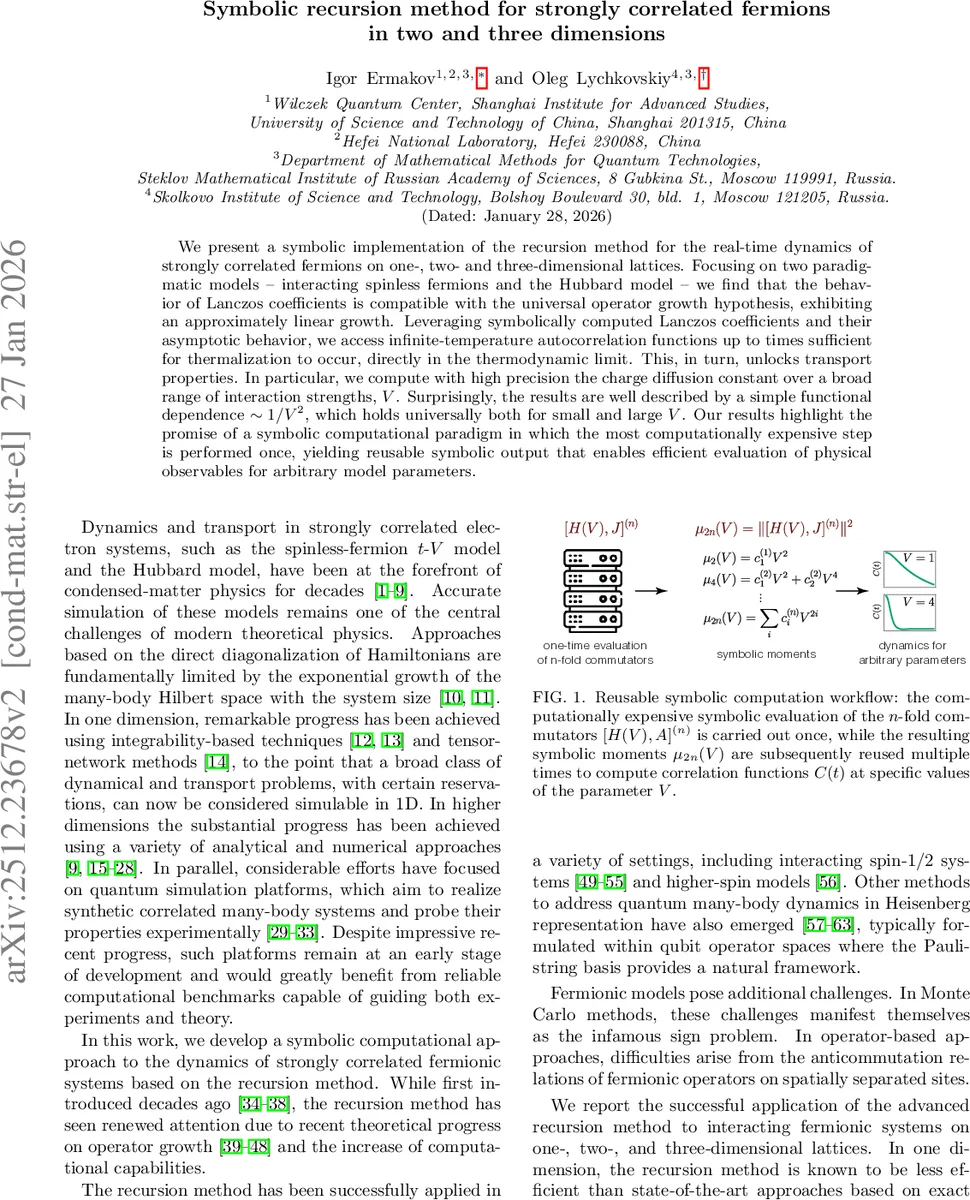
We present a symbolic implementation of recursion method for the dynamics of strongly correlated fermions on one-, two- and three-dimensional lattices. Focusing on two paradigmatic models, interacting spinless fermions and the Hubbard model, we first directly confirm that the universal operator growth hypothesis holds for interacting fermionic systems, manifested by the linear growth of Lanczos coefficients. Equipped with symbolically computed Lanczos coefficients and knowledge of their asymptotics, we are able to compute infinite-temperature autocorrelation functions up to times long enough for thermalization to occur. In turn, the knowledge of autocorrelation functions unlocks transport properties. We compute with high precision the charge diffusion constant over a broad range of interaction strengths, $V$. Surprisingly, we observe that these results are well described by a simple functional dependence $\sim 1/V^2$ universally valid both for small and large $V$. All results are obtained directly in the thermodynamic limit. Our results highlight the promise of symbolic computational paradigm where the most costly step is performed once and outputs symbolic results that can further be used multiple times to easily compute physical quantities for specific values of model parameters.
💡 Research Summary
In this work the authors develop a symbolic implementation of the recursion (Lanczos) method to study real‑time dynamics of strongly correlated fermions on hypercubic lattices in one, two and three dimensions. The two benchmark models are the spinless fermion t‑V model and the Hubbard model at half‑filling, both with nearest‑neighbour hopping t_hop (set to unity) and an interaction strength V (or U). The central object of interest is the infinite‑temperature current autocorrelation function
C(t)=⟨J(t)J⟩/‖J‖²,
where J is the total particle current.
The authors first compute the nested commutators
Comments & Academic Discussion
Loading comments...
Leave a Comment