The lonely runner conjecture holds for nine runners
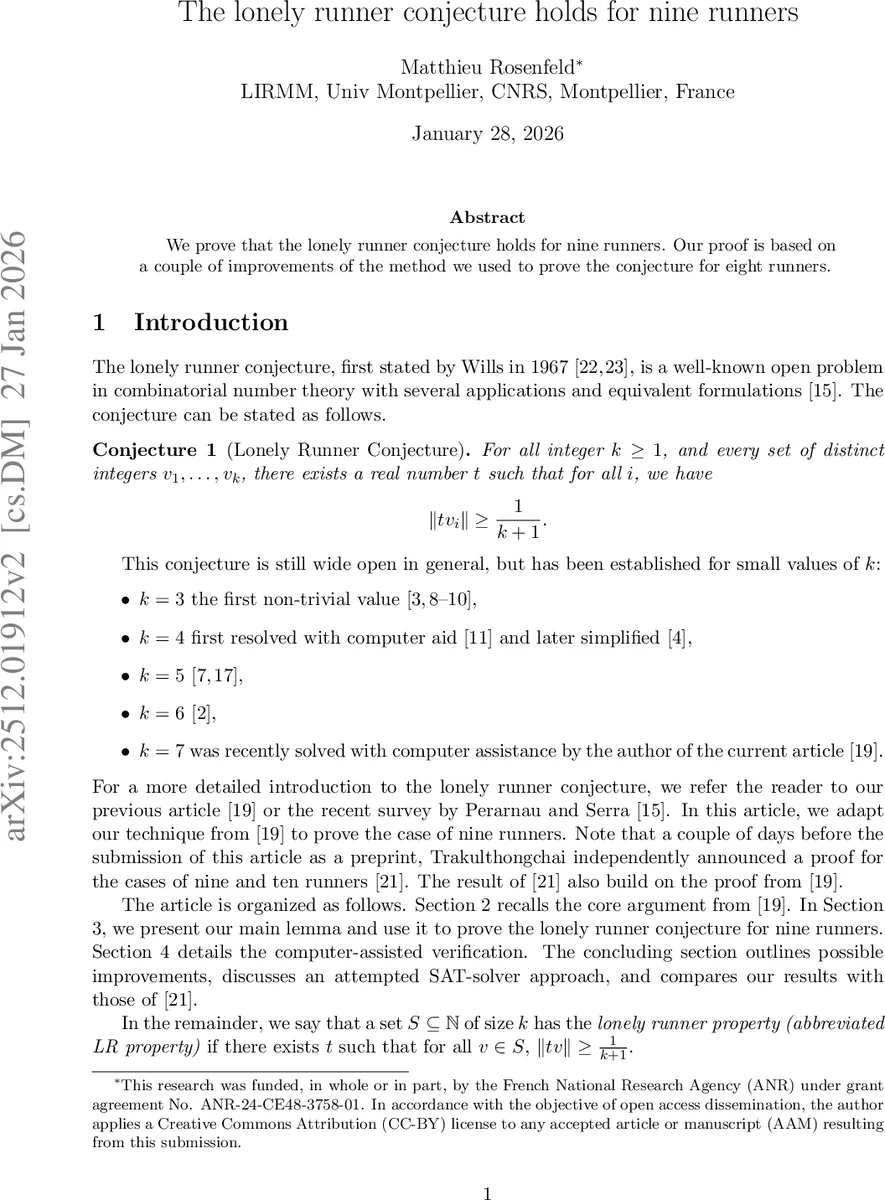
We prove that the lonely runner conjecture holds for nine runners. Our proof is based on a couple of improvements of the method we used to prove the conjecture for eight runners.
💡 Research Summary
The paper establishes the Lonely Runner Conjecture for nine runners, extending the author’s previous work that settled the case of eight runners. The conjecture states that for any set of k distinct integer speeds v₁,…,v_k there exists a real time t such that every runner is at distance at least 1/(k+1) from the starting point, i.e., ‖t·v_i‖ ≥ 1/(k+1) for all i. The authors build on a bound originally due to Malikiosis, Santos, and Schymura, which limits the product P = ∏v_i of a minimal counterexample. Their earlier approach for k = 7 used Lemma 3 and Lemma 4 to force many small prime divisors into P, eventually contradicting the bound.
In the present work two new lemmas are introduced. Lemma 5 shows that if among eight integers at least six are divisible by 3, or at least five are divisible by 9, then the set automatically has the Lonely Runner property. The proof exploits the fact that a suitable t can be shifted by multiples of 1/3 or 1/9, guaranteeing that the remaining two numbers also satisfy the distance condition. Lemma 6 generalizes this idea: for any positive integers d and c, if a 8‑tuple of residues modulo 9·c·d satisfies (i) every 7‑subset together with 9·c·d has gcd = 1, (ii) at most five entries are multiples of 3, (iii) at most four are multiples of 9, and (iv) the product of the residues is not divisible by d, then there exists a t in the residue range that yields the required distance ≥ 1/9. Consequently any counterexample must have its product divisible by d.
The authors then select a set S of 34 numbers, each a prime power (e.g., 64 = 2⁶, 81 = 3⁴, 25 = 5², etc.), covering all primes up to 191 except 7. For each d∈S they compute the smallest c for which Lemma 6’s conditions can be verified by a computer program. The verification is reformulated as a set‑cover problem: a residue v “covers” an integer j if the fractional part of v·j/(9·c·d) lies within distance 1/8 of an integer. Using bit‑set representations and a sophisticated pruning strategy that discards partial covers which cannot be completed, the search space is dramatically reduced. The implementation, written in C++, is publicly available. Empirically, the worst case (d·c = 163) runs in about 50 minutes, a huge improvement over the 32‑hour runtime of the earlier 7‑runner code.
With Lemma 6 validated for every d in S, the product P of any hypothetical minimal counterexample must be divisible by all elements of S. Since the elements of S are pairwise coprime, P must be divisible by their least common multiple, which is approximately 9.09778 × 10⁷⁹. However, Corollary 2 provides an upper bound on P of roughly 8.47657 × 10⁷⁹. This contradiction shows that no counterexample exists for nine runners, completing the proof of the conjecture in this case.
The paper concludes by discussing scalability: while the method works up to nine runners, the computational cost grows rapidly with k and with the size of the primes required. The authors suggest encoding the set‑cover condition as a SAT instance, leveraging modern SAT solvers that have shown superior performance on similar combinatorial problems. They note that the theoretical framework could, in principle, be applied to any fixed number of runners, but practical limitations will likely require further algorithmic innovations. Overall, the work represents a significant advance in the Lonely Runner problem, combining refined number‑theoretic lemmas with high‑performance exhaustive search to settle the nine‑runner case.
Comments & Academic Discussion
Loading comments...
Leave a Comment