62.6 GHz ScAlN Solidly Mounted Acoustic Resonators
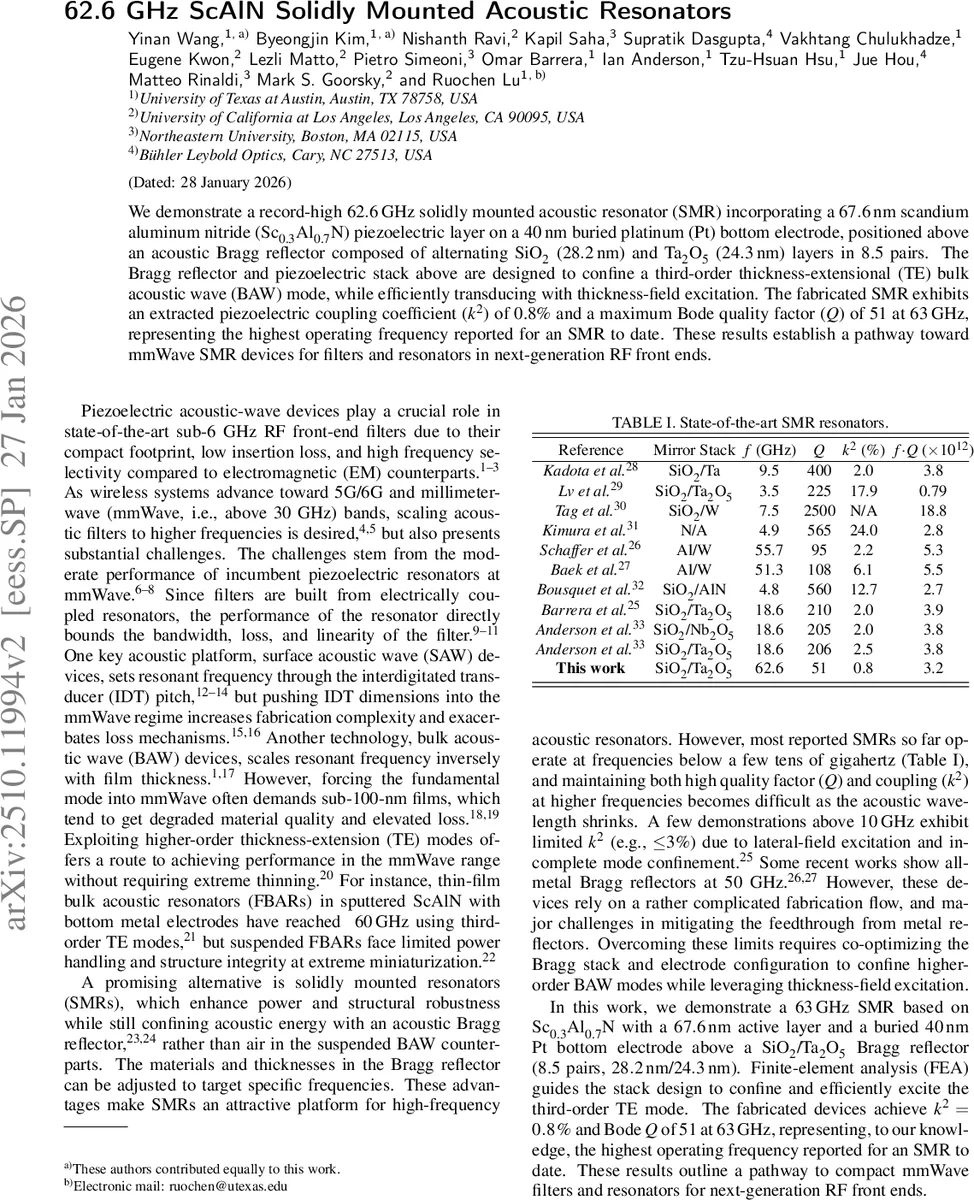
We demonstrate a record-high 62.6 GHz solidly mounted acoustic resonator (SMR) incorporating a 67.6 nm scandium aluminum nitride (Sc0.3Al0.7N) piezoelectric layer on a 40 nm buried platinum (Pt) bottom electrode, positioned above an acoustic Bragg reflector composed of alternating SiO2 (28.2 nm) and Ta2O5 (24.3 nm) layers in 8.5 pairs. The Bragg reflector and piezoelectric stack above are designed to confine a third-order thickness-extensional (TE) bulk acoustic wave (BAW) mode, while efficiently transducing with thickness-field excitation. The fabricated SMR exhibits an extracted piezoelectric coupling coefficient (k2) of 0.8% and a maximum Bode quality factor (Q) of 51 at 63 GHz, representing the highest operating frequency reported for an SMR to date. These results establish a pathway toward mmWave SMR devices for filters and resonators in next-generation RF front ends.
💡 Research Summary
The paper presents a record‑breaking 62.6 GHz solidly mounted acoustic resonator (SMR) that leverages a 67.6 nm Sc₀.₃Al₀.₇N piezoelectric layer and a 40 nm buried platinum (Pt) bottom electrode, stacked on an 8.5‑pair SiO₂/Ta₂O₅ acoustic Bragg reflector. The authors target the third‑order thickness‑extensional (TE₃) bulk acoustic wave (BAW) mode, which allows operation in the millimeter‑wave (mmWave) band without requiring sub‑100 nm film thicknesses that would otherwise degrade material quality.
Design considerations focus on acoustic confinement and efficient thickness‑field excitation. The Bragg reflector, composed of low‑impedance SiO₂ (28.2 nm) and high‑impedance Ta₂O₅ (24.3 nm), yields a fractional stop‑band width of roughly 60 %, providing robust isolation even with process variations. The ScAlN thickness and Pt electrode thicknesses are chosen so that the acoustic wavelength places a stress antinode at the Pt/ScAlN interfaces, maximizing the e₃₃‑mediated electromechanical coupling while minimizing leakage into the silicon substrate.
Finite‑element analysis (FEA) performed in COMSOL predicts a TE₃ resonance near 49 GHz with an effective coupling coefficient k² of 2.21 % (assuming a mechanical Q of 50). The simulated admittance shows clear first‑ and third‑order TE modes, confirming that the designed stack can support the desired high‑order mode with strong confinement.
Fabrication proceeds on high‑resistivity silicon. The Bragg stack is sputtered, followed by Pt bottom electrode deposition, ScAlN growth via magnetron sputtering, and subsequent patterning of the top Pt electrode. Cross‑sectional TEM, EDS line scans, and X‑ray diffraction verify layer thicknesses, composition periodicity, and the c‑axis texture of ScAlN (FWHM = 2.42°). A single‑mask mesa etch, PECVD SiO₂ back‑fill, and lift‑off steps define the resonator geometry, while a 300 nm Al pad reduces probe resistance.
Electrical characterization uses a ground‑signal‑ground (GSG) probe and a vector network analyzer calibrated to the probe plane. Measured admittance reveals a series resonance at 62.6 GHz and an anti‑resonance at 63.8 GHz, with the first‑order TE₁ mode appearing at 11.7 GHz. A modified Butterworth‑Van Dyke model extracts a coupling coefficient k² = 0.8 % for the TE₃ mode and a Bode quality factor Q = 50.9 at 63.75 GHz, giving an f·Q product of 3.13 × 10¹² Hz. The extracted series resistance (Rₛ = 52 Ω) and inductance (Lₛ = 0.06 nH) are identified as the primary contributors to the lower measured Q relative to simulation, reflecting the high resistivity of thin Pt electrodes at mmWave frequencies.
A secondary TE₂ mode at 40.4 GHz indicates asymmetry between the top and bottom Pt electrodes; post‑fabrication FEA matching suggests the top Pt thickness is ~28 nm rather than the intended 40 nm, causing a shift of the TE₃ resonance toward 60 GHz and a reduction in k². Despite this deviation, the wide Bragg stop‑band maintains strong acoustic confinement.
The work demonstrates that ScAlN‑based SMRs can achieve practical electromechanical coupling and quality factors well beyond 60 GHz, establishing a viable pathway toward mmWave filters and resonators for next‑generation RF front‑ends. Future directions include exploring metal‑based Bragg reflectors for improved thermal management, reducing electrode resistance through thicker or alternative metals (e.g., Au), and integrating multiple resonators in series to enhance bandwidth and linearity. These advances are poised to impact 5G/6G communications, automotive radar, and other applications demanding compact, low‑loss, high‑frequency acoustic components.
Comments & Academic Discussion
Loading comments...
Leave a Comment