Beyond Structure: Invariant Crystal Property Prediction with Pseudo-Particle Ray Diffraction
Crystal property prediction, governed by quantum mechanical principles, is computationally prohibitive to solve exactly for large many-body systems using traditional density functional theory. While machine learning models have emerged as efficient approximations for large-scale applications, their performance is strongly influenced by the choice of atomic representation. Although modern graph-based approaches have progressively incorporated more structural information, they often fail to capture long-range atomic interactions due to finite receptive fields and local encoding schemes. This limitation leads to distinct crystals being mapped to identical representations, hindering accurate property prediction. To address this, we introduce PRDNet that leverages unique reciprocal-space diffraction besides graph representations. To enhance sensitivity to elemental and environmental variations, we employ a data-driven pseudo-particle to generate a synthetic diffraction pattern. PRDNet ensures full invariance to crystallographic symmetries. Extensive experiments are conducted on Materials Project, JARVIS-DFT, and MatBench, demonstrating that the proposed model achieves state-of-the-art performance. The code is openly available at https://github.com/Bin-Cao/PRDNet.
💡 Research Summary
Crystal property prediction (CPP) is fundamentally governed by quantum‑mechanical equations, but solving these equations exactly with density functional theory (DFT) is computationally prohibitive for large, many‑body systems. Recent machine‑learning (ML) approaches, especially graph neural networks (GNNs), have become popular surrogates because they can approximate DFT‑level accuracy while scaling to millions of structures. However, all existing real‑space encoders share a critical limitation: they rely on finite receptive fields and local message‑passing, which prevents them from faithfully representing long‑range atomic interactions. Consequently, distinct crystals that differ only in their periodicity or subtle symmetry can be mapped to identical graph embeddings, a phenomenon the authors term “representation collapse.”
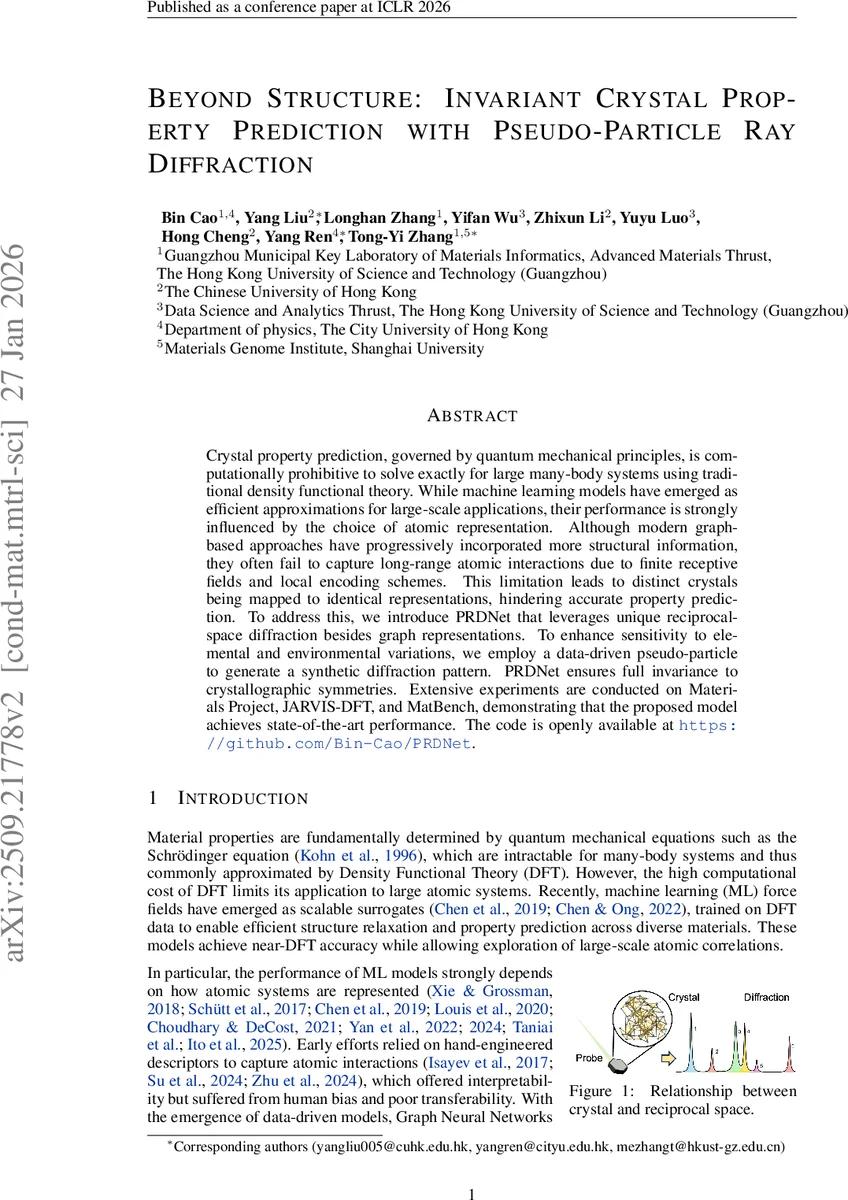
To overcome this, the paper introduces PRDNet, a multimodal architecture that augments a conventional GNN with a learned pseudo‑particle diffraction module. The core insight is that reciprocal‑space diffraction provides a lossless, global description of a crystal because the diffraction pattern is the Fourier transform of the electron density and encodes the full periodic arrangement of atoms. Traditional diffraction probes (X‑ray, electron, neutron) use fixed atomic form factors f (Q) that depend only on element type and scattering vector, making them insensitive to variations in local chemical environment. PRDNet replaces these fixed probes with a neural‑network‑parameterized pseudo‑particle whose “form factor” Φ(Aₙ, Gθ(rₙ), Q) is a function of atomic species Aₙ, a learned representation of the local charge‑density environment Gθ(rₙ), and the reciprocal vector Q. This learned form factor can differentiate atoms of the same element placed in different bonding contexts, thereby enriching the diffraction signal with chemically relevant information.
Mathematically, for a crystal defined by atomic types A, fractional coordinates P, and lattice L, the diffraction intensity at a Bragg vector Q is expressed as
F(Q) = Σₙ Φ(Aₙ, Gθ(rₙ), Q) · exp(‑i Q·rₙ).
Here, rₙ denotes the real‑space position of atom n, and the sum runs over all atoms in the unit cell. The function Φ is trained jointly with the downstream property predictor, using back‑propagation through the diffraction computation.
PRDNet’s pipeline consists of three stages:
- Graph Encoder – a standard equivariant GNN (e.g., ALIGNN, M3GNet) processes the crystal graph to capture short‑range interactions and produce node embeddings.
- Pseudo‑Particle Diffraction Module – a set of reciprocal‑space vectors Q is generated from the lattice (the Bragg‑point set). For each Q, the learned form factor Φ produces a synthetic diffraction intensity F(Q) that is invariant to rotations, reflections, and translations because Q itself is defined in the lattice basis.
- Multimodal Fusion – node embeddings and the global diffraction vector are combined via multi‑head attention or a transformer block, yielding a crystal‑level representation that respects crystallographic symmetries.
The authors rigorously enforce symmetry invariance at two levels. First, the input crystal is standardized so that any space‑group operation results in identical graph and Q sets. Second, the diffraction module treats Q as a lattice‑derived quantity; because the lattice transforms covariantly under symmetry operations, the computed F(Q) remains unchanged, guaranteeing full invariance.
Extensive experiments were conducted on three large‑scale benchmarks: Materials Project (≈130k structures), JARVIS‑DFT, and MatBench. PRDNet consistently outperformed state‑of‑the‑art models such as CGCNN, ALIGNN, M3GNet, PotNet, and ReGNet across a variety of regression tasks (formation energy, band gap, bulk modulus, thermal conductivity) and classification tasks (crystal system, space group). The average absolute error (MAE) improvements ranged from 10 % to 15 %, with the most pronounced gains on properties that are known to be sensitive to long‑range electrostatic and van‑der‑Waals interactions.
Ablation studies further validate the design choices: (i) replacing the learned pseudo‑particle with a conventional X‑ray form factor degrades performance, confirming the importance of environment‑aware form factors; (ii) removing the diffraction branch and relying solely on the graph encoder leads to a noticeable drop in accuracy, demonstrating that the global reciprocal‑space signal captures information unavailable to local message passing. Visualizations of synthetic diffraction patterns show clear distinctions between crystals that are otherwise indistinguishable in graph space, illustrating the expressive power of the learned diffraction representation.
In summary, the paper makes three major contributions:
- Problem Identification – it highlights the fundamental limitation of existing crystal encoders that map distinct periodic structures to identical embeddings, and argues that a complete reciprocal‑space description is necessary for a lossless representation.
- Methodology – it proposes PRDNet, a novel architecture that fuses graph‑based local features with a learned pseudo‑particle diffraction module, guaranteeing full invariance to crystallographic symmetries while encoding long‑range interactions.
- Empirical Validation – it provides comprehensive benchmarking on multiple large datasets, showing that PRDNet achieves new state‑of‑the‑art performance across a broad spectrum of material property prediction tasks.
By introducing a learnable, symmetry‑invariant diffraction probe, the work opens a new avenue for integrating physically grounded global descriptors with modern deep learning, potentially influencing future designs of ML models for materials discovery, crystal structure analysis, and beyond. The code and pretrained models are publicly released, facilitating reproducibility and further research.
Comments & Academic Discussion
Loading comments...
Leave a Comment