Taming the dark photon production via a non-minimal coupling to gravity
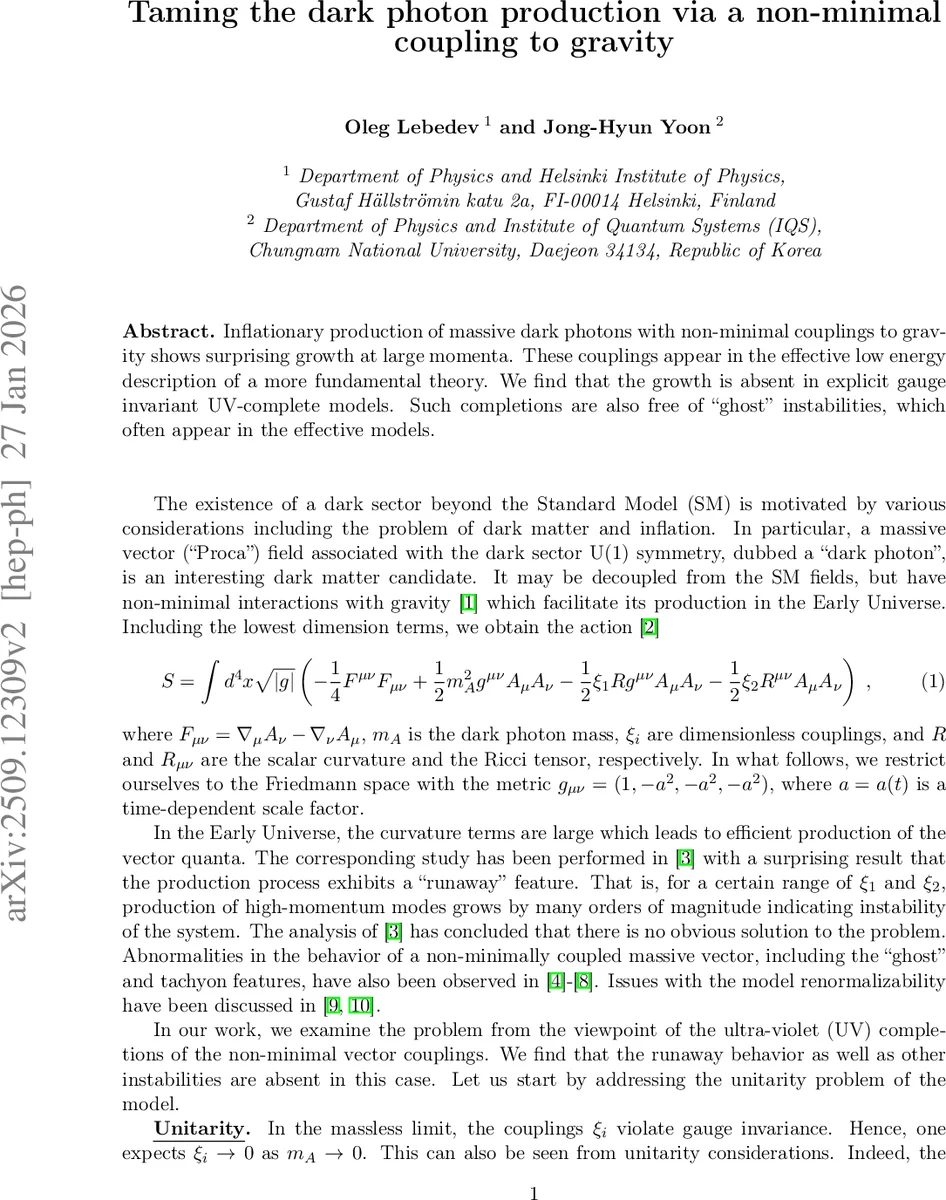
Inflationary production of massive dark photons with non-minimal couplings to gravity shows surprising growth at large momenta. These couplings appear in the effective low energy description of a more fundamental theory. We find that the growth is absent in explicit gauge invariant UV-complete models. Such completions are also free of “ghost” instabilities, which often appear in the effective models.
💡 Research Summary
The paper investigates the production of massive dark photons (Proca fields) during inflation when the vector field is coupled non‑minimally to gravity through the terms ξ₁ R A_μA^μ and ξ₂ R_{μν}A^μA^ν. In a naïve effective field theory (EFT) treatment these couplings lead to two severe problems: (i) a “runaway” amplification of high‑momentum modes, and (ii) ghost or tachyonic instabilities when the effective kinetic or mass terms become negative. The authors show that these pathologies are artifacts of treating ξ_i as constant parameters up to arbitrarily high energies.
First, they analyze unitarity. Scattering of two vectors into gravitons (AA→GG) grows as |𝒜|∝|ξ|E⁴/(m_A²M_Pl²). Perturbative unitarity therefore breaks down at a momentum cutoff
p_max ≲ √(m_A M_Pl) |ξ|^{-1/4},
which collapses to zero in the massless limit, indicating that the EFT must be UV‑completed.
The paper then presents two explicit UV‑complete constructions in which the non‑minimal couplings arise as low‑energy form factors after integrating out heavy fields.
-
Scalar (Higgs) Completion – A complex scalar Φ charged under the dark U(1) carries a non‑minimal coupling ξ R|Φ|². After Φ acquires a VEV v, the dark photon gets mass m_A = g v and a heavy radial scalar ϕ with mass m_s remains. Integrating out ϕ yields an effective ξ₁ = ξ m_A²/m_s². Consistency of the EFT requires p ≪ p_max ∼ s ξ ξ₁ m_A and |ξ R|/2 ≪ m_s². During inflation R≈−12H², which forces |ξ₁| ≪ m_A²/(6H²). Hence ξ₁ must be tiny, and at energies above m_s it scales as 1/p², removing the runaway.
-
Tensor (Kaluza‑Klein Graviton) Completion – In a 5‑dimensional setup with bulk gravity and brane‑localized matter, the KK tower of massive gravitons h_{μν}^{(n)} couples to the scalar kinetic term. Integrating out the lightest KK mode (mass m₁) generates ξ₂ ≈ 2ε m_A²/m₁² (and a comparable ξ₁), where ε≪1 parametrises a localized curvature term. The EFT breaks down at p ∼ m_A/|ξ_i|, and for p≫m₁ the couplings fall as 1/p².
Both constructions share the generic momentum dependence
ξ_i(p) = m_A²/(p² − M²) + O(H²),
where M is the mass of the heavy state that has been integrated out. This form guarantees that ξ_i → 0 at high energies, preserving gauge invariance in the massless limit and satisfying unitarity. To keep ξ_i approximately constant up to the Hubble scale H, one must have M≫H, which in turn forces the magnitude of the couplings to satisfy |ξ_i| ≪ m_A²/H². Consequently, the kinetic and mass corrections m_t² and m_x² remain positive, eliminating ghosts and tachyons.
The authors perform a numerical study of particle production using the full longitudinal mode action, reproducing the “runaway” spike reported in earlier work when the couplings are taken as constants. However, the spike appears only beyond the EFT cutoff (the shaded region in Fig. 2). In the UV‑complete models the form‑factor suppression kicks in before this region, and the resulting spectrum is comparable to that of a minimally coupled vector.
In summary, the paper demonstrates that non‑minimal gravitational couplings of dark photons are not fundamental parameters but emergent, energy‑dependent form factors arising from integrating out heavy scalars or spin‑2 fields. When these UV completions are taken into account, the apparent runaway production, ghost, and tachyonic instabilities disappear, and the theory remains unitary and gauge‑invariant up to the Planck scale. This work clarifies the proper domain of validity of effective non‑minimal couplings and provides concrete UV‑complete frameworks for studying dark photon cosmology.
Comments & Academic Discussion
Loading comments...
Leave a Comment