Genus stabilization for the homology of moduli spaces of orbit-framed curves with symmetries-I
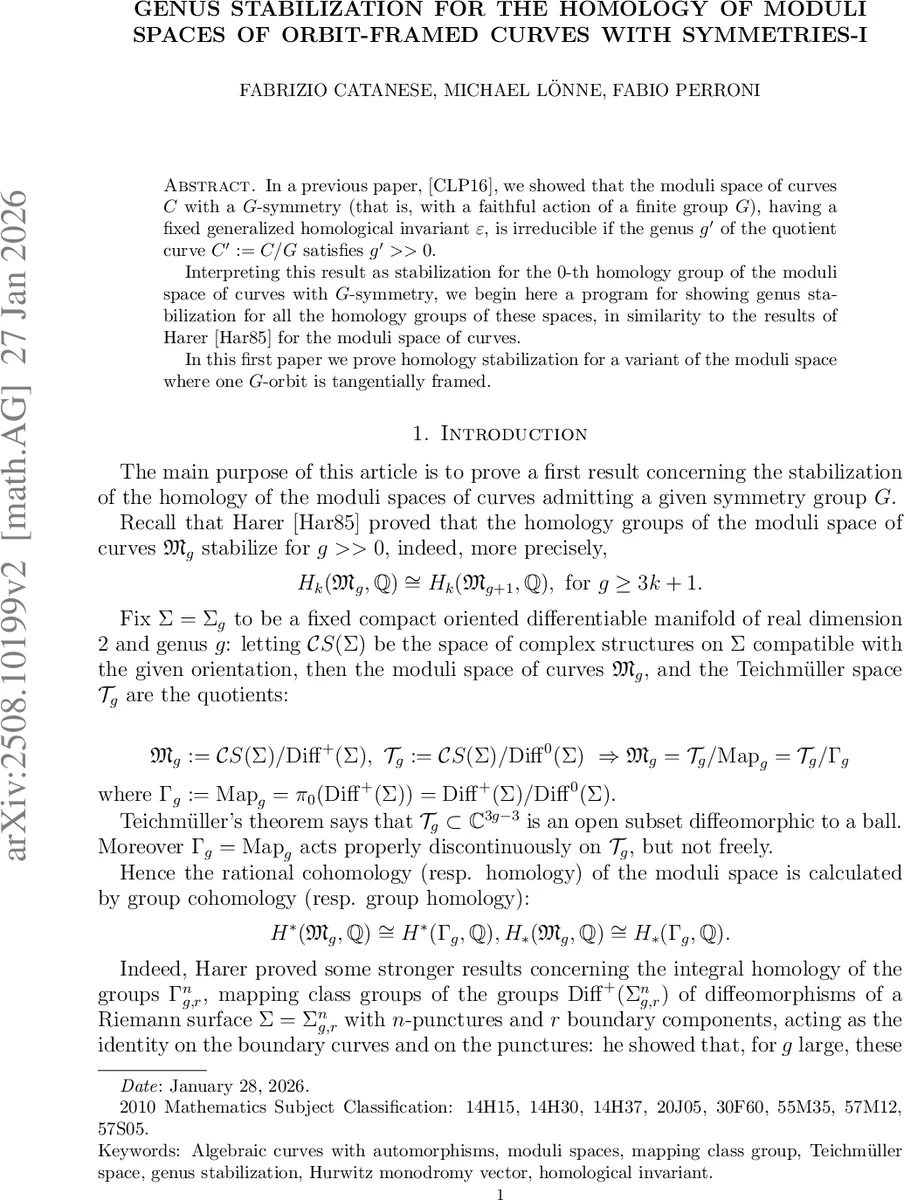
In a previous paper, arXiv:1301.4409, we showed that the moduli space of curves C with a G-symmetry (that is, with a faithful action of a finite group G), having a fixed generalized homological invariant, is irreducible if the genus g’ of the quotient curve C’ : = C/G satisfies g’»0. Interpreting this result as stabilization for the 0-th homology group of the moduli space of curves with G-symmetry, we begin here a program for showing genus stabilization for all the homology groups of these spaces, in similarity to the results of Harer for the moduli space of curves. In this first paper we prove homology stabilization for a variant of the moduli space where one G-orbit is tangentially framed.
💡 Research Summary
The paper initiates a program to extend Harer’s homology stability for the moduli space of curves to the setting where curves carry a faithful action of a finite group G. In a previous work (arXiv:1301.4409) the authors proved that the 0‑th homology (i.e. the number of connected components) of the G‑symmetric moduli space stabilizes when the genus g′ of the quotient curve C′=C/G is sufficiently large. This paper tackles the next step: proving that all higher homology groups also stabilize under a suitable “genus stabilization” operation, at least for a variant of the moduli space in which one G‑orbit is equipped with a tangential framing.
The authors begin by recalling the classical description of the moduli space M_g of genus‑g curves as the quotient of the space of complex structures by the orientation‑preserving diffeomorphism group, and the associated mapping class group Γ_g. They then focus on the subvarieties consisting of curves admitting a G‑symmetry. Such curves are classified by the topological type of the G‑action, which is encoded by a homomorphism ρ: G→Out(π_1(Σ_g)). Fixing ρ determines a fixed locus T_{g,ρ} in Teichmüller space, which is a ball, and the corresponding component M_{g,ρ} of the moduli space is a quotient of this ball by the normalizer of ρ(G) in Γ_g.
A key observation is that the data of a G‑cover C→C′ is equivalent, via the Riemann existence theorem, to a Hurwitz vector v=(a_1,b_1,…,a_{g′},b_{g′},c_1,…,c_n)∈G^{2g′+n} satisfying the usual product‑one relation and generating G. The numbers g′ (genus of the quotient), n (number of branch points), and the branching multiplicities m_i are constant on each irreducible component. The authors define a “genus stabilization” operation by attaching a trivial handle to the quotient surface Σ_{g′} and extending the monodromy trivially on the new generators (i.e. mapping the new a_{g′+1},b_{g′+1} to the identity). This operation increases g′ by one while preserving the Hurwitz vector up to insertion of a pair (1,1).
To translate this geometric stabilization into algebraic statements about homology, the paper introduces a non‑commutative graded ring R of connected components: R_{g′}=ℤ⟨G^{2g′}/Γ_{g′,1}⟩, where Γ_{g′,1} is the mapping class group of a surface of genus g′ with one boundary component (the boundary encodes the base point for the fundamental group). The ring R encodes how Hurwitz vectors for different genera are related under stabilization. The authors develop a theory of left R‑modules, extending the Koszul‑type complexes of Ellenberg‑Venkatesh‑Westerland to integer coefficients. The prototypical R‑module is M(q)=⊕{g′≥0} H_q(Γ{g′,1},ℤ⟨G^{2g′}⟩), which records the q‑th homology of the mapping class groups with coefficients in the free ℤ‑module generated by Hurwitz vectors.
The central algebraic operator is U: M(q){g′}→M(q){g′+1}, defined by inserting the pair (1,1) into a Hurwitz vector; geometrically this corresponds to the genus‑stabilization handle attachment. The main technical result (Theorem 1.4) asserts that there exist constants ˜A(R) and A(R) such that U is an isomorphism for all g′≥(8˜A(R)+deg U)·q+˜A(R)+6A(R)+2. In other words, after a linear bound in q, the homology groups become independent of the genus. This is precisely the desired homology stability.
The proof relies on two sophisticated tools. First, the authors adapt the “tethered chain complex” introduced by Hatcher and Vogtmann. A tethered chain is a pair of intersecting simple closed curves together with an arc (the tether) joining one side of the second curve to a fixed interval on the boundary. The simplicial complex TCh_{g′,1} of isotopy classes of disjoint tethered chains is shown to be (g′−2)-connected. This high connectivity yields vanishing of the E^1‑page of a spectral sequence beyond a range that grows linearly with g′.
Second, they construct a spectral sequence whose E^1‑term involves the homology of the mapping class groups with coefficients in the R‑module generated by Hurwitz vectors, and whose differentials are expressed in terms of the tethered chain complex. By analyzing the filtration induced by the degree in the graded ring R, they bound the degrees of kernels and cokernels of U, ultimately proving the isomorphism range stated above.
Having established the algebraic stability, the authors translate it back to geometry. They define M_g(G)^* as the moduli space of curves with a faithful G‑action together with a tangential framing of a single G‑orbit O (i.e., a choice of a non‑zero tangent vector at each point of O, permuted simply transitively by G). For this space, Theorem 1.3 follows directly from the algebraic stability: the rational homology H_i(M_g(G)^*,ℚ) is independent of g once g≫0. The paper treats in detail the case where the G‑action is free away from O (so n=0), and indicates how the argument extends to the presence of branch points (n>0) and to multiple framed orbits (r>1) in Section 5, though the notation becomes heavier.
The authors conclude by noting that their result simultaneously generalizes Harer’s stability for M_g and the Dunfield‑Thurston stabilization for unramified G‑covers. Working with integer coefficients opens the possibility of detecting torsion phenomena in the homology of these moduli spaces. They also announce a forthcoming paper in which they will prove stability for the unramified G‑cover moduli space M_g(G)^{unr} and, ultimately, for the full G‑symmetric moduli space M_g(G).
In summary, the paper provides a robust framework—combining Hurwitz‑vector combinatorics, a non‑commutative graded ring of connected components, and high‑connectivity complexes of tethered chains—to establish genus‑stabilization for the rational homology of orbit‑framed G‑symmetric curve moduli spaces, laying the groundwork for a full homological stability theory in this equivariant setting.
Comments & Academic Discussion
Loading comments...
Leave a Comment