Gradient-Direction-Aware Density Control for 3D Gaussian Splatting
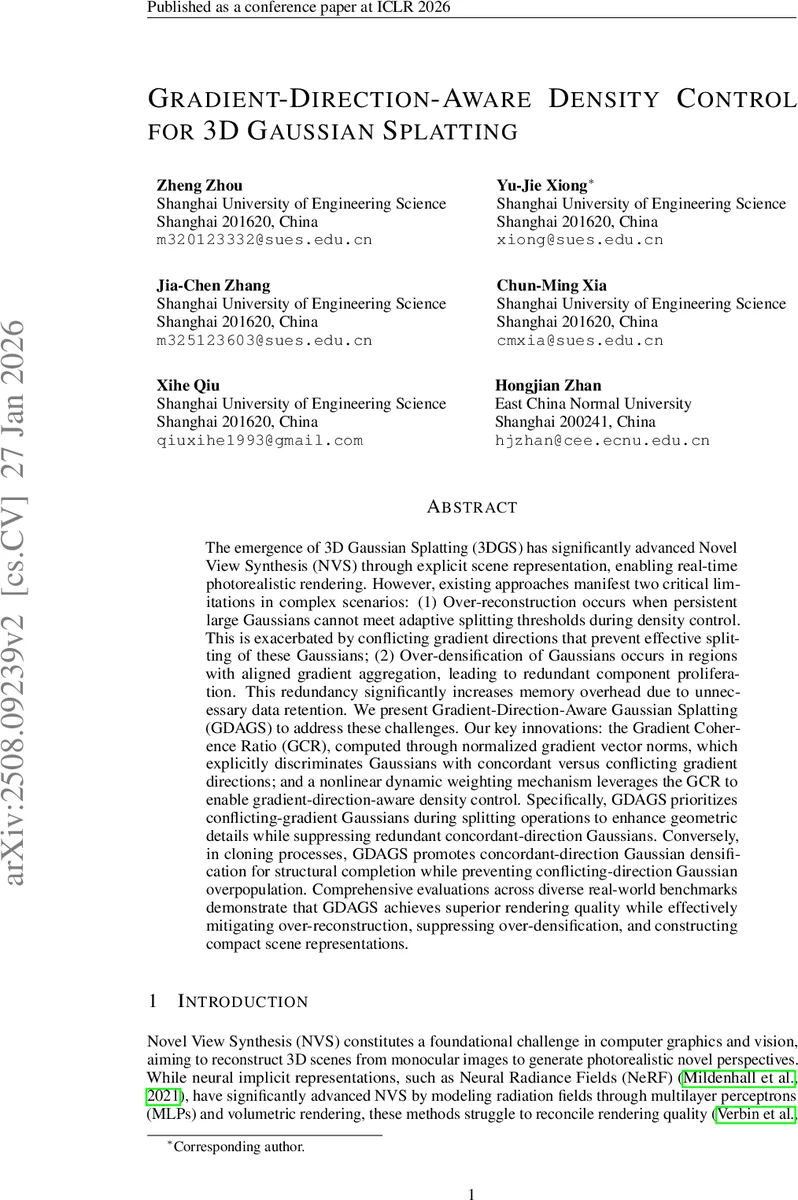
The emergence of 3D Gaussian Splatting (3DGS) has significantly advanced Novel View Synthesis (NVS) through explicit scene representation, enabling real-time photorealistic rendering. However, existing approaches manifest two critical limitations in complex scenarios: (1) Over-reconstruction occurs when persistent large Gaussians cannot meet adaptive splitting thresholds during density control. This is exacerbated by conflicting gradient directions that prevent effective splitting of these Gaussians; (2) Over-densification of Gaussians occurs in regions with aligned gradient aggregation, leading to redundant component proliferation. This redundancy significantly increases memory overhead due to unnecessary data retention. We present Gradient-Direction-Aware Gaussian Splatting (GDAGS) to address these challenges. Our key innovations: the Gradient Coherence Ratio (GCR), computed through normalized gradient vector norms, which explicitly discriminates Gaussians with concordant versus conflicting gradient directions; and a nonlinear dynamic weighting mechanism leverages the GCR to enable gradient-direction-aware density control. Specifically, GDAGS prioritizes conflicting-gradient Gaussians during splitting operations to enhance geometric details while suppressing redundant concordant-direction Gaussians. Conversely, in cloning processes, GDAGS promotes concordant-direction Gaussian densification for structural completion while preventing conflicting-direction Gaussian overpopulation. Comprehensive evaluations across diverse real-world benchmarks demonstrate that GDAGS achieves superior rendering quality while effectively mitigating over-reconstruction, suppressing over-densification, and constructing compact scene representations.
💡 Research Summary
The paper tackles two persistent problems in 3D Gaussian Splatting (3DGS) – over‑reconstruction (large Gaussians that fail to split, causing blurry regions) and over‑densification (excessive small Gaussians that waste memory and slow rendering). Both issues stem from the original density‑control rule, which relies solely on the magnitude of view‑space positional gradients. When sub‑gradients from different pixels point in opposite directions, their magnitudes cancel, lowering the norm and preventing a large Gaussian from being split. Conversely, when sub‑gradients are aligned, the norm inflates, causing many unnecessary splits or clones.
The authors introduce Gradient‑Direction‑Aware Gaussian Splatting (GDAGS). The core idea is to measure the directional consistency of a Gaussian’s sub‑gradients using the Gradient Coherence Ratio (GCR, denoted C_i). For each Gaussian i, C_i is defined as
C_i = ‖∑_pixel ∇_v,i,pixel‖² / (∑_pixel ‖∇_v,i,pixel‖² + ε)
where ∇_v,i,pixel is the 2‑D view‑space gradient contributed by pixel “pixel” across all training views. By construction, C_i ∈
Comments & Academic Discussion
Loading comments...
Leave a Comment