GraphRAG-R1: Graph Retrieval-Augmented Generation with Process-Constrained Reinforcement Learning
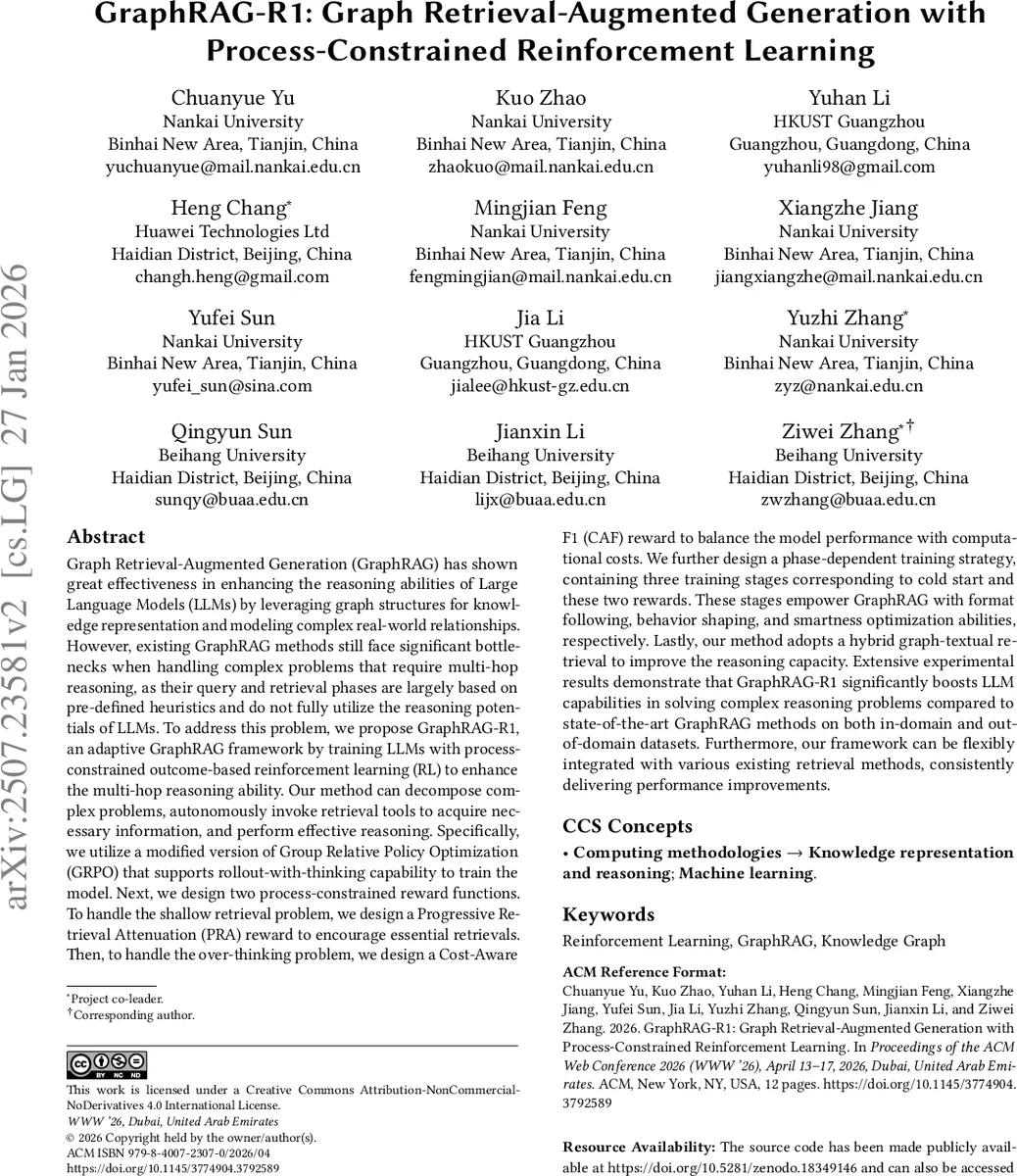
Graph Retrieval-Augmented Generation (GraphRAG) has shown great effectiveness in enhancing the reasoning abilities of LLMs by leveraging graph structures for knowledge representation and modeling complex real-world relationships. However, existing GraphRAG methods still face significant bottlenecks when handling complex problems that require multi-hop reasoning, as their query and retrieval phases are largely based on pre-defined heuristics and do not fully utilize the reasoning potentials of LLMs. To address this problem, we propose GraphRAG-R1, an adaptive GraphRAG framework by training LLMs with process-constrained outcome-based reinforcement learning (RL) to enhance the multi-hop reasoning ability. Our method can decompose complex problems, autonomously invoke retrieval tools to acquire necessary information, and perform effective reasoning. Specifically, we utilize a modified version of Group Relative Policy Optimization (GRPO) that supports rollout-with-thinking capability. Next, we design two process-constrained reward functions. To handle the shallow retrieval problem, we design a Progressive Retrieval Attenuation (PRA) reward to encourage essential retrievals. Then, to handle the over-thinking problem, we design Cost-Aware F1 (CAF) reward to balance the model performance with computational costs. We further design a phase-dependent training strategy, containing three training stages corresponding to cold start and these two rewards. Lastly, our method adopts a hybrid graph-textual retrieval to improve the reasoning capacity. Extensive experimental results demonstrate that GraphRAG-R1 boosts LLM capabilities in solving complex reasoning problems compared to state-of-the-art GraphRAG methods on both in-domain and out-of-domain datasets. Furthermore, our framework can be flexibly integrated with various existing retrieval methods, consistently delivering performance improvements.
💡 Research Summary
GraphRAG‑R1 introduces a novel reinforcement‑learning (RL) framework for Graph Retrieval‑Augmented Generation (GraphRAG) that specifically targets the shortcomings of existing systems when dealing with complex, multi‑hop reasoning tasks. Traditional GraphRAG pipelines rely heavily on static heuristics for query processing and graph traversal, which leads to two major failure modes: shallow retrieval (insufficient knowledge acquisition) and over‑thinking (excessive computation without performance gains).
To overcome these issues, the authors propose a three‑component solution: (1) a modified Group Relative Policy Optimization (GRPO) algorithm that incorporates a “rollout‑with‑thinking” mechanism, allowing the language model to interleave generation steps with dynamic calls to an external retrieval tool; (2) two process‑constrained reward functions—Progressive Retrieval Attenuation (PRA) and Cost‑Aware F1 (CAF)—that shape the model’s behavior during training; and (3) a phase‑dependent training schedule that isolates cold‑start, retrieval‑optimization, and cost‑optimization phases.
The rollout‑with‑thinking GRPO treats each generation step as a decision point: the policy πθ either emits a token or issues a retrieval action. Retrieved graph fragments and textual passages are immediately fed back into the model’s context, enabling the policy to learn a closed‑loop “generate → retrieve → generate” loop. This contrasts with prior GraphRAG methods that perform retrieval as a pre‑processing stage, disconnected from the generation dynamics.
PRA is designed to encourage necessary retrievals early in the reasoning chain while gradually attenuating the retrieval reward as the depth of reasoning increases. This dynamic scaling prevents the model from stopping after a single shallow query and simultaneously discourages redundant calls later in the process. CAF, on the other hand, combines the final answer’s F1 score with a penalty proportional to computational resources (e.g., number of retrieval calls, token usage). By rewarding high‑quality answers that are obtained efficiently, CAF mitigates over‑thinking and promotes economical reasoning strategies.
Training proceeds in three stages. The cold‑start stage focuses on learning the output format and basic answer structure, stabilizing the policy before any reward shaping. In the second stage, PRA is activated, guiding the model to discover optimal retrieval frequencies for diverse problem types. The final stage introduces CAF, fine‑tuning the policy to balance accuracy against cost. Empirically, this staged approach yields smoother convergence and avoids the reward‑hacking phenomena often observed in single‑objective RL for language models.
Beyond the RL core, GraphRAG‑R1 employs a hybrid graph‑textual retrieval module. Graph structures capture explicit entity relationships (causality, hierarchy, dependencies), while raw textual snippets preserve nuanced semantic context. By fusing both modalities, the system can retrieve concise relational subgraphs and richer narrative evidence, addressing the information loss typical of pure text‑only or pure graph‑only retrieval.
Extensive experiments were conducted on both in‑domain benchmarks (science and history QA) and out‑of‑domain datasets (general knowledge and complex logical reasoning). GraphRAG‑R1 consistently outperformed strong baselines—including the original GraphRAG, ToG, HippoRAG, KGP, and LightRAG—by 7–12 percentage points in F1. Notably, the model reduced average retrieval calls by roughly 30 % and overall inference latency by about 15 % thanks to the CAF reward. Ablation studies confirmed that PRA primarily improves recall of essential facts in early reasoning steps, while CAF curtails unnecessary computation without sacrificing answer quality.
The authors also release code, model weights, and a Zenodo dataset, demonstrating that GraphRAG‑R1 can be seamlessly integrated with various existing retrieval back‑ends (BM25, dense vector search, GNN‑based subgraph extraction). This flexibility suggests broad applicability across domains such as biomedical literature mining, legal reasoning, and recommendation systems.
In summary, GraphRAG‑R1 advances the state of the art in knowledge‑augmented language generation by marrying reinforcement learning with graph‑structured retrieval. Its process‑constrained reward design and phase‑wise training enable LLMs to autonomously decompose complex queries, invoke retrieval tools judiciously, and produce accurate answers efficiently. The work opens avenues for further research on reward engineering, multi‑modal retrieval fusion, and real‑time interactive reasoning systems.
Comments & Academic Discussion
Loading comments...
Leave a Comment