Orca: Browsing at Scale Through User-Driven and AI-Facilitated Orchestration Across Malleable Webpages
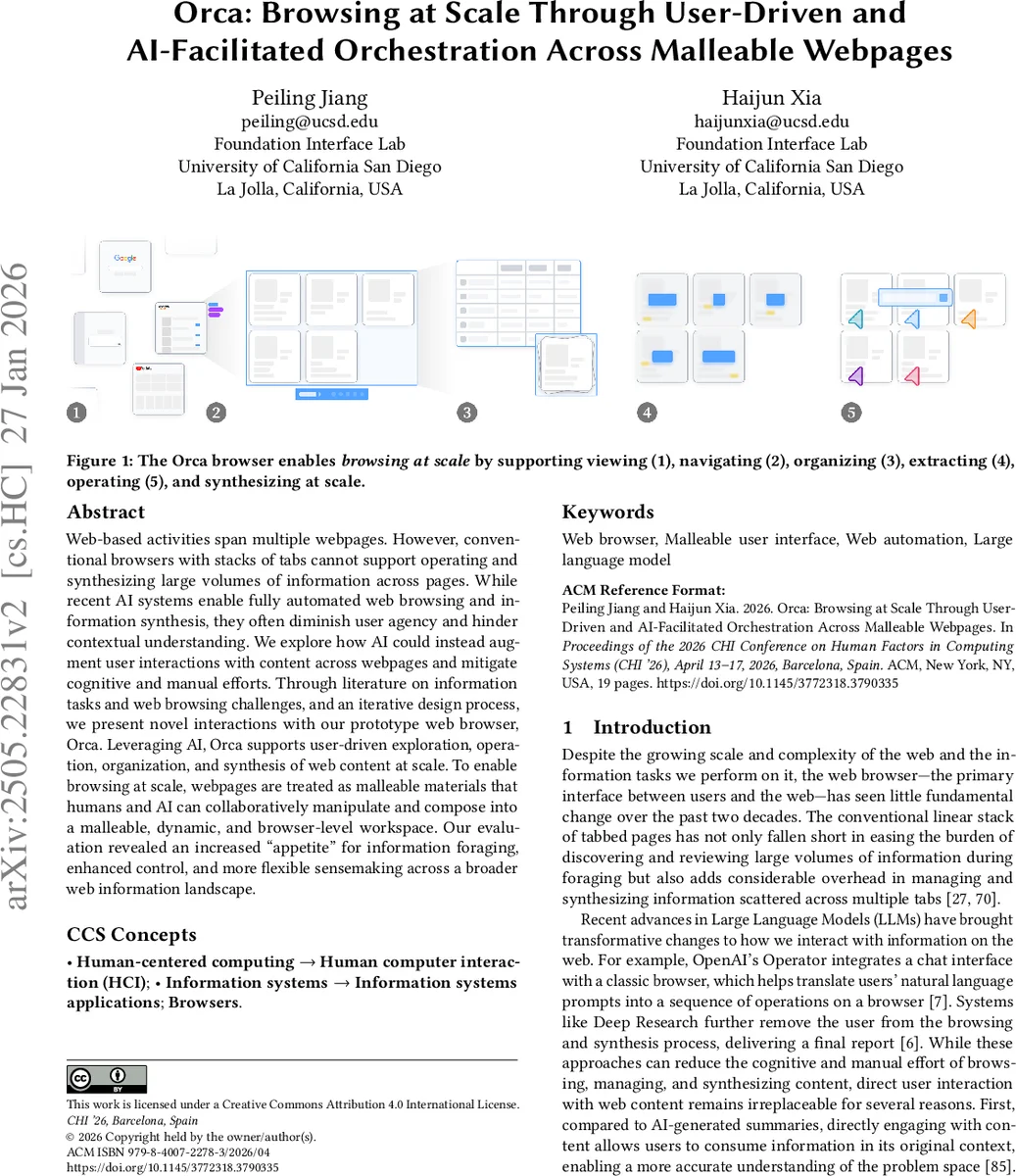
Web-based activities span multiple webpages. However, conventional browsers with stacks of tabs cannot support operating and synthesizing large volumes of information across pages. While recent AI systems enable fully automated web browsing and information synthesis, they often diminish user agency and hinder contextual understanding. We explore how AI could instead augment user interactions with content across webpages and mitigate cognitive and manual efforts. Through literature on information tasks and web browsing challenges, and an iterative design process, we present novel interactions with our prototype web browser, Orca. Leveraging AI, Orca supports user-driven exploration, operation, organization, and synthesis of web content at scale. To enable browsing at scale, webpages are treated as malleable materials that humans and AI can collaboratively manipulate and compose into a malleable, dynamic, and browser-level workspace. Our evaluation revealed an increased “appetite” for information foraging, enhanced control, and more flexible sensemaking across a broader web information landscape.
💡 Research Summary
Orca tackles the longstanding limitation of conventional tab‑based browsers, which force users to view and interact with web content one page at a time, leading to high cognitive load, context loss, and inefficient information foraging. The authors introduce a novel “malleable workspace” concept: web pages are treated as flexible materials that can be placed, resized, grouped, and transformed on a canvas‑style interface. Within this workspace, users retain direct engagement with original content while AI agents, powered by large language models (LLMs), assist with repetitive actions, parallel searches, and dynamic summarization.
The system architecture combines a React/Fabric.js canvas with LLM APIs to provide three core capabilities. First, natural‑language‑driven automation agents translate user commands such as “extract price information from these pages” into concurrent click, scroll, and data‑extraction operations across multiple tabs. Second, on‑demand summarization uses adaptive prompting to generate concise digests of selected pages; users can edit or request new summaries, forming a human‑AI collaborative loop that preserves agency and trust. Third, task‑centric structures (grids, lists, cards) allow users to save and later revisit organized collections of pages together with their associated metadata and latest summaries, dramatically reducing the effort required for revisiting and re‑collecting information.
To ground their design, the authors extend Ellis’s information‑seeking model into seven stages—starting, scouting, filtering, revisiting, collecting, synthesizing, and transacting—identifying specific cognitive costs at each stage and proposing AI‑enabled mitigations. For example, during scouting the system can launch parallel agents that crawl linked resources and present visual snapshots; during filtering the AI ranks relevance to help users prune irrelevant material; during synthesis the LLM integrates insights across pages into a coherent narrative or diagram.
A user study with eight participants compared Orca to a traditional browser in realistic information‑gathering tasks. Quantitative results showed a 32 % reduction in total exploration time and a 45 % decrease in page‑switching actions. Qualitative feedback highlighted increased “appetite” for foraging, a sense of enhanced control, and appreciation for the ability to delegate low‑level operations while still overseeing source selection and verification. Participants especially valued the parallel view for maintaining situational awareness and the flexible organization tools for adapting to evolving goals.
In sum, Orca demonstrates that a canvas‑based, AI‑augmented browser can support large‑scale, user‑driven web exploration without sacrificing direct content interaction. By treating webpages as manipulable objects within a shared workspace and providing on‑demand, human‑in‑the‑loop AI assistance, Orca reduces manual and cognitive burdens while preserving agency, serendipity, and deep sense‑making. The work offers a concrete blueprint for future research at the intersection of human‑computer interaction, web automation, and large‑language‑model integration, suggesting broad applicability to domains such as academic research, market intelligence, and collaborative knowledge work.
Comments & Academic Discussion
Loading comments...
Leave a Comment