Universal Bound States with Bose-Fermi Duality in Microwave-Shielded Polar Molecules
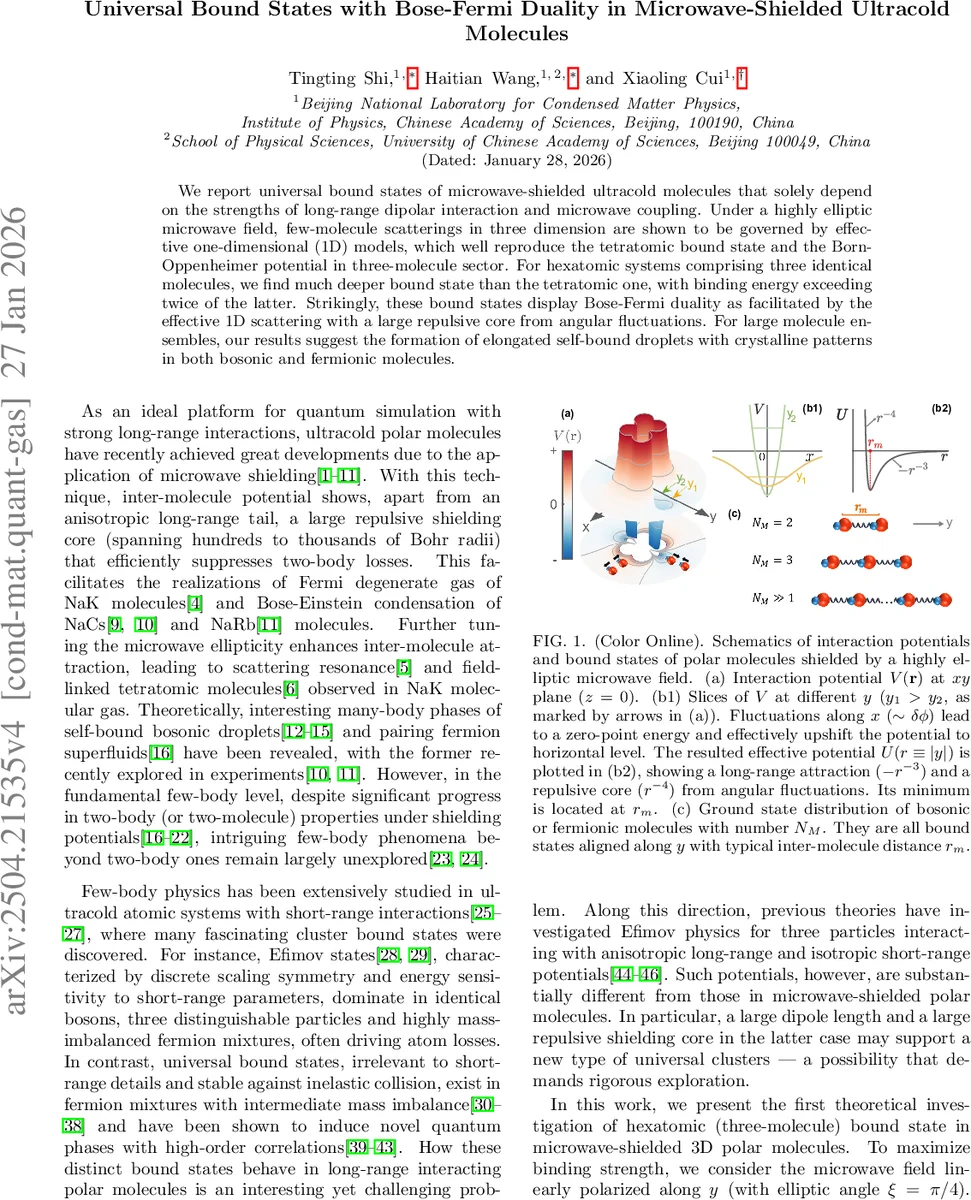
We report universal bound states of microwave-shielded ultracold molecules that solely depend on the strengths of long-range dipolar interaction and microwave coupling. Under a highly elliptic microwave field, few-molecule scatterings in three dimension are shown to be governed by effective one-dimensional (1D) models, which well reproduce the tetratomic bound state and the Born-Oppenheimer potential in three-molecule sector. For hexatomic systems comprising three identical molecules, we find much deeper bound state than the tetratomic one, with binding energy exceeding twice of the latter. Strikingly, these bound states display Bose-Fermi duality as facilitated by the effective 1D scattering with a large repulsive core from angular fluctuations. For large molecule ensembles, our results suggest the formation of elongated self-bound droplets with crystalline patterns in both bosonic and fermionic molecules.
💡 Research Summary
In this paper the authors present a comprehensive theoretical study of universal few‑body bound states that arise in ultracold polar molecules when a highly elliptical microwave field is used to create a shielding potential. The key idea is that, under a microwave field linearly polarized along the y‑axis with ellipticity ξ = π/4, the intermolecular interaction becomes extremely anisotropic: it is strongly attractive (∝ −4C₃/r³) along the field direction and strongly repulsive (∝ 2C₃/r³) in the transverse directions, while a microwave‑induced C₆/r⁶ term provides additional short‑range structure. By expanding the angular deviations (δθ, δϕ) around the y‑axis to quadratic order, the authors show that the two‑molecule problem can be mapped onto an effective one‑dimensional (1D) Hamiltonian. The zero‑point energy of the angular harmonic oscillators generates a repulsive core that scales as r⁻⁴, which prevents the molecules from approaching each other and forces the 1D wave function to vanish at the origin. The resulting 1D potential,
U₂(r) = −4C₃/r³ + (ℏ²/2m)
Comments & Academic Discussion
Loading comments...
Leave a Comment