Fast and direct preparation of a genuine lattice BEC via the quantum Mpemba effect
We demonstrate that dissipative state preparation protocols in many-body systems can be substantially accelerated via the quantum Mpemba effect. Our approach exploits weak symmetries to analytically identify a class of simple, experimentally-realizable states that converge exponentially faster to the steady state than typical random initializations. In particular, we study the preparation of a lattice Bose-Einstein condensate (BEC), where the depletion can be controlled via the dissipation strength. We also show how to tune the momentum of the created high-fidelity BEC by combining superfluid immersion with lattice shaking. Our theoretical predictions are confirmed by numerical simulations of the dissipative dynamics. This protocol paves the way to unlock the enormous potential of the dissipative preparation of highly entangled states in analog quantum simulators.
💡 Research Summary
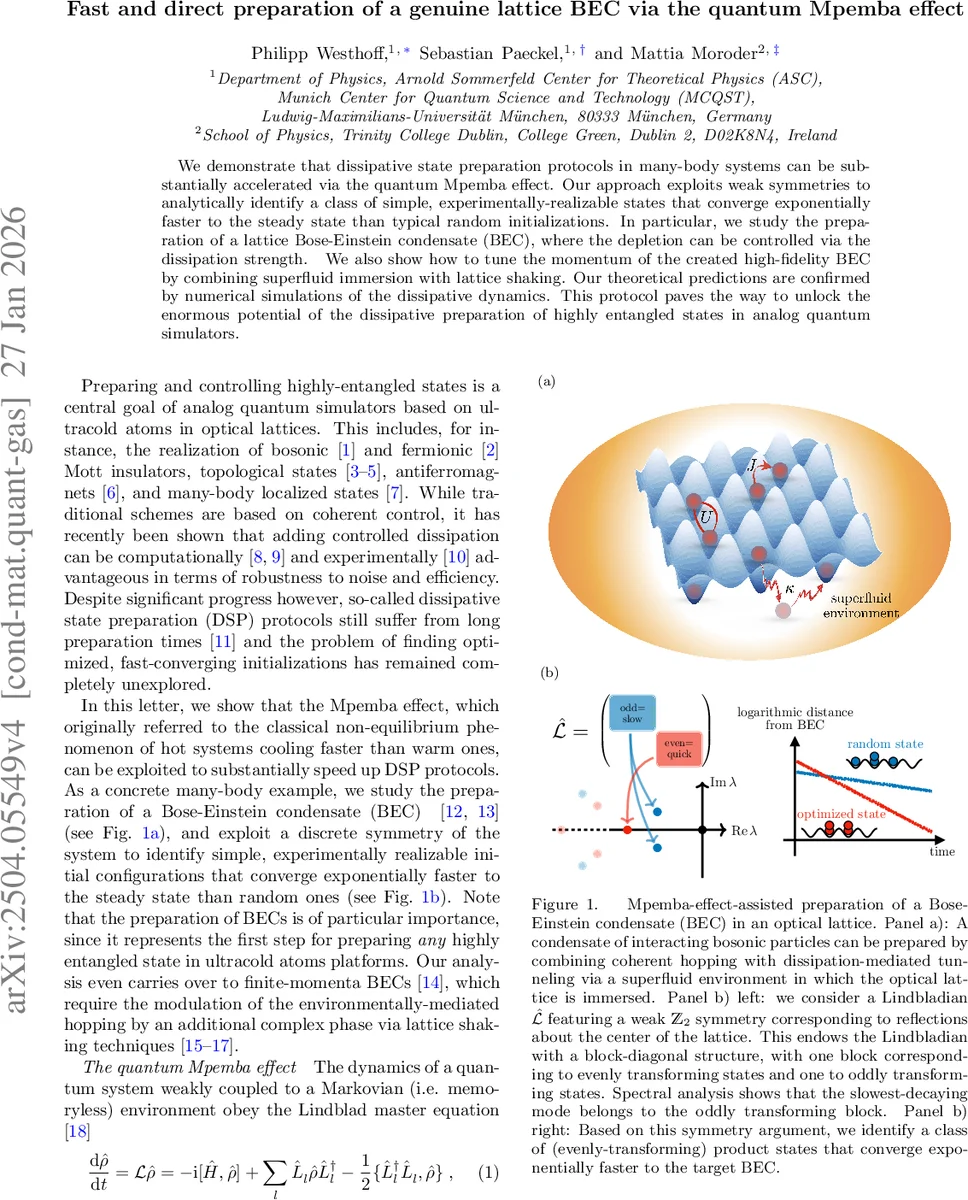
In this work the authors introduce a dissipative state‑preparation protocol that exploits the quantum Mpemba effect to dramatically accelerate the formation of a lattice Bose‑Einstein condensate (BEC). Starting from the Lindblad master equation for a many‑body system weakly coupled to a Markovian bath, they note that the spectrum of the Liouvillian L consists of eigenvalues λ₁=0 (steady state) and a hierarchy of negative‑real‑part eigenvalues λ₂, λ₃, … . A generic random initial state relaxes with the slowest non‑zero mode λ₂, i.e. ∝exp(Re λ₂ t). However, if the initial state has zero overlap with the eigenmode associated with λ₂, the relaxation is governed by the next eigenvalue λ₃, leading to a faster exponential decay. When the distance to the steady state of such a “fast” state is initially larger than that of a random state, the two distance curves cross in time – the hallmark of the Mpemba effect.
The concrete model considered is a one‑dimensional Bose‑Hubbard lattice with hopping amplitude J, on‑site interaction U, and a set of engineered jump operators
\
Comments & Academic Discussion
Loading comments...
Leave a Comment