Discrete series representations of quaternionic ${ m GL}_n(D)$ with symplectic periods
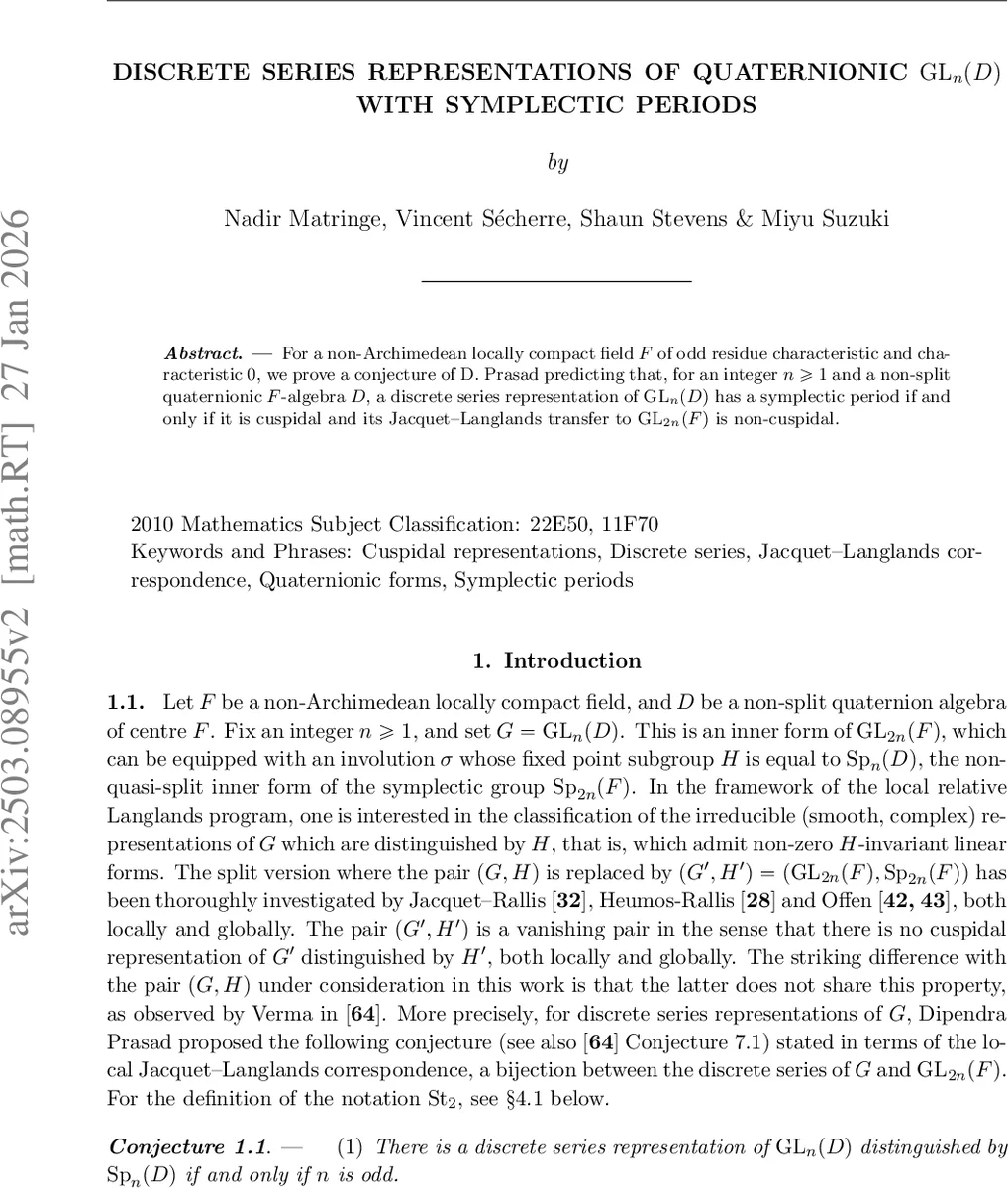
For a non-Archimedean locally compact field $F$ of odd residue characteristic and characteristic $0$, we prove a conjecture of D. Prasad predicting that, for an integer $n \geq 1$ and a non-split quaternionic $F$-algebra $D$, a discrete series representation of ${\rm GL}n(D)$ has a symplectic period if and only if it is cuspidal and its Jacquet–Langlands transfer to ${\rm GL}{2n}(F)$ is non-cuspidal.
💡 Research Summary
The paper addresses a conjecture of Dipendra Prasad concerning distinguished representations of the inner form GLₙ(D) of GL₂ₙ(F), where F is a non‑Archimedean local field of characteristic 0 with odd residue characteristic and D is the unique non‑split quaternion division algebra over F. The subgroup H = Spₙ(D) is the non‑quasi‑split inner form of the symplectic group Sp₂ₙ(F) and is the fixed‑point group of an involution σ on G = GLₙ(D). A representation π of G is said to be H‑distinguished if Hom_H(π,ℂ)≠0.
Prasad’s conjecture predicts two statements: (1) an H‑distinguished discrete series of G exists only when n is odd; (2) when n is odd, the distinguished discrete series are precisely the cuspidal representations whose Jacquet–Langlands (JL) transfer to GL₂ₙ(F) is non‑cuspidal, i.e. of the form St₂(τ) for a cuspidal τ of GLₙ(F). The authors prove both statements, thereby confirming the conjecture (Corollary 1.4).
The proof splits into two main theorems. Theorem 1.2 establishes the “if” direction: any cuspidal π whose JL transfer is non‑cuspidal is H‑distinguished. The argument relies on Bushnell–Kutzko type theory. Starting from a cuspidal π, one chooses a Bushnell–Kutzko type (J,λ) such that π≅c‑Ind_J^G λ. The group J is an open compact-mod-center subgroup stable under σ, and λ decomposes as κ⊗ρ where κ contains a simple character θ. The key observation is that non‑cuspidality of the JL transfer forces the existence of a simple character θ satisfying θ∘σ=θ⁻¹. This yields a σ‑stable κ that is distinguished by J×H. The remaining factor ρ reduces to a cuspidal representation ϱ of GL_m(l) (for some finite extension l of the residue field) and the σ‑invariance forces ϱ to be Gal(l/l₀)‑invariant, which precisely matches the condition that the JL transfer be non‑cuspidal. A careful analysis shows that the quadratic character χ arising in the distinction of κ must be trivial; otherwise one would obtain a counter‑example to the non‑cuspidality assumption. Consequently κ⊗ρ, and thus π, is H‑distinguished.
Theorem 1.3 treats the converse: any H‑distinguished discrete series of G must be cuspidal. An arbitrary discrete series π can be expressed as the unique irreducible quotient of a standard module I(s,ρ) induced from a cuspidal ρ of GL_{n/m}(D) with a parameter m dividing n. If m≥2, the authors construct an open intertwining period J(s,·,μ) attached to a suitable H‑invariant linear form μ on the inducing data, and relate it to the standard intertwining operator M(s,w) via a meromorphic scalar α(s,ρ). Using a globalisation of ρ to an automorphic representation Π of GL_t(B) (where B is a quaternion algebra over a totally imaginary number field with B_u≅D), they compute α(s,ρ) in terms of Rankin–Selberg γ‑factors. The functional equation shows that α(1,ρ)≠0, while the vanishing of M(1,w) for m≥2 forces α(1,ρ)=0, a contradiction. Hence m=1 and π is cuspidal.
The global input needed for the computation of α(s,ρ) is supplied by Verma’s theorem, which in characteristic 0 and odd residue characteristic proves that any H‑distinguished cuspidal representation has a non‑cuspidal JL transfer. Combining Verma’s result with Theorem 1.2 yields the full equivalence of Prasad’s conjecture (Corollary 1.4).
The paper also discusses the “non‑abelian base change” map b_D^F from cuspidal representations of GLₙ(F) to those of GLₙ(D) defined by the inverse of the bijection π↦τ (where τ is the unique GLₙ(F) cuspidal such that JL(π)=St₂(τ)). For depth‑zero representations, a complete description of b_D^F is given using recent work on types and explicit local Langlands correspondences.
Methodologically, the work blends several sophisticated tools: Bushnell–Kutzko types and simple characters for the local analysis of cuspidal representations, the Jacquet–Langlands correspondence for relating inner forms, global automorphic techniques (globalisation of local representations, Rankin–Selberg theory, functional equations of intertwining periods), and a careful study of open intertwining periods attached to non‑closed orbits. The restriction p≠2 appears in the analysis of simple characters, while the characteristic‑zero assumption is needed for the global period machinery.
In summary, the authors prove that for GLₙ(D) with D non‑split, an H‑distinguished discrete series exists exactly when n is odd, and such representations are precisely the cuspidal ones whose JL transfer to GL₂ₙ(F) is a Steinberg representation St₂(τ). This settles Prasad’s conjecture in full generality for the quaternionic inner form, and provides an explicit description of the associated non‑abelian base change.
Comments & Academic Discussion
Loading comments...
Leave a Comment