Understanding and Detecting Platform-Specific Violations in Android Auto Apps
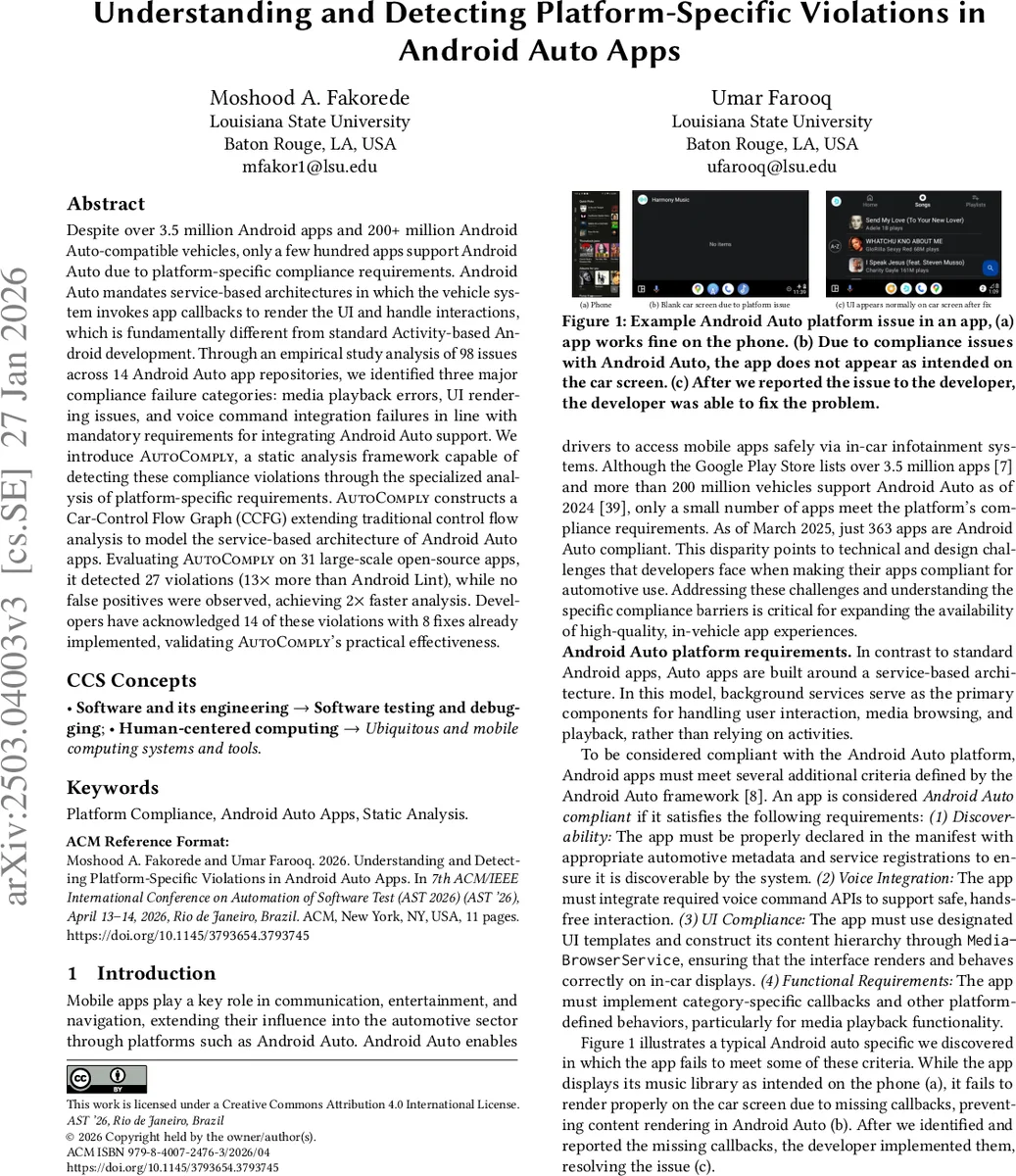
Despite over 3.5 million Android apps and 200+ million Android Auto-compatible vehicles, only a few hundred apps support Android Auto due to platform-specific compliance requirements. Android Auto mandates service-based architectures in which the vehicle system invokes app callbacks to render the UI and handle interactions, which is fundamentally different from standard Activity-based Android development. Through an empirical study analysis of 98 issues across 14 Android Auto app repositories, we identified three major compliance failure categories: media playback errors, UI rendering issues, and voice command integration failures in line with mandatory requirements for integrating Android Auto support. We introduce AutoComply, a static analysis framework capable of detecting these compliance violations through the specialized analysis of platform-specific requirements. AutoComply constructs a Car-Control Flow Graph (CCFG) extending traditional control flow analysis to model the service-based architecture of Android Auto apps. Evaluating AutoComply on 31 large-scale open-source apps, it detected 27 violations (13X more than Android Lint), while no false positives were observed, achieving 2X faster analysis. Developers have acknowledged 14 of these violations with 8 fixes already implemented, validating AutoComply’s practical effectiveness.
💡 Research Summary
The paper addresses a critical gap in the Android ecosystem: while millions of Android apps exist, only a few hundred are compliant with Android Auto, a platform that requires a fundamentally different service‑based architecture. Android Auto apps must expose automotive metadata in the manifest, implement a MediaBrowserService for UI population, and provide a full set of MediaSessionCompat callbacks for media control, as well as integrate voice command intents for hands‑free operation. Failure to meet any of these requirements leads to UI rendering problems, playback control errors, or missing voice command support, which are often invisible during standard phone‑centric development and are not caught by existing static analysis tools such as Android Lint or FlowDroid.
To uncover the nature and prevalence of these platform‑specific violations, the authors conducted a formative study on open‑source Android Auto projects. They harvested 4,387 apps from F‑Droid, filtered those that explicitly declared automotive metadata and a MediaBrowserService, yielding 37 candidate apps (Corpus‑F). Mining issue trackers with automotive‑related keywords and manually curating the results produced 98 distinct Android Auto‑specific issues across 14 repositories. Classification of these issues revealed three dominant violation categories: (i) Media Playback (59 issues, 60.2 %), (ii) User Interface (31 issues, 31.6 %), and (iii) Voice Commands (8 issues, 8.2 %). The study highlighted that most problems stem from incomplete or incorrect implementation of required callbacks and state‑management logic, which are invisible in phone‑only testing.
Recognizing that traditional inter‑procedural control‑flow graphs (ICFGs) cannot model the host‑driven entry points used by the vehicle system, the authors introduced the Car‑Control Flow Graph (CCFG). CCFG augments the ICFG with synthetic nodes representing manifest‑declared services and edges that capture host‑initiated invocations such as UI requests (onGetRoot, onLoadChildren), media control (onPlay, onPause, onStop, onPlayFromMediaId), and voice‑assistant actions (onPlayFromSearch). By making these external flows explicit, the CCFG enables precise static reasoning about Android Auto compliance.
Built on the CCFG, the authors implemented AutoComply, a static analysis framework comprising three dedicated checkers: (1) Media Checker, which verifies the presence and correct behavior of all MediaSessionCompat callbacks and associated state updates; (2) UI Checker, which ensures that MediaBrowserService callbacks correctly construct the media hierarchy required by automotive UI templates; and (3) Voice Command Checker, which validates that required voice intents and Assistant‑driven callbacks are declared and implemented. Each checker traverses the CCFG, looking for missing nodes, malformed edges, or inconsistent internal logic.
The evaluation involved 31 large‑scale open‑source Android Auto apps (approximately 1.2 M lines of code). AutoComply identified 27 compliance violations, a 13× increase over the baseline Android Lint (which found only two issues). Importantly, no false positives were reported, and the analysis ran roughly twice as fast as the baseline ICFG‑based approach. The authors reported the findings to the respective developers; 14 of the 27 violations were acknowledged, and eight have already been fixed, demonstrating concrete real‑world impact.
Key contributions of the work are: (1) the first systematic empirical study of Android Auto compliance challenges; (2) the design of the Car‑Control Flow Graph, a novel abstraction that captures platform‑specific host‑driven control flow; (3) the development and open‑source release of AutoComply, a static analysis tool that automatically detects media, UI, and voice command violations in Android Auto apps; and (4) an extensive empirical validation showing high precision, recall, and practical usefulness. The authors also discuss limitations, noting that the current CCFG focuses on media‑type apps and that extending it to navigation, messaging, or other Android Auto categories is future work. They suggest that combining CCFG‑based static analysis with dynamic testing could further improve detection of runtime‑only bugs, and that the approach may be transferable to other automotive platforms such as Apple CarPlay or Huawei Car. Overall, the paper presents a compelling solution to a pressing problem in the automotive app ecosystem, offering both a rigorous analytical foundation and a practical tool that can accelerate the adoption of compliant Android Auto applications.
Comments & Academic Discussion
Loading comments...
Leave a Comment