Log-concavity in one-dimensional Coulomb gases and related ensembles
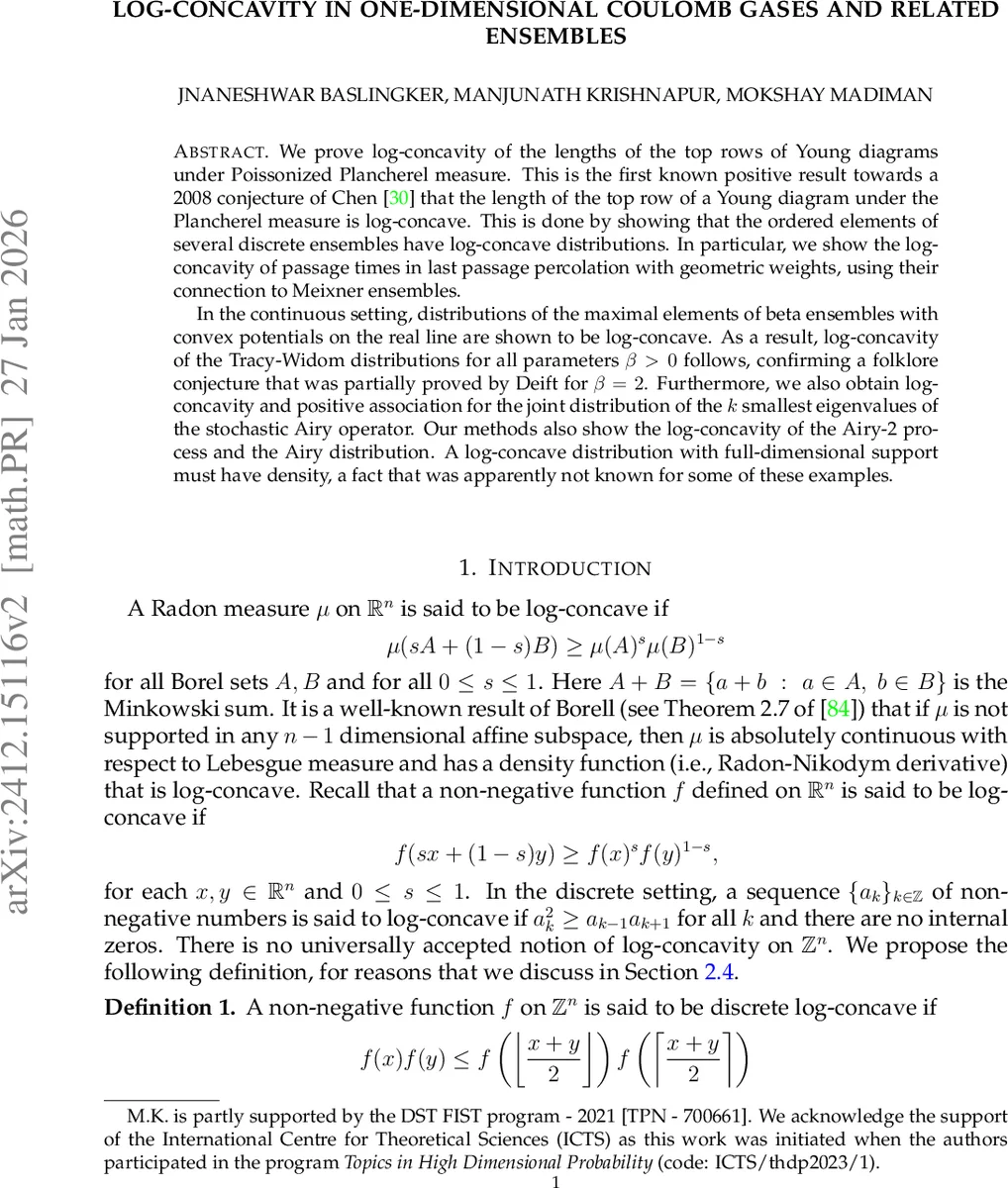
We prove log-concavity of the lengths of the top rows of Young diagrams under Poissonized Plancherel measure. This is the first known positive result towards a 2008 conjecture of Chen that the length of the top row of a Young diagram under the Plancherel measure is log-concave. This is done by showing that the ordered elements of several discrete ensembles have log-concave distributions. In particular, we show the log-concavity of passage times in last passage percolation with geometric weights, using their connection to Meixner ensembles. In the continuous setting, distributions of the maximal elements of beta ensembles with convex potentials on the real line are shown to be log-concave. As a result, log-concavity of the Tracy-Widom distributions for all parameters $β>0$ follows, confirming a folklore conjecture that was partially proved by Deift for $β=2$. Furthermore, we also obtain log-concavity and positive association for the joint distribution of the $k$ smallest eigenvalues of the stochastic Airy operator. Our methods also show the log-concavity of the Airy-2 process and the Airy distribution. A log-concave distribution with full-dimensional support must have density, a fact that was apparently not known for some of these examples.
💡 Research Summary
The paper establishes a broad family of log‑concave probability distributions arising from one‑dimensional Coulomb‑type gases, both in discrete and continuous settings, and uses these results to make progress on several longstanding conjectures. After recalling the classical definition of log‑concavity for measures on ℝⁿ (Borell’s theorem) and introducing a discrete analogue that is preserved under marginalisation, the authors focus on two main classes of models.
First, they treat discrete ensembles that can be written in the form
Pₙ,w,Q(h) ∝ ∏{i<j} Q{i,j}(h_j−h_i) ∏{j} w_j(h_j)
with strictly increasing integer vectors h. Assuming that each weight w_i and each interaction kernel Q{i,j} is a log‑concave sequence on ℤ, they prove (Theorem 4) that the full joint law is discrete log‑concave and, more importantly, that each marginal Pₙ,w,Q(h_i = k) satisfies the usual log‑concave inequality. This theorem applies to the classical orthogonal‑polynomial ensembles: Meixner, Charlier, Krawtchouk and Hahn. In the Charlier and Krawtchouk cases the weights are ultra‑log‑concave, which yields ultra‑log‑concave marginals. As a consequence they obtain sharp Poisson‑type concentration bounds (Corollary 2) and variance controls for the individual particles.
Second, they turn to continuous β‑ensembles (log‑gases) with convex external potentials. By embedding the discrete Meixner ensemble into a family of β‑log‑gases via a scaling limit, they show that the distribution of the right‑most particle (the maximal eigenvalue) is log‑concave for every β>0. This immediately implies that the Tracy–Widom β distributions, which are the weak limits of these maximal particles, inherit log‑concavity (Corollary 5). While Deift had proved log‑concavity of TW₂ on the positive half‑line, the present work extends it to the whole real line and to all β, confirming a folklore conjecture.
A major combinatorial application concerns Chen’s 2008 conjecture that the length ℓₙ(σ) of the longest increasing subsequence of a uniform random permutation has a log‑concave distribution. Using the Robinson–Schensted correspondence, this is equivalent to log‑concavity of the first row length λ₁ under the Plancherel measure μ^{(2)}ₙ. The authors introduce a Poissonised mixture M(α,β) of β‑Plancherel measures and prove (Theorem 1) that for any i≥1 the distribution of λ_i under M(α,β) is log‑concave. In the case β=2 and α=n this mixture is very close to the original Plancherel measure, providing strong evidence for Chen’s conjecture and even suggesting a possible strengthening to all rows. They also give a partial deterministic result (Theorem 2) showing log‑concavity of λ₁ near the top of its support for large n. Since Poissonisation does not always preserve log‑concavity, they establish a sufficient condition (Theorem 3) guaranteeing that a Poissonised sequence remains log‑concave.
Finally, the paper addresses the stochastic Airy operator. By proving log‑concavity and positive association for the joint law of the k smallest eigenvalues, they deduce log‑concavity of the Airy‑2 process and the Airy distribution itself. Moreover, they note that a log‑concave distribution with full‑dimensional support must possess a density, a fact that appears to be new for several of the exotic distributions considered.
Overall, the work unifies discrete orthogonal‑polynomial ensembles, β‑log‑gases, and random‑partition models under the umbrella of log‑concavity, providing new probabilistic inequalities, concentration results, and a decisive step toward resolving Chen’s conjecture. The techniques blend combinatorial identities, integrable probability, and functional‑analytic arguments, and they open the door to further applications of log‑concavity in random matrix theory and related fields.
Comments & Academic Discussion
Loading comments...
Leave a Comment