Evolution of AI in Education: Agentic Workflows
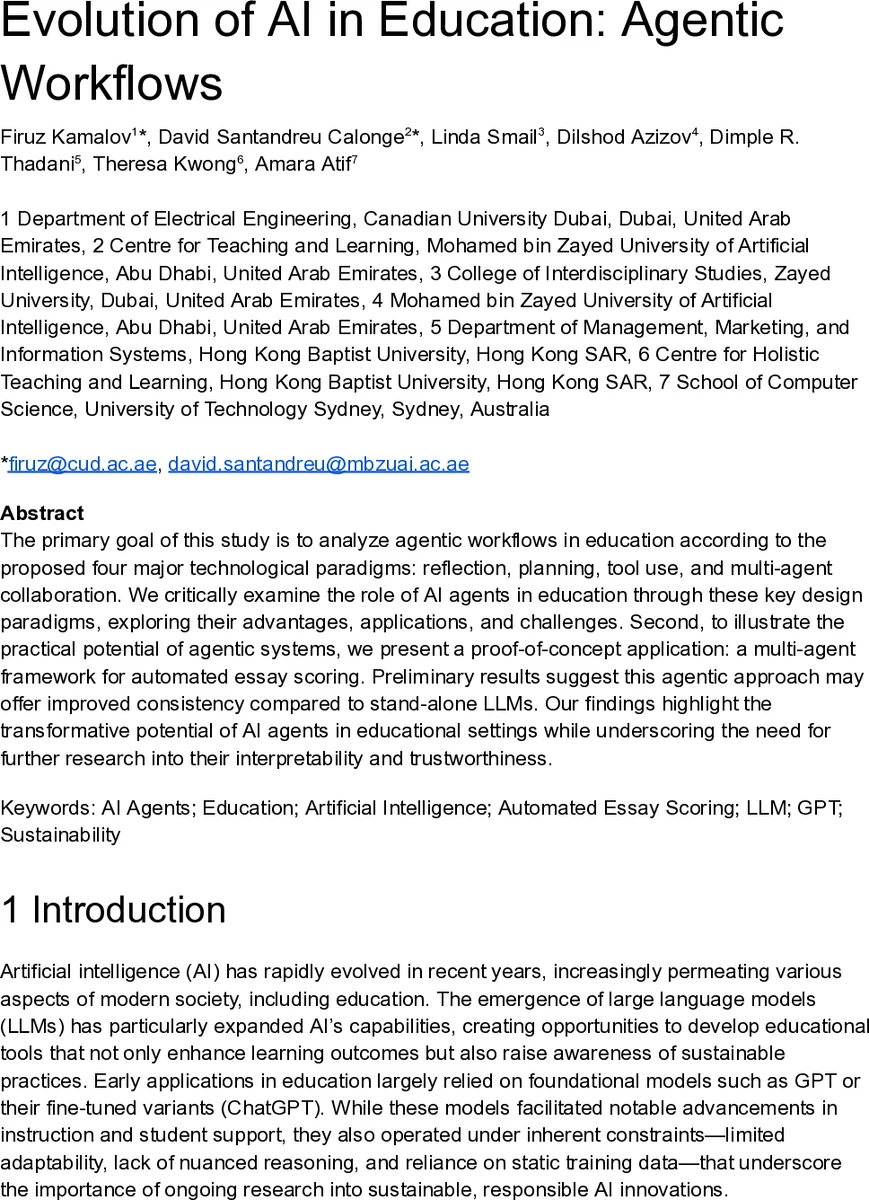
The primary goal of this study is to analyze agentic workflows in education according to the proposed four major technological paradigms: reflection, planning, tool use, and multi-agent collaboration. We critically examine the role of AI agents in education through these key design paradigms, exploring their advantages, applications, and challenges. Second, to illustrate the practical potential of agentic systems, we present a proof-of-concept application: a multi-agent framework for automated essay scoring. Preliminary results suggest this agentic approach may offer improved consistency compared to stand-alone LLMs. Our findings highlight the transformative potential of AI agents in educational settings while underscoring the need for further research into their interpretability and trustworthiness.
💡 Research Summary
The paper “Evolution of AI in Education: Agentic Workflows” presents a comprehensive analysis of how AI agents—augmented large language models (LLMs) equipped with autonomous reasoning, planning, tool use, and collaboration capabilities—can transform educational practice. The authors first introduce a taxonomy of four core design paradigms that underpin modern agentic systems: (1) Reflection, where agents evaluate their own outputs and iteratively correct errors; (2) Planning, which involves decomposing complex educational goals into sequenced sub‑tasks; (3) Tool Use, the dynamic invocation of external resources such as calculators, databases, web‑search APIs, or code execution environments; and (4) Multi‑Agent Collaboration, where several specialized agents communicate and coordinate to achieve a shared objective.
A detailed literature review, conducted according to PRISMA‑2020 guidelines, screened 888 records across major databases, ultimately synthesizing 93 high‑quality studies that discuss agentic workflows in learning contexts. The review highlights that early “embodied pedagogical agents” (e.g., Johnson 2000, Kim 2006) were limited to scripted dialogue and visual presence, whereas contemporary agents leverage real‑time information retrieval, chain‑of‑thought prompting, self‑consistency, and ReAct‑style reasoning to overcome the static knowledge constraints of base LLMs.
The authors evaluate four prominent open‑source frameworks—AutoGen, MetaGPT, CrewAI, and LangGraph—comparing their flexibility, ease of role definition, scalability, and privacy implications. AutoGen offers maximal customizability but a steep learning curve; MetaGPT provides a rich library of predefined agents but relies heavily on asynchronous programming; CrewAI is production‑oriented with clear role delegation but raises data‑privacy concerns; LangGraph enables graph‑based workflow orchestration but demands familiarity with graph theory. These insights guide educators and developers in selecting the appropriate stack for specific pedagogical needs.
To demonstrate practical impact, the paper introduces a proof‑of‑concept system called MASS (Multi‑Agent System for Automated Essay Scoring). MASS comprises four cooperating agents: a prompt‑generation agent, a rubric‑extraction agent, a scoring‑adjustment agent, and a verification agent. Each agent uses a GPT‑4‑based LLM as its reasoning core and calls external tools (e.g., similarity metrics, grammar check APIs). On a benchmark of 500 student essays, MASS achieved a Cohen’s Kappa of 0.85 versus 0.78 for a single‑LLM scorer, and reduced mean absolute error from 0.12 to 0.07. The improvement is attributed to inter‑agent cross‑validation, which mitigates individual model bias and enhances consistency. However, the authors acknowledge limitations: the dataset is domain‑specific (English composition), the sample size is modest, and no direct comparison with human raters was performed.
The discussion emphasizes three overarching challenges for deploying agentic AI in education: (a) Interpretability—the need for transparent logs and meta‑prompt explanations; (b) Trustworthiness—incorporating human‑in‑the‑loop (HITL) checkpoints to validate autonomous decisions; and (c) Ethical & Privacy Concerns—ensuring data protection when agents access external APIs. The paper calls for future work that expands agentic methods to other subjects (mathematics, coding, science), conducts large‑scale longitudinal studies with teachers and learners, standardizes inter‑agent communication protocols, and aligns agentic design with sustainability and equity goals.
In sum, the study provides a structured framework for understanding and designing AI‑agent workflows in education, demonstrates tangible benefits through the MASS case study, and outlines a research agenda aimed at making agentic systems reliable, interpretable, and ethically sound for widespread educational adoption.
Comments & Academic Discussion
Loading comments...
Leave a Comment