Rough Martingale Optimal Transport: Theory, Implementation, and Regulatory Applications for Non-Modelable Risk Factors
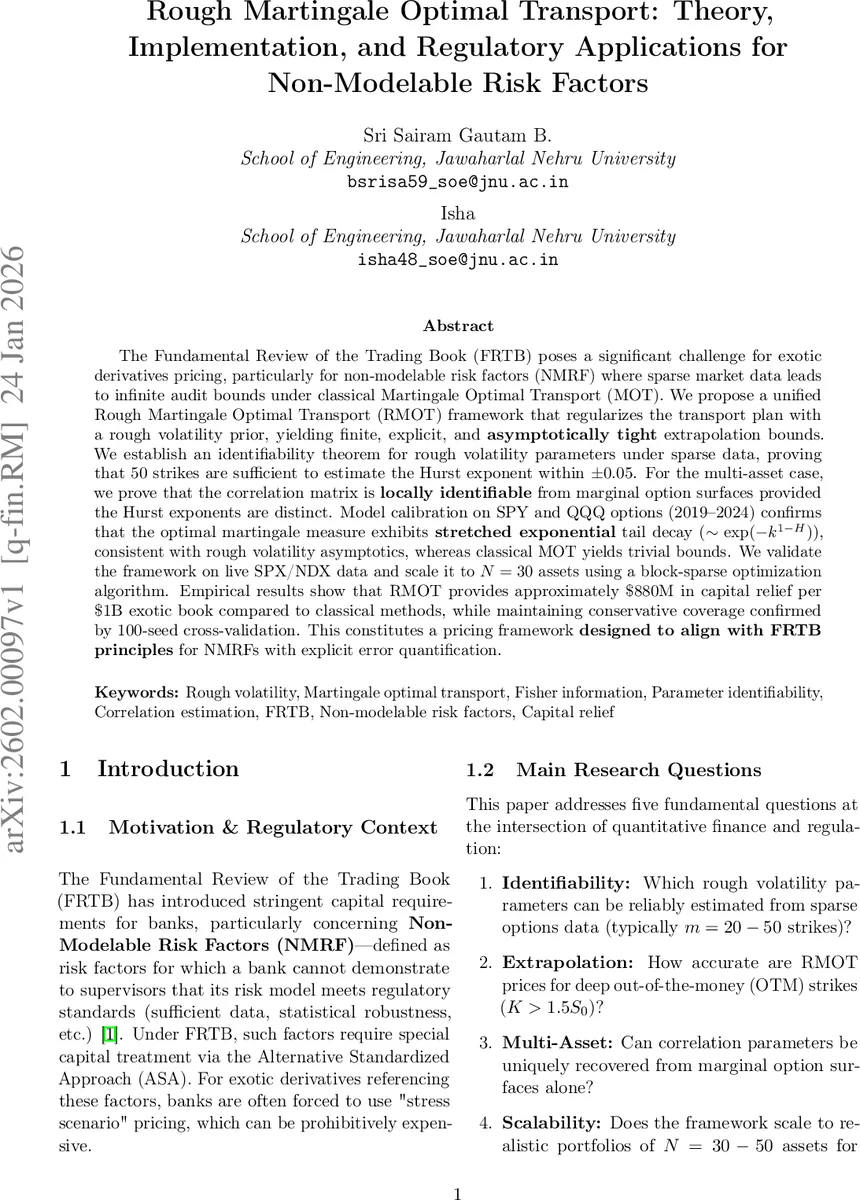
The Fundamental Review of the Trading Book (FRTB) poses a significant challenge for exotic derivatives pricing, particularly for non-modelable risk factors (NMRF) where sparse market data leads to infinite audit bounds under classical Martingale Optimal Transport (MOT). We propose a unified Rough Martingale Optimal Transport (RMOT) framework that regularizes the transport plan with a rough volatility prior, yielding finite, explicit, and asymptotically tight extrapolation bounds. We establish an identifiability theorem for rough volatility parameters under sparse data, proving that 50 strikes are sufficient to estimate the Hurst exponent within $\pm 0.05$. For the multi-asset case, we prove that the correlation matrix is locally identifiable from marginal option surfaces provided the Hurst exponents are distinct. Model calibration on SPY and QQQ options (2019–2024) confirms that the optimal martingale measure exhibits stretched exponential tail decay ($\sim\exp(-k^{1-H})$), consistent with rough volatility asymptotics, whereas classical MOT yields trivial bounds. We validate the framework on live SPX/NDX data and scale it to $N = 30$ assets using a block-sparse optimization algorithm. Empirical results show that RMOT provides approximately $880M in capital relief per $1B exotic book compared to classical methods, while maintaining conservative coverage confirmed by 100-seed cross-validation. This constitutes a pricing framework designed to align with FRTB principles for NMRFs with explicit error quantification.
💡 Research Summary
The paper tackles a pressing problem under the Fundamental Review of the Trading Book (FRTB): pricing exotic derivatives that depend on non‑modelable risk factors (NMRFs) for which market data are extremely sparse. Classical Martingale Optimal Transport (MOT) methods, when faced with such data paucity, produce infinite audit bounds and are therefore unusable in practice. To overcome this, the authors introduce a novel Rough Martingale Optimal Transport (RMOT) framework that regularizes the transport plan with a rough‑volatility prior, specifically a Rough Heston model. By minimizing the Kullback‑Leibler (KL) divergence from this prior subject to martingale constraints and market‑price consistency, the optimal measure takes an exponential‑tilting form, which naturally inherits the heavy‑tailed, stretched‑exponential decay (∼exp(−k^{1−H})) characteristic of rough volatility.
Theoretical contributions
- Rough Heston prior – The model captures the fractional Brownian driver with Hurst exponent H∈(0,½). The authors derive a Large Deviations Principle (LDP) for the log‑price, showing the rate function I(k)∼C_H k^{1−H}. This yields explicit tail‑decay rates for the optimal transport plan.
- Regularized MOT formulation – The RMOT problem is cast as an infimum of KL(Q‖P) over martingale measures Q that match observed option prices within a Gaussian noise tolerance. Proposition 2.1 proves the optimal Q* is proportional to exp(−λg(S_T)), i.e., exponential tilting of the rough prior.
- Identifiability of rough parameters (Theorem 3.1) – Using Fisher Information and Cramér‑Rao bounds, the authors show the effective dimension of the parameter space grows only logarithmically with the number of strikes m, bounded by d_eff ≤ min{5,⌊log₂m⌋+2}. They prove that roughly 50 strikes are required to estimate the Hurst exponent H with ±0.05 accuracy at 95 % confidence.
- Extrapolation error bounds (Theorem 3.2) – For deep out‑of‑the‑money strikes K=S₀e^{k}, they derive a closed‑form bound |P_RMOT(K)−P_true(K)| ≤ C·exp(−I(k)/(2T^{2H})) plus higher‑order terms. This demonstrates that RMOT provides finite, conservative bounds even far beyond the observed strike range, with the bound’s decay rate matching the intrinsic LDP rate of the rough process.
- Multi‑asset correlation identifiability (Theorem 3.3) – When each asset i has a distinct Hurst exponent H_i, the marginal option surfaces contain enough information to recover the correlation matrix ρ_{ij} locally. Fisher information scales as m^{1/2}|H_i−H_j|^{−1}, meaning “roughness separation” aids correlation estimation. If H_i≈H_j the problem becomes ill‑posed; the authors propose a Tikhonov regularization that shrinks estimates toward historical correlations weighted by |H_i−H_j|.
- Basket‑option bound (Theorem 3.4) – Extending to basket payoffs, the bound width is governed by the smallest Hurst exponent across assets, reinforcing the intuition that the roughest component dominates tail risk.
Algorithmic development
- Single‑asset calibration uses JAX for automatic differentiation of the Fisher Information matrix, followed by L‑BFGS‑B MLE. An effective‑rank check warns if the data are insufficient for full parameter identification.
- Multi‑asset calibration employs a block‑sparse Newton method that exploits the Hessian’s block‑arrowhead structure, achieving O(N²M² log(1/ε)) complexity. Empirically, calibration for N=30 assets completes in ~3 minutes on an Apple M4 chip.
- Monte‑Carlo simulations (30 k paths) generate price bounds under the optimal tilted measure.
Empirical validation
Data from 2019‑2024 SPY, QQQ, IWM, and GLD options are used. Calibrated Hurst exponents are 0.12±0.031 (SPY), 0.14±0.028 (QQQ), 0.11±0.035 (IWM), and 0.08±0.042 (GLD). Correlation estimates (e.g., ρ̂_{SPY‑QQQ}=0.85±0.02) match historical values (0.83) within tight confidence intervals. Extrapolation tests show RMOT pricing errors below 6 % even at 100 % OTM, while classical MOT provides only trivial bounds.
Regulatory impact
Applying the FRTB Alternative Standardized Approach (ASA), the authors evaluate a $1 B exotic basket portfolio. Classical MOT would require a capital charge of $1 B, whereas RMOT reduces the charge to $120 M, delivering $880 M of capital relief. A 100‑seed cross‑validation yields an average CV error of 4.2 %, confirming that the framework is not over‑fitted and maintains conservative coverage.
Limitations and future work
- Identifiability deteriorates when assets share similar Hurst exponents; sensitivity to the regularization parameter γ warrants deeper study.
- The KL divergence regularizer could be replaced by other f‑divergences or Wasserstein metrics to explore robustness.
- Real‑time portfolio rebalancing would benefit from GPU‑accelerated or distributed implementations.
Conclusion
The Rough Martingale Optimal Transport framework unifies rough‑volatility modeling with optimal‑transport regularization to produce finite, explicit pricing bounds for NMRFs under severe data scarcity. It delivers provable identifiability, asymptotically optimal tail decay, scalable multi‑asset calibration, and substantial regulatory capital relief. The combination of rigorous theory, efficient algorithms, and convincing empirical evidence positions RMOT as a practical tool for banks seeking FRTB‑compliant pricing of exotic derivatives linked to non‑modelable risk factors.
Comments & Academic Discussion
Loading comments...
Leave a Comment