Risk-based test framework for LLM features in regulated software
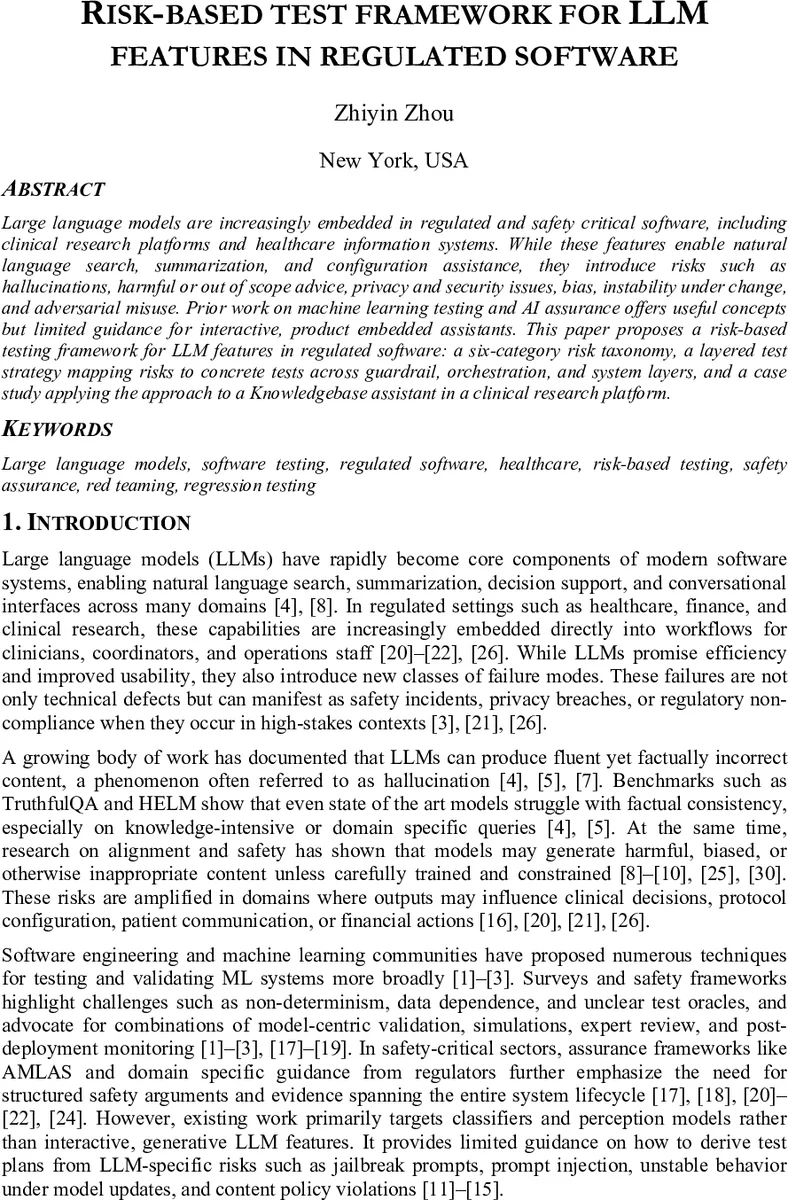
Large language models are increasingly embedded in regulated and safety-critical software, including clinical research platforms and healthcare information systems. While these features enable natural language search, summarization, and configuration assistance, they introduce risks such as hallucinations, harmful or out-of-scope advice, privacy and security issues, bias, instability under change, and adversarial misuse. Prior work on machine learning testing and AI assurance offers useful concepts but limited guidance for interactive, product-embedded assistants. This paper proposes a risk-based testing framework for LLM features in regulated software: a six-category risk taxonomy, a layered test strategy mapping risks to concrete tests across guardrail, orchestration, and system layers, and a case study applying the approach to a Knowledgebase assistant in a clinical research platform.
💡 Research Summary
The paper addresses the growing integration of large language models (LLMs) into regulated, safety‑critical software such as clinical research platforms and health‑information systems. While these models bring valuable capabilities—natural‑language search, summarisation, and configuration assistance—they also introduce a distinct set of risks that traditional machine‑learning testing methods do not fully cover. To bridge this gap, the authors propose a risk‑based testing framework specifically tailored for LLM features in regulated environments.
First, they synthesize prior work on LLM evaluation, AI safety, and regulatory guidance to define six inter‑related risk categories: (1) factual errors and omissions, (2) harmful or out‑of‑scope advice, (3) privacy and security breaches, (4) bias and unfairness, (5) instability under change or drift, and (6) adversarial misuse. Each category is linked to concrete regulatory expectations (e.g., FDA, WHO, emerging AI risk‑management standards).
Second, they map these risks onto a three‑layer test strategy. The Guardrail layer focuses on immediate policy enforcement through prompt filtering, content‑policy detectors, and automated red‑team style adversarial prompts. The Orchestration layer validates the interaction between the LLM and surrounding system components, testing for prompt injection, context‑preservation, data‑masking, and secure logging. The System layer conducts end‑to‑end scenario testing, regression suites, and continuous monitoring to assess model updates, data drift, and long‑term stability. Techniques such as SelfCheckGPT‑style self‑consistency checks, metamorphic testing, and demographic‑specific performance analysis are incorporated to address factuality, bias, and drift.
Third, the framework is illustrated with a case study on a Knowledgebase assistant embedded in a clinical research platform. The authors built a test corpus of roughly 200 functional prompts and 50 adversarial red‑team attacks, achieving over 85 % coverage across the six risk categories. Test artefacts—including test cases, execution logs, and validation reports—are shown to serve as evidence for safety cases and regulatory audits.
The paper concludes that a risk‑based, layered testing approach provides a pragmatic pathway for engineering teams to translate high‑level regulatory principles into actionable test plans for LLM‑enabled features. Continuous documentation, monitoring, and alignment with governance processes are emphasized as essential for maintaining compliance and trustworthiness throughout the product lifecycle.
Comments & Academic Discussion
Loading comments...
Leave a Comment