Local spreading of stabilizer Rényi entropy in a brickwork random Clifford circuit
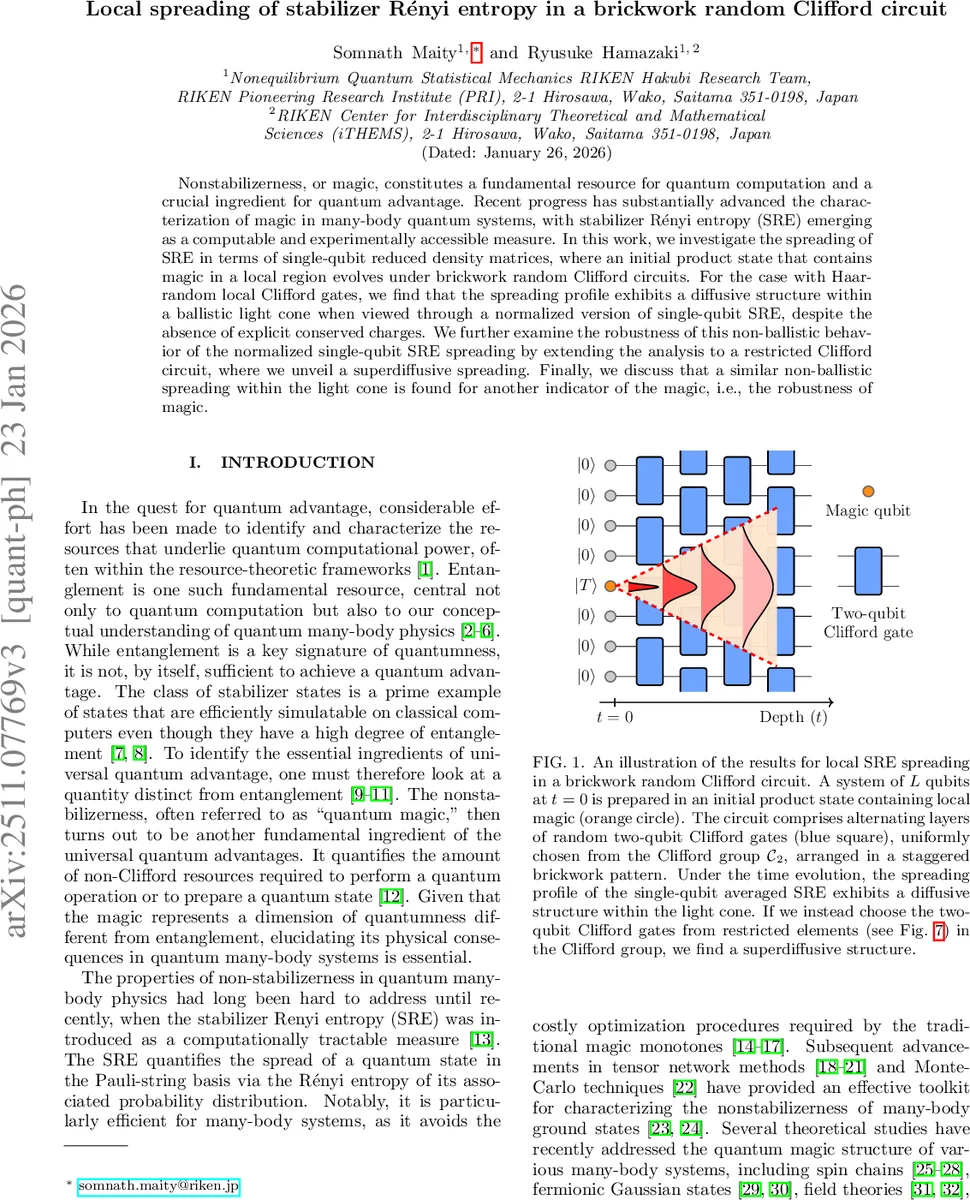
Nonstabilizerness, or magic, constitutes a fundamental resource for quantum computation and a crucial ingredient for quantum advantage. Recent progress has substantially advanced the characterization of magic in many-body quantum systems, with stabilizer Rényi entropy (SRE) emerging as a computable and experimentally accessible measure. In this work, we investigate the spreading of SRE in terms of single-qubit reduced density matrices, where an initial product state that contains magic in a local region evolves under brickwork random Clifford circuits. For the case with Haar-random local Clifford gates, we find that the spreading profile exhibits a diffusive structure within a ballistic light cone when viewed through a normalized version of single-qubit SRE, despite the absence of explicit conserved charges. We further examine the robustness of this non-ballistic behavior of the normalized single-qubit SRE spreading by extending the analysis to a restricted Clifford circuit, where we unveil a superdiffusive spreading. Finally, we discuss that a similar non-ballistic spreading within the light cone is found for another indicator of the magic, i.e., the robustness of magic.
💡 Research Summary
This paper investigates how non‑stabilizerness, or “magic”, spreads locally in a many‑qubit system evolving under a brickwork random Clifford circuit. The authors start from a simple product state of L qubits, all in |0⟩, and inject a single‑qubit T‑state (the canonical magic resource) at site m. This initial state can be written as an equal superposition of two stabilizer states, so the total amount of magic (as measured by the stabilizer Rényi entropy, SRE) is minimal yet non‑zero. The system then evolves under a brickwork circuit composed of two‑qubit Clifford gates drawn uniformly from the full Clifford group C₂. Because Clifford unitaries map Pauli strings onto Pauli strings, the authors work in the Heisenberg picture: each local Pauli operator Pσi is propagated as Pσi(t)=U†(t)PσiU(t). The expectation values ⟨Pσi(t)⟩ on the low‑magic initial state are computed efficiently using a binary‑vector (symplectic) representation of Pauli strings, allowing exact evaluation of the reduced density matrix ρi(t) for every qubit.
From the Pauli expansion coefficients ciσ(t)=Tr
Comments & Academic Discussion
Loading comments...
Leave a Comment