Why LoRA Resists Label Noise: A Theoretical Framework for Noise-Robust Parameter-Efficient Fine-Tuning
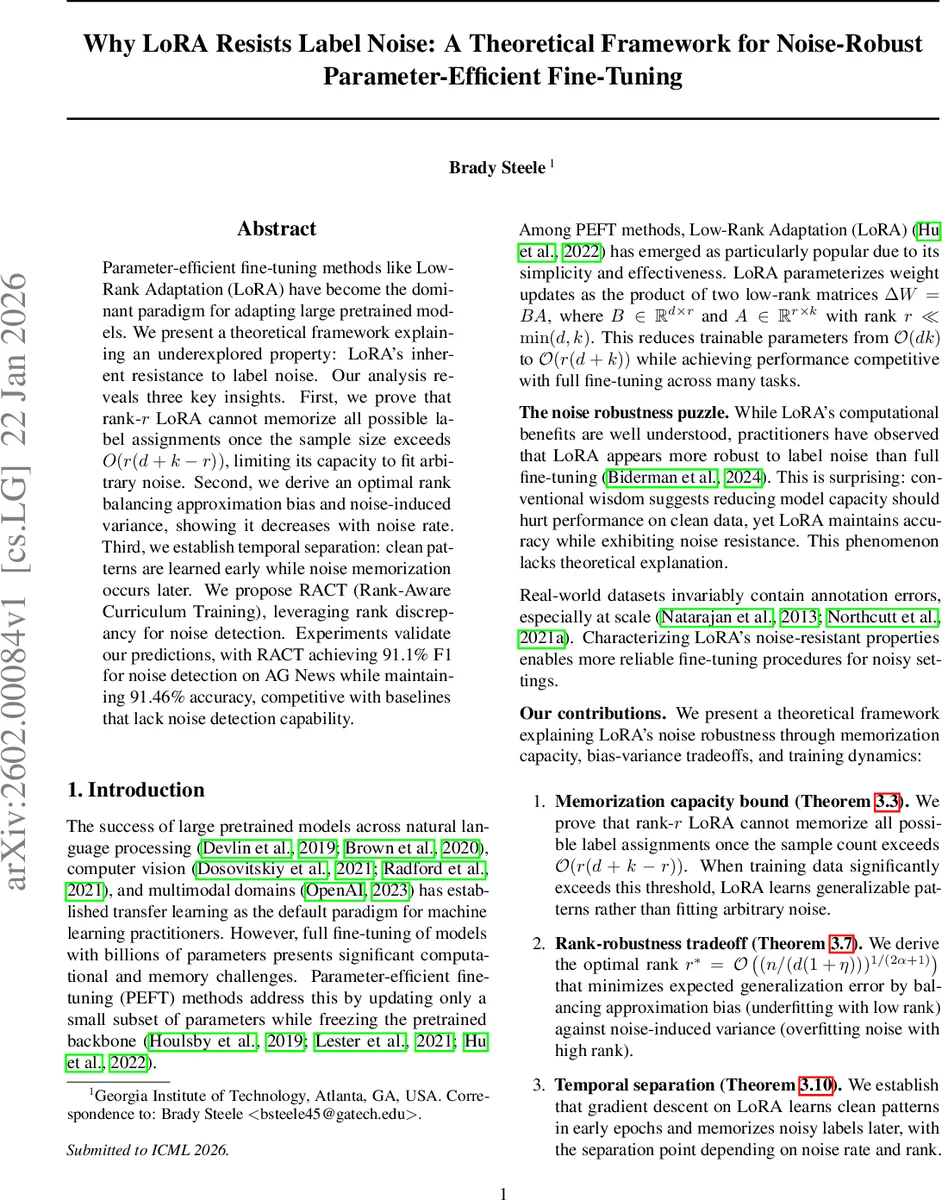
Parameter-efficient fine-tuning methods like Low-Rank Adaptation (LoRA) have become the dominant paradigm for adapting large pretrained models. We present a theoretical framework explaining an underexplored property: LoRA’s inherent resistance to label noise. Our analysis reveals three key insights. First, we prove that rank-$r$ LoRA cannot memorize all possible label assignments once the sample size exceeds $O(r(d+k-r))$, limiting its capacity to fit arbitrary noise. Second, we derive an optimal rank balancing approximation bias and noise-induced variance, showing it decreases with noise rate. Third, we establish temporal separation: clean patterns are learned early while noise memorization occurs later. We propose RACT (Rank-Aware Curriculum Training), leveraging rank discrepancy for noise detection. Experiments validate our predictions, with RACT achieving 91.1% F1 for noise detection on AG News while maintaining 91.46% accuracy, competitive with baselines that lack noise detection capability.
💡 Research Summary
The paper investigates why Low‑Rank Adaptation (LoRA), a popular parameter‑efficient fine‑tuning technique, exhibits robustness to label noise. The authors develop a three‑part theoretical framework and a practical algorithm (RACT) that leverages the insights.
- Memorization capacity bound – LoRA updates are constrained to a rank‑r matrix ΔW = BA with B∈ℝ^{d×r}, A∈ℝ^{r×k}. This gives r(d + k − r) degrees of freedom. Theorem 3.3 shows that when the number of training examples n exceeds this quantity, there exist label assignments that cannot be realized by any rank‑r LoRA. Consequently, if the dataset contains more noisy labels than the model’s capacity, LoRA cannot memorize all of them and must focus on the dominant clean signal. This contrasts with full fine‑tuning, whose O(dk) parameters can memorize essentially any labeling.
- Rank‑robustness trade‑off – Assuming the true target function has a spectral decay ∥f* − f*_r∥² = O(r^{−2α}) (α > 0), the authors decompose the expected generalization error for squared loss into three terms: bias O(r^{−2α}), variance O(rd/n), and noise‑induced variance O(η rd/n), where η is the noise fraction. Minimizing the sum yields an optimal rank r* = O((n/(d(1+η)))^{1/(2α+1)}. Thus, higher noise rates call for smaller ranks, providing a principled rule for rank selection under noisy conditions.
- Temporal separation of learning – In a linearized NTK regime, the clean‑data gradient covariance Σ_clean has singular values σ₁≥…≥σ_r that are well‑separated. Gradient flow amplifies components along these singular vectors at rates e^{γσ_i t}. Early training (t < t*/2) aligns the model with the top singular directions, reducing loss on clean samples. Later (t > 2t*), where t* ≈ (1/(γσ_r))·log(1/η), the amplified noise signal becomes comparable to the residual clean signal, and the model begins to fit noisy labels. This explains why early stopping or lower rank prolongs the clean‑learning phase.
- RACT (Rank‑Aware Curriculum Training) – The algorithm trains two LoRA adapters simultaneously: a low‑rank adapter (r_L) and a high‑rank adapter (r_H > r_L). For each example i, it computes the “rank discrepancy” d_i = L(f_{r_H}(x_i), ỹ_i) − L(f_{r_L}(x_i), ỹ_i). Clean examples yield d_i≈0 because both adapters fit them; noisy examples produce d_i < 0 because the high‑rank adapter can memorize the corrupted label while the low‑rank one cannot. By thresholding d_i, RACT identifies noisy samples, removes or re‑weights them, and then fine‑tunes on the cleaned set.
- Empirical validation – Experiments on AG News with synthetic label noise (≈30%) show that RACT detects noisy samples with 91.1 % F1 score and achieves 91.46 % classification accuracy, matching or slightly surpassing standard full fine‑tuning baselines that lack noise detection. Additional ablations confirm the predicted decrease of optimal rank with increasing η and the early‑learning/late‑memorization dynamics.
Overall, the work provides a rigorous explanation for LoRA’s implicit regularization against noisy labels, quantifies the capacity‑noise interaction, and translates the theory into a practical curriculum‑style training method. It bridges the gap between the empirical observation that LoRA “just works” on noisy data and a solid statistical learning foundation, offering actionable guidance for practitioners deploying PEFT in real‑world, imperfect datasets.
Comments & Academic Discussion
Loading comments...
Leave a Comment