Code Mixologist : A Practitioner's Guide to Building Code-Mixed LLMs
Code-mixing and code-switching (CSW) remain challenging phenomena for large language models (LLMs). Despite recent advances in multilingual modeling, LLMs often struggle in mixed-language settings, exhibiting systematic degradation in grammaticality, factuality, and safety behavior. This work provides a comprehensive overview of CSW research in modern large language model settings. We introduce a unifying taxonomy that organizes prior work along dimensions of data, modeling, and evaluation, and we distill these findings into a practical playbook of actionable recommendations for building, adapting, and evaluating CSW-capable LLMs. We review modeling approaches ranging from CSW-tailored pre-training and task-specific post-training to prompting strategies and in-context learning. We analyze current evaluation practices, highlighting sources of instability and limited reproducibility, and we catalog existing benchmarks while critically examining their linguistic coverage and English-centric biases. Finally, we discuss emerging safety concerns, including use of code-mixing as a mechanism for bypassing model safeguards, and identify open research challenges.
💡 Research Summary
The paper “Code Mixologist: A Practitioner’s Guide to Building Code‑Mixed LLMs” offers a comprehensive, end‑to‑end roadmap for developing large language models (LLMs) that can robustly handle code‑mixing and code‑switching (CSW) phenomena. It begins by framing CSW linguistically, distinguishing intra‑sentential code‑mixing from inter‑sentential code‑switching, and revisiting classic constraints such as the Equivalence Constraint and Free Morpheme Constraint. The authors highlight that most prior work is English‑centric, focusing on language pairs like Hinglish or Spanglish, and that this bias limits both linguistic coverage and model generalization.
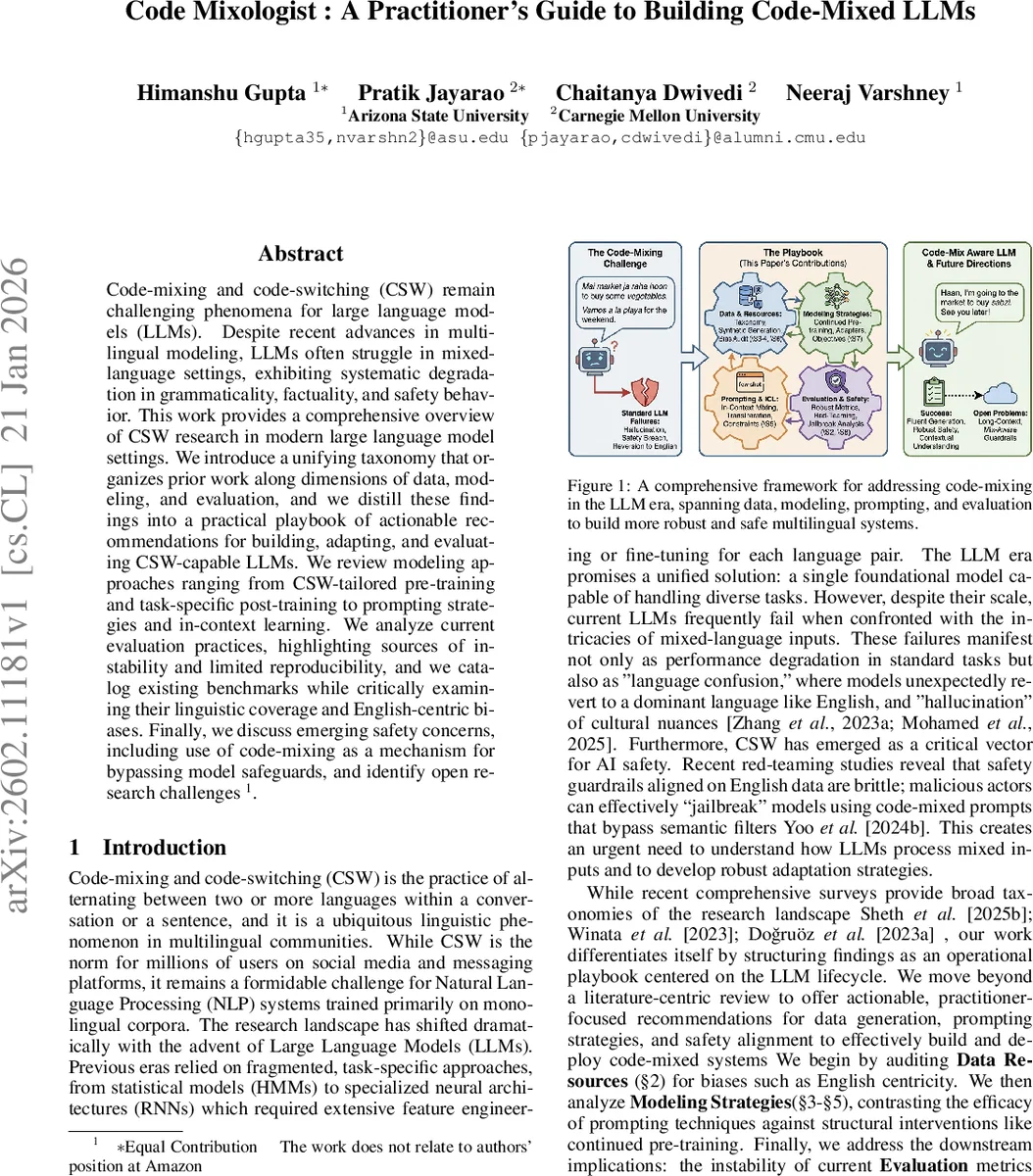
The core contribution is a unifying taxonomy that organizes prior research along four pillars—data, modeling, prompting, and evaluation—each mapped to concrete practitioner actions. In the data pillar, the paper surveys large‑scale synthetic generation techniques: (1) alignment‑guided substitution using word‑level alignments (e.g., GIZA++), (2) zero‑shot synthesis with multilingual backbones and lightweight adapters (the GLOSS framework), (3) a “filter‑then‑finetune” pipeline that first generates a massive noisy corpus and then selects a high‑quality “silver” subset based on language‑identification consistency, perplexity, and toxicity checks, (4) pseudo‑parallel construction where LLMs “monolingualize” code‑mixed sentences to create aligned training pairs, and (5) constrained prompting approaches (e.g., EZSwitch) that embed linguistic theory directly into the prompt to guarantee syntactically valid switch points. The authors provide a clear decision matrix: cheap alignment‑based methods for rapid domain coverage, adapter‑based zero‑shot for unseen language pairs, and filtered synthetic data for high‑fidelity downstream performance.
In the modeling pillar, the paper contrasts three levels of intervention. Foundational pre‑training that includes code‑mixed corpora builds intrinsic robustness to language switching. Post‑training adaptation includes (a) continued pre‑training on code‑mixed data, (b) parameter‑efficient adapters or LoRA modules that specialize a frozen multilingual backbone, and (c) instruction‑tuned fine‑tuning for specific tasks (e.g., language identification, NER). The authors argue that while prompting can achieve quick prototypes, it often lags behind dedicated fine‑tuned models on structurally demanding tasks.
Prompting and in‑context learning receive a dedicated section. Two distinct paradigms are identified: (i) “code‑mix prompting to unlock multilingual capabilities,” where few‑shot examples are deliberately code‑mixed (In‑Context Mixing, CSICL) to align internal representations and activate cultural knowledge, and (ii) “prompting for controlled code‑mixed generation,” which requires explicit system‑prompt definitions, linguistic constraints (e.g., switch only at noun‑phrase boundaries), and rule‑based substitution to avoid unnatural token‑level flipping. Empirical citations show that formal definitions in prompts dramatically improve human‑rated naturalness compared to vague role‑playing instructions.
The evaluation pillar critiques existing benchmarks for their English‑centricity, limited language‑pair coverage, and metric instability. The authors point out that many current metrics (e.g., language‑identification accuracy, perplexity) fluctuate across runs and do not capture cultural factuality or safety. They propose a richer evaluation suite that jointly measures (a) language‑identification precision, (b) switch‑point accuracy against linguistic theory, (c) cultural fact consistency, and (d) safety compliance under mixed‑language adversarial prompts.
Safety considerations form the final pillar. The paper documents how code‑mixed prompts can bypass English‑only safety filters, enabling jailbreaks that exploit the model’s multilingual understanding. Red‑team experiments (e.g., Yoo et al., 2024b) demonstrate that models trained primarily on English data are brittle when faced with mixed‑script or transliterated inputs. To mitigate this, the authors recommend (1) multilingual safety classifiers that detect code‑mixed intent, (2) language‑aware guardrails that apply separate toxicity and policy checks per language, and (3) continuous adversarial testing that includes hyper‑mixed synthetic stress tests.
Overall, the paper delivers a practical “playbook” that translates academic insights into actionable checklists for data engineers, model developers, prompt designers, evaluators, and safety engineers. By structuring the CSW research landscape into a lifecycle‑oriented taxonomy and providing concrete recommendations at each stage, it bridges the gap between theory and deployment, enabling the next generation of LLMs that are both multilingual and robust to the complexities of real‑world code‑mixed communication.
Comments & Academic Discussion
Loading comments...
Leave a Comment