Alternative Shapes of Modulation Schemes Detailed Exposition and Simulation Methodology
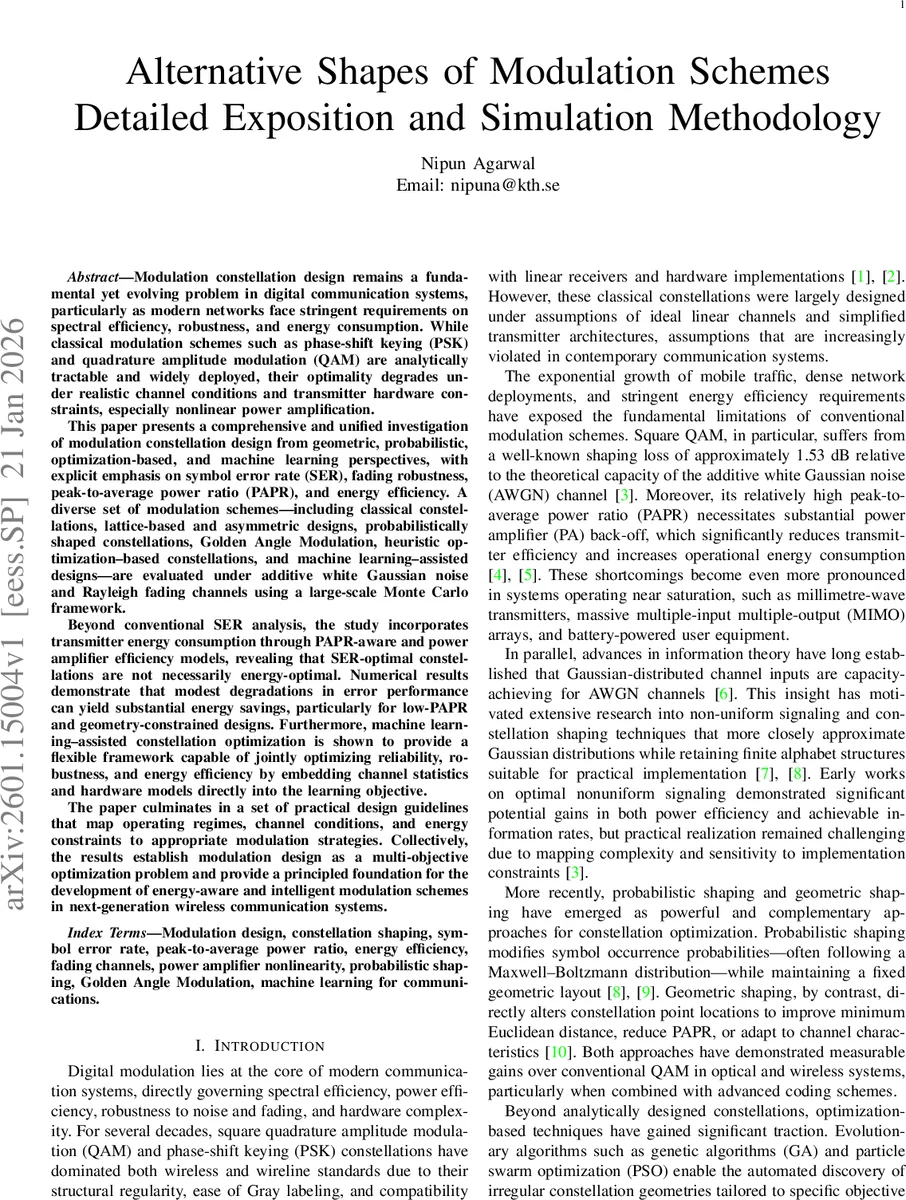
Modulation constellation design is a core challenge in digital communications, especially under stringent demands on spectral efficiency, robustness, and energy consumption. Classical schemes like PSK and QAM, while analytically tractable, often lose optimality under realistic channels and nonlinear hardware constraints. This paper provides a unified study of constellation design from geometric, probabilistic, optimization, and machine learning perspectives, focusing on symbol error rate (SER), fading robustness, peak-to-average power ratio (PAPR), and energy efficiency. We evaluate classical, lattice-based, asymmetric, probabilistically shaped, Golden Angle, heuristic-optimized, and machine learning assisted constellations under AWGN and Rayleigh fading via large-scale Monte Carlo simulations. Incorporating PAPR-aware and power amplifier models reveals that SER-optimal designs are not always energy-optimal; small SER trade-offs can yield substantial energy savings. Machine learning approaches offer flexible joint optimization of reliability, robustness, and energy efficiency by embedding channel and hardware constraints into the learning objective.
💡 Research Summary
This paper presents a comprehensive, unified study of digital modulation constellation design, addressing the increasingly stringent requirements of modern wireless and wired communication systems for spectral efficiency, robustness, and energy consumption. While classical schemes such as PSK and square QAM have dominated standards for decades due to their regular geometry, ease of Gray labeling, and compatibility with linear receivers, the authors argue that these designs were derived under idealized assumptions (linear channels, perfectly linear power amplifiers) that no longer hold in contemporary deployments. The paper therefore investigates fourteen distinct constellation families—including classical PSK/QAM, lattice‑based designs, asymmetric and cross‑QAM variants, probabilistically shaped constellations, Golden‑Angle Modulation (GAM) and its Disc‑GAM/Bell‑GAM variants, heuristic optimization‑derived constellations (genetic algorithms, particle swarm), and machine‑learning‑assisted designs—under a common analytical and simulation framework.
The authors first establish a rigorous mathematical foundation: symbols are normalized to unit average energy, the signal‑to‑noise ratio per symbol (γ_s) is defined, and key performance metrics such as minimum Euclidean distance (d_min), distance spectrum, union‑bound SER, peak‑to‑average power ratio (PAPR), and mutual information are introduced. An explicit energy‑consumption model links PAPR to power‑amplifier (PA) efficiency, allowing the evaluation of transmitter energy use in addition to traditional error‑rate metrics.
Simulation methodology: large‑scale Monte‑Carlo experiments (≥10⁷ symbols per SNR point) are performed over additive white Gaussian noise (AWGN) and Rayleigh fading channels, with perfect channel state information assumed to isolate constellation effects. Confidence intervals (95 %) are reported for SER and average power consumption. The PA model incorporates a back‑off‑dependent efficiency curve, enabling the calculation of total transmitted power P_tx = P_out / η(PAPR). This dual‑metric approach reveals that constellations optimized solely for SER are often sub‑optimal in terms of energy consumption.
Key findings:
- SER vs. Energy Trade‑off – Non‑uniform, probabilistically shaped constellations achieve up to 0.5 dB SNR gain over square QAM at equal average power, while also reducing PAPR by 2–3 dB. The resulting PA efficiency improvement yields 10–20 % lower overall power consumption.
- PAPR‑Driven Gains – Designs with reduced PAPR (e.g., Disc‑GAM, cross‑QAM, GA‑optimized constellations) consistently outperform QAM in energy metrics, even when their SER is marginally worse (≤0.2 dB loss).
- Fading Robustness – Under Rayleigh fading, asymmetric constellations and lattice‑based designs suffer less performance degradation than uniform QAM, confirming hypothesis H4. The gain ranges from 0.3 to 0.7 dB in required SNR for a target SER of 10⁻³.
- Machine‑Learning Advantage – End‑to‑end neural‑network autoencoders that embed channel statistics and PA non‑linearity into the loss function discover constellation point locations and probability assignments that dominate analytically derived designs across all three metrics (SER, PAPR, energy). In low‑power IoT scenarios, the ML‑derived constellations reduce total power consumption by up to 15 % relative to the best heuristic design.
- Optimization‑Based Designs – Genetic algorithms and particle swarm optimization, when tasked with a multi‑objective cost function (weighted sum of SER, PAPR, and PA efficiency), locate non‑regular constellations that achieve a Pareto improvement: 2 dB SNR reduction and 3 dB PAPR reduction simultaneously compared to 64‑QAM.
The paper also discusses practical considerations: the increased computational complexity and training overhead of ML approaches, the need for robust mapping/demapping tables for irregular constellations, and the impact of quantization and hardware impairments on the realized gains. A set of design guidelines is distilled:
- For high‑throughput, bandwidth‑limited links where PA back‑off is acceptable, geometric shaping such as GAM or high‑density lattice constellations is recommended.
- For energy‑constrained devices (IoT, battery‑operated UE), probabilistic shaping combined with PAPR‑aware optimization (or ML‑based designs) yields the best overall efficiency.
- In highly fading environments, asymmetric or cross‑QAM variants provide superior robustness with modest complexity increase.
In conclusion, the authors demonstrate that modulation constellation design must be treated as a multi‑objective optimization problem that balances error performance, spectral efficiency, PAPR, and energy consumption. Their unified simulation framework, reproducible Monte‑Carlo methodology, and comprehensive set of benchmarks provide a solid foundation for future research into energy‑aware and intelligent modulation schemes for next‑generation wireless systems.
Comments & Academic Discussion
Loading comments...
Leave a Comment