Limit theorems for a supercritical multi-type branching process with immigration in a random environment
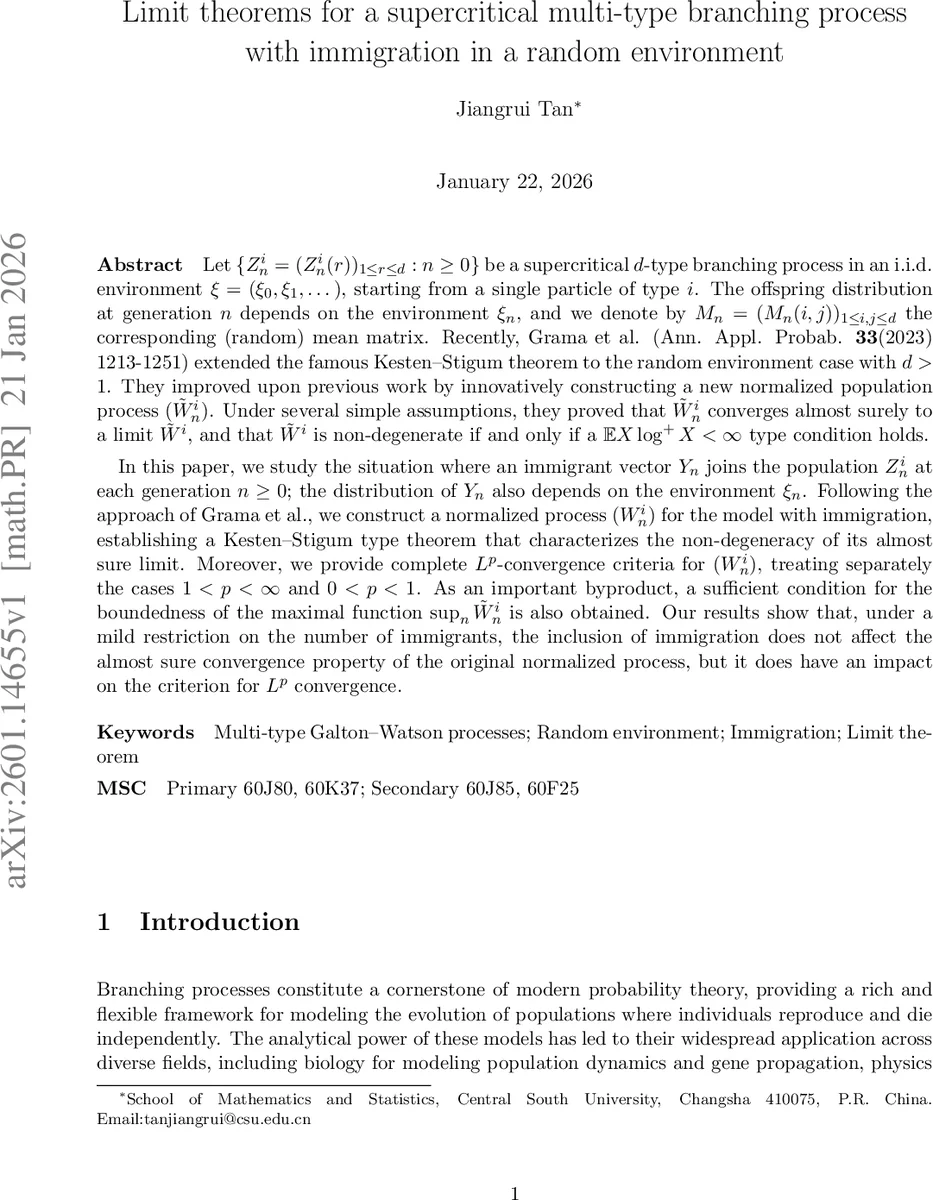
Let ${Z_n^i = (Z_n^i(r)){1 \le r \le d}: n \ge 0}$ be a supercritical $d$-type branching process in an i.i.d. environment $ξ= (ξ_0, ξ_1, \dots)$, starting from a single particle of type $i$. The offspring distribution at generation $n$ depends on the environment $ξ_n$, and we denote by $M_n = (M_n(i,j)){1 \le i,j \le d}$ the corresponding (random) mean matrix. Recently, Grama et al. (Ann. Appl. Probab. \textbf{33}(2023) 1213-1251) extended the famous Kesten–Stigum theorem to the random environment case with $d>1$. They improved upon previous work by innovatively constructing a new normalized population process $(\tilde{W}^i_n)$. Under several simple assumptions, they proved that $\tilde{W}^i_n$ converges almost surely to a limit $\tilde{W}^i$, and that $\tilde{W}^i$ is non-degenerate if and only if a $\mbb{E}X\log^+ X<\infty$ type condition holds. In this paper, we study the situation where an immigrant vector $Y_n$ joins the population $Z_n^i$ at each generation $n \ge 0$; the distribution of $Y_n$ also depends on the environment $ξ_n$. Following the approach of Grama et al., we construct a normalized process $(W^i_n)$ for the model with immigration, establishing a Kesten–Stigum type theorem that characterizes the non-degeneracy of its almost sure limit. Moreover, we provide complete $L^p$-convergence criteria for $(W^i_n)$, treating separately the cases $1 < p < \infty$ and $0 < p < 1$. As an important byproduct, a sufficient condition for the boundedness of the maximal function $\sup_n \tilde{W}_n^i$ is also obtained. Our results show that, under a mild restriction on the number of immigrants, the inclusion of immigration does not affect the almost sure convergence property of the original normalized process, but it does have an impact on the criterion for $L^p$ convergence.
💡 Research Summary
This paper investigates a supercritical multi‑type branching process in an i.i.d. random environment (BPRE) when a random immigration vector is added at every generation. The authors build on the recent breakthrough of Grama, Liu, and Mallein (Ann. Appl. Probab. 2023) who extended the classical Kesten–Stigum theorem to multi‑type BPREs without immigration by introducing a novel normalized martingale ˜Wₙᶦ based on the random Perron–Frobenius eigenvectors of the product of mean matrices. In the presence of immigration, the naïve extension of ˜Wₙᶦ fails because the immigration term destroys the martingale property.
To overcome this, the authors employ Hennion’s theory of products of random positive matrices. For each generation n they define a random right eigenvector Uₙ,∞ and a “pseudo‑spectral radius’’ λₙ = ‖MₙUₙ₊₁,∞‖, where Mₙ is the conditional mean matrix of the offspring distribution given the environment ξₙ. Using these objects they construct a new normalized process
W₀ᶦ = 1, Wₙᶦ = ⟨Xₙᶦ, Uₙ,∞⟩ · (λ₀·…·λₙ₋₁)⁻¹ · U₀,∞(i), n ≥ 1,
where Xₙᶦ denotes the total population (offspring plus immigrants) when the process starts from a single particle of type i. The key observation is that (Wₙᶦ)ₙ≥0 forms a sub‑martingale under both the quenched law (conditioned on the environment) and the annealed law (averaged over the environment).
The paper’s main contributions are fourfold:
- Almost‑sure convergence – Under mild moment assumptions (E
Comments & Academic Discussion
Loading comments...
Leave a Comment