BioProBench: Comprehensive Dataset and Benchmark in Biological Protocol Understanding and Reasoning
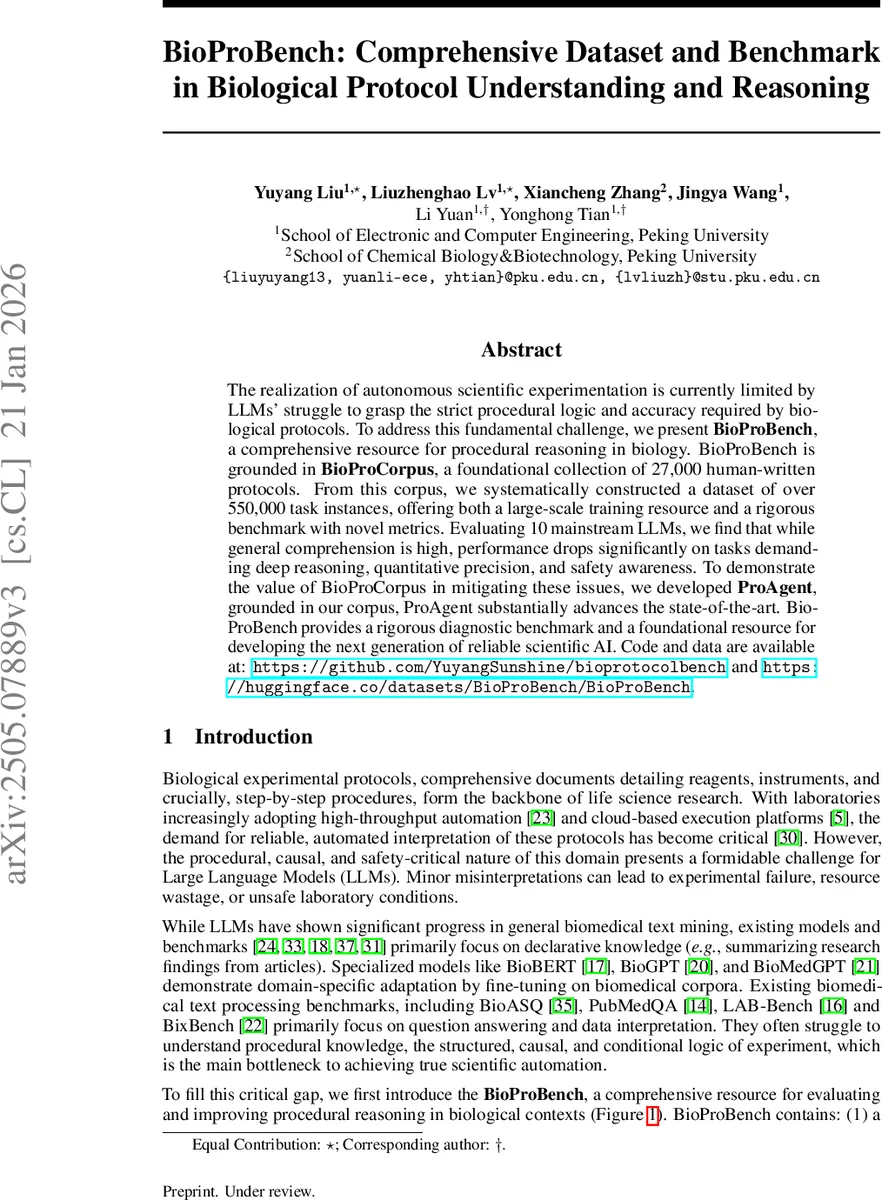
The realization of autonomous scientific experimentation is currently limited by LLMs’ struggle to grasp the strict procedural logic and accuracy required by biological protocols. To address this fundamental challenge, we present \textbf{BioProBench}, a comprehensive resource for procedural reasoning in biology. BioProBench is grounded in \textbf{BioProCorpus}, a foundational collection of 27,000 human-written protocols. From this corpus, we systematically constructed a dataset of over 550,000 task instances, offering both a large-scale training resource and a rigorous benchmark with novel metrics. Evaluating 10 mainstream LLMs, we find that while general comprehension is high, performance drops significantly on tasks demanding deep reasoning, quantitative precision, and safety awareness. To demonstrate the value of BioProCorpus in mitigating these issues, we developed \textbf{ProAgent}, grounded in our corpus, ProAgent substantially advances the state-of-the-art. BioProBench provides a rigorous diagnostic benchmark and a foundational resource for developing the next generation of reliable scientific AI. Code and data are available at: https://github.com/YuyangSunshine/bioprotocolbench and https://huggingface.co/datasets/BioProBench/BioProBench.
💡 Research Summary
BioProBench introduces a large‑scale, domain‑specific benchmark for evaluating large language models (LLMs) on the procedural understanding and reasoning required by biological experimental protocols. The authors first assembled BioProCorpus, a curated collection of 26,933 full‑text protocols sourced from six reputable repositories (Bio‑Protocol, Protocol‑Exchange, JOVE, Nature Protocols, Morimoto Lab, and Protocols.io). After extensive cleaning, deduplication, and hierarchical parsing, each protocol is represented as a structured JSON object containing metadata (ID, title, URL, keywords, abstract, inputs, length, classification) and a tree‑like step hierarchy (top‑step and child‑step relationships).
From this corpus, five distinct tasks were automatically generated, yielding a total of 556,171 instances (380,697 publicly released). The tasks are designed to probe different facets of procedural competence:
- Protocol Question Answering (PQA) – extracts precise reagent dosages, parameter values, and operational instructions from the source text; distractor options are generated under strict constraints to test fine‑grained factual recall.
- Step Ordering (ORD) – shuffles original steps (both global top‑step and local child‑step levels) and requires the model to reconstruct the correct sequence, evaluating causal and hierarchical reasoning.
- Error Correction (ERR) – injects subtle safety or validity errors (e.g., incorrect concentrations) into otherwise correct protocols; the model must detect and correct them, testing safety awareness.
- Protocol Generation (GEN) – asks the model to assemble a complete, coherent protocol using only information explicitly present in the source, assessing long‑form instruction synthesis.
- Protocol Reasoning (REA) – extends GEN and ERR with Chain‑of‑Thought (CoT) prompting, making the model’s reasoning process explicit and measuring logical justification.
To assess performance, the authors introduced novel domain‑specific metrics alongside traditional exact‑match scores. Keyword‑based content metrics quantify the overlap of critical terms, while embedding‑based structural metrics evaluate the similarity of the reconstructed step hierarchy to the ground truth. Ten state‑of‑the‑art LLMs (including GPT‑4, Claude‑2, LLaMA‑2‑70B, etc.) were evaluated on both the large training split and the rigorously filtered test split. Results show that while models achieve high accuracy (>80 %) on basic comprehension tasks such as PQA, performance drops dramatically (<30 %) on tasks demanding deep procedural logic, quantitative precision, or safety reasoning. This gap highlights the current inability of LLMs to reliably handle the fine‑grained, causal, and safety‑critical aspects of laboratory protocols.
To demonstrate the practical utility of the corpus, the authors built ProAgent, a retrieval‑augmented agent that queries BioProCorpus for relevant protocol fragments, integrates them, and applies step‑wise verification before producing an answer. ProAgent consistently outperforms the base LLMs, improving PQA by 12 percentage points, ORD by 18 pp, ERR by 22 pp, GEN by 15 pp, and REA by 20 pp. These gains illustrate how grounding LLMs in a high‑quality procedural knowledge base can substantially raise reliability for scientific AI applications.
The paper’s contributions are: (1) the release of BioProCorpus, the largest publicly available collection of human‑written biological protocols; (2) the construction of a multi‑task benchmark with over half a million instances covering diverse sub‑fields (cell culture, genomics, immunology, synthetic biology, etc.); (3) novel evaluation metrics tailored to procedural content and structure; (4) the ProAgent system that showcases how corpus‑grounded retrieval can bridge current performance gaps; and (5) a thorough analysis of LLM weaknesses in procedural reasoning, providing a roadmap for future research.
Future directions suggested include integrating multimodal data (e.g., images of lab equipment, video of protocol execution), coupling the benchmark with robotic automation platforms, and establishing community‑driven updates and validation pipelines to keep the corpus current. BioProBench thus positions itself as a foundational resource for the next generation of trustworthy, autonomous scientific AI.
Comments & Academic Discussion
Loading comments...
Leave a Comment