Symmetric Schur-class functions on the bidisk and Schur-class functions on the symmetrized bidisk
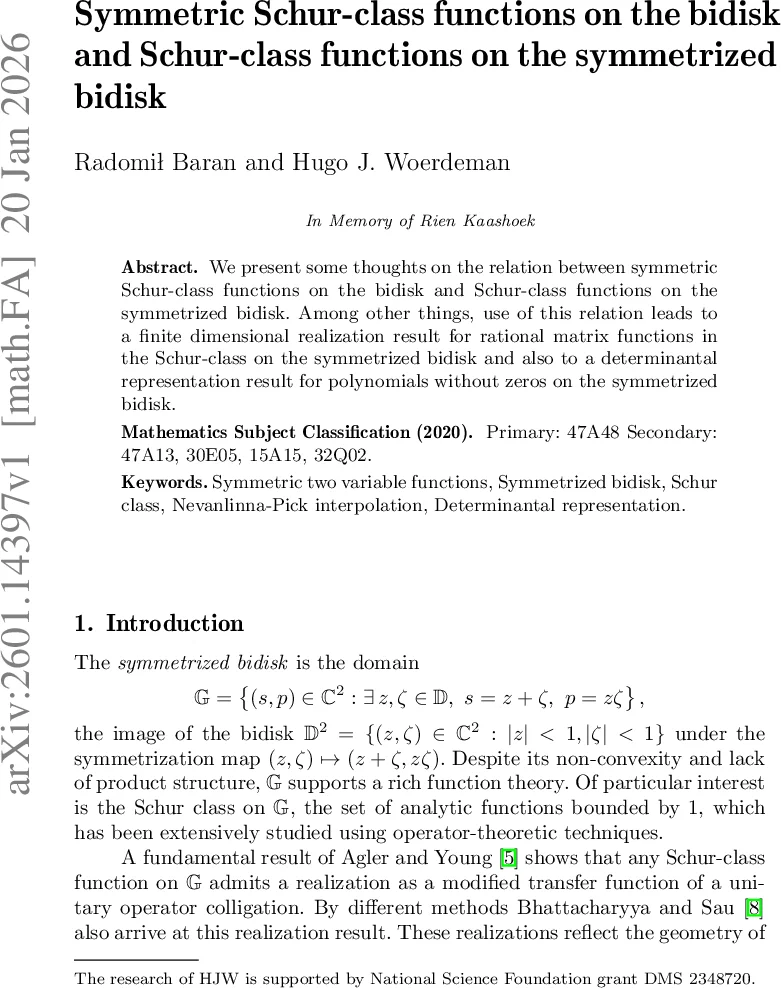
We present some thoughts on the relation between symmetric Schur-class functions on the bidisk and Schur-class functions on the symmetrized bidisk. Among other things, use of this relation leads to a finite dimensional realization result for rational matrix functions in the Schur-class on the symmetrized bidisk and also to a determinantal representation result for polynomials without zeros on the symmetrized bidisk.
💡 Research Summary
The paper investigates the relationship between symmetric Schur‑class functions on the bidisk ( \mathbb D^2) and Schur‑class functions on the symmetrized bidisk ( G={(s,p):s=z+\zeta ,,p=z\zeta ,,|z|,|\zeta|<1}). The authors first establish a realization theorem for symmetric Schur‑class functions on ( \mathbb D^2). Theorem 2.1 shows that a function (f(z,\zeta)) with the symmetry (f(z,\zeta)=f(\zeta ,z)) can be written as a transfer‑function of a contractive colligation matrix (M) that possesses a block‑symmetric structure. This representation automatically enforces symmetry and reduces the number of free parameters compared with the general Agler‑Young realization. When (f) is rational, the colligation can be taken on a finite‑dimensional space, using results of Knese and others.
Theorem 2.2 provides a determinantal representation for a symmetric polynomial (p(z,\zeta)) that has no zeros in the closed bidisk. The polynomial can be expressed as
(p(z,\zeta)=p(0,0)\det!\bigl(I-\begin{bmatrix}A_1&A_2\A_2&A_1\end{bmatrix}\begin{bmatrix}zI&0\0&\zeta I\end{bmatrix}\bigr))
with the block matrix being a contraction. The size of the matrices can be taken at most (2n) where (n) is the degree in each variable. This extends the classical one‑variable stable‑polynomial factorization to the two‑variable symmetric case.
The paper then treats a symmetric Nevanlinna‑Pick interpolation problem on ( \mathbb D^2). Proposition 2.3 shows that if a solution exists, the symmetrized average (\hat f(z,\zeta)=\frac12\bigl(f(z,\zeta)+f(\zeta ,z)\bigr)) is also a solution, thereby reducing the problem to the usual Pick condition with an additional symmetry constraint.
The central contribution is the transfer of these results to the symmetrized bidisk. Theorem 3.1 proves that a function (g(s,p)) belongs to the Schur class on (G) if and only if it admits a realization of the form
(g(s,p)=\delta+\frac12\gamma,(sI-2p\alpha_2)\bigl(I-s^2(\alpha_1+\alpha_2)+p\alpha_1\alpha_2\bigr)^{-1}\beta)
with a contractive colligation (\tilde M) of a specific block pattern. The proof proceeds by setting (f(z,\zeta)=g(z+\zeta ,z\zeta )), applying the symmetric realization from Theorem 2.1, and conjugating the colligation by a unitary matrix that implements the change of variables from ((z,\zeta)) to ((s,p)). This yields explicit formulas (\alpha_1=A_1+A_2,\ \alpha_2=A_1-A_2,\ \beta=\sqrt2,B,\ \gamma=\sqrt2,C,\ \delta=D). As in the bidisk case, rational matrix‑valued (g) admits a finite‑dimensional colligation.
Theorem 3.3 gives a determinantal representation for a polynomial (g(s,p)) without zeros in (G). By pulling back to the symmetric polynomial (p(z,\zeta)=g(z+\zeta ,z\zeta )) and invoking Theorem 2.2, the authors construct contraction matrices (A_1,A_2) (size ≤ (2n)) such that
(g(s,p)=g(0,0)\det!\bigl(I-sA_1+p(A_1+A_2)(A_1-A_2)\bigr)).
If the polynomial is strictly zero‑free on (G), a scaling argument yields a strict contraction.
The paper also connects these representation results with interpolation. Proposition 3.4 shows that the Nevanlinna‑Pick problem on (G) is equivalent to the symmetric Pick problem on ( \mathbb D^2). The authors note that the latter can be solved via semidefinite programming (SDP) using the Agler‑McCarthy kernel conditions, making the problem computationally tractable. An explicit example (Example 3.5) demonstrates the SDP formulation, construction of a contractive colligation, and derivation of a rational inner solution on (G).
In summary, the article exploits the symmetry inherent in the bidisk‑to‑symmetrized‑bidisk map to obtain concrete finite‑dimensional realizations and determinantal formulas for Schur‑class functions and zero‑free polynomials. These results not only deepen the theoretical understanding of multivariable operator‑theoretic function theory but also provide practical tools for interpolation, control synthesis, and the study of Γ‑contractions. Future work may address minimal‑dimension realizations, extensions to other symmetric domains, and applications to multivariable system theory.
Comments & Academic Discussion
Loading comments...
Leave a Comment