Transgressions and Chern characters in coarse homotopy theory
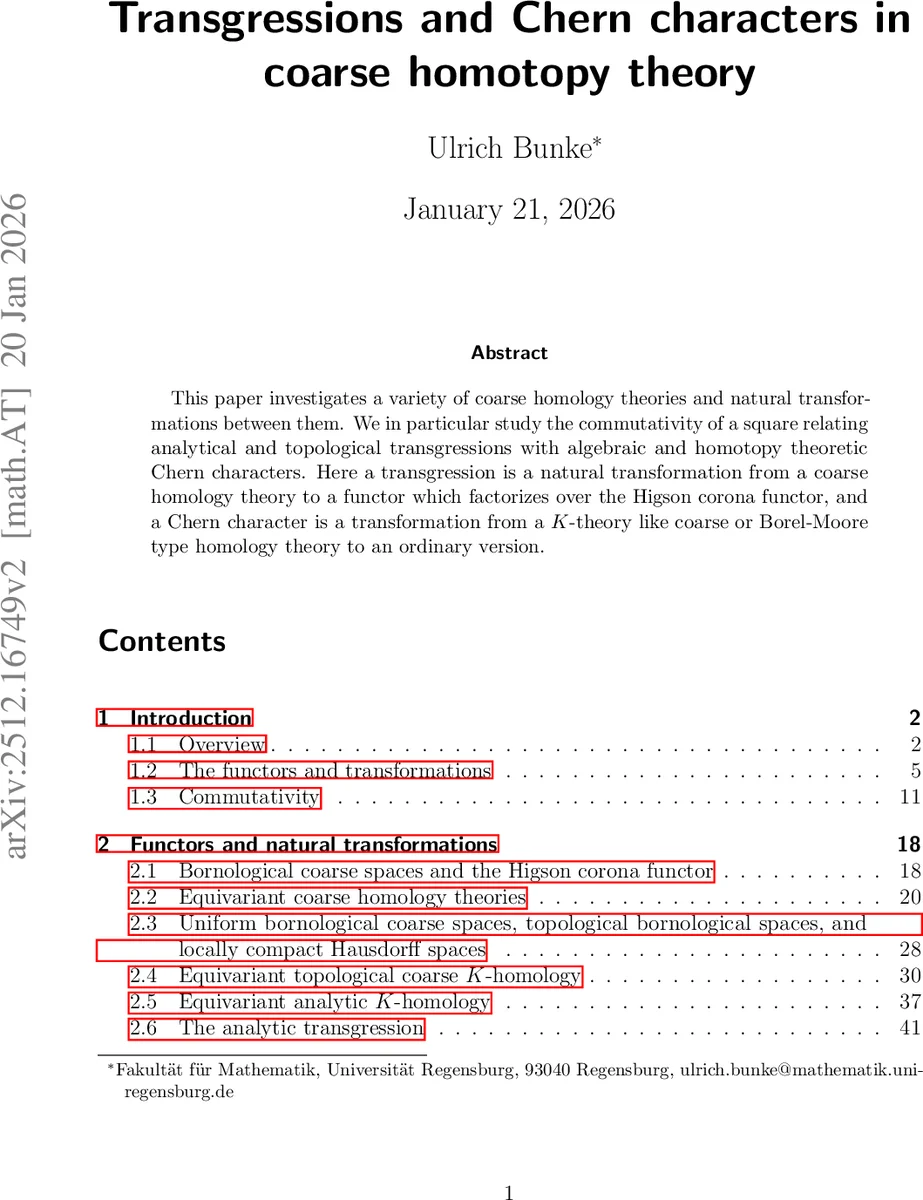
This paper investigates a variety of coarse homology theories and natural transformations between them. We in particular study the commutativity of a square relating analytical and topological transgressions with algebraic and homotopy theoretic Chern characters. Here a transgression is a natural transformation from a coarse homology theory to a functor which factorizes over the Higson corona functor, and a Chern character is a transformation from a $K$-theory like coarse or Borel-Moore type homology theory to an ordinary version.
💡 Research Summary
The paper “Transgressions and Chern characters in coarse homotopy theory” develops a comprehensive framework for relating several coarse homology theories via natural transformations called transgressions and Chern characters. The setting is equivariant coarse homotopy theory: objects are G‑bornological coarse spaces (G‑BC) equipped with a proper action of a discrete group G, and morphisms are controlled maps. A central functor is the Higson corona ∂ₕ: G‑BC → G‑CH, which sends a coarse space to its corona, a compact Hausdorff G‑space.
Two families of transgressions are constructed. The analytic transgression T₍G,an₎ links equivariant coarse topological K‑homology KX_G (built from Roe categories of controlled Hilbert‑space modules) to equivariant analytic K‑homology K_G,an (obtained from equivariant E‑theory applied to C₀(–)⊗C(G)_{std}). Its definition uses a Paschke‑type morphism and the functoriality of Roe categories. The topological transgression T₍G,top₎ connects the coarsification of a Borel‑Moore homology theory with the original Borel‑Moore theory; it is defined by exploiting the strong excision property of Borel‑Moore homology.
Chern characters are natural transformations from K‑theoretic coarse homology to ordinary (co)homology. The paper introduces a coarse algebraic K‑theory KX_G,ctr, defined by composing the homotopy K‑theory functor KCat_ZH (Weibel’s K‑theory for Z‑linear categories) with the uncompleted Roe category V_G,ctr and the trace‑class operator algebra L¹. A comparison map c_G: KX_G,ctr → KX_G (topological) is shown to be an equivalence on sufficiently finite coarse spaces, using results of Cortiñas–Thom. The algebraic Chern character ch_G,alg: KX_G,ctr → PCH_XG (coarse periodic cyclic homology) is induced by the classical Goodwillie‑Jones trace from K‑theory to negative cyclic homology, together with the trace on L¹.
The main diagram (1.2) combines these ingredients: analytic and topological transgressions on the left, algebraic and homotopy‑theoretic Chern characters on the right, and Borel‑Moore homology theories after applying the Higson corona. The central question is whether the square commutes. The authors prove commutativity in several stages. First, they evaluate the diagram on the cone over a point O^∞(∗) and compute both compositions explicitly, normalizing the homotopies to obtain equality in the stable ∞‑category (Theorem 3.1). Next, by naturality of the involved functors (all are spectrum‑valued and satisfy homological axioms), they extend the result to cones over finite CW‑complexes. This yields commutativity for Borel‑equivariant versions on finite G‑CW‑complexes when G is finite.
To go beyond these cases, the paper proposes a “motivic transgression” T_mot and a corresponding motivic Chern character. The idea is to associate to any equivariant coarse homology theory E_G a Borel‑Moore theory F_G := E_G ∘ O^∞ and a transgression from E_G to F_G ∘ ∂ₕ. While this construction is not yet fully satisfactory (F_G is not a genuine Borel‑Moore theory), it illustrates a pathway to a universal compatibility between transgressions and Chern characters.
Further, the authors discuss the trace transformation τ: PCH_XG → PH_XG (periodic to Borel‑Moore homology) induced by the L¹‑trace, and they analyze pairings of the right‑hand corner of the diagram with cohomology classes. Using the established commutativity, they derive a formula (3.36) analogous to the one appearing in Elliott–Lück (EL25), showing that the values of these pairings are independent of the chosen factorization through transgressions or Chern characters.
Overall, the paper achieves three major contributions: (1) a systematic construction of analytic and topological transgressions in the equivariant coarse setting; (2) a detailed algebraic Chern character from coarse algebraic K‑theory to coarse periodic cyclic homology, together with a comparison to topological K‑theory; (3) a proof of the commutativity of the fundamental square for a broad class of spaces, and a conceptual framework (motivic transgression) for extending this compatibility further. The work bridges operator‑algebraic techniques (Roe algebras, Paschke morphisms), homotopy‑theoretic tools (stable ∞‑categories, homotopy K‑theory), and classical algebraic topology (Borel‑Moore homology, Chern characters), thereby providing a unified perspective on how coarse geometric invariants interact with both analytic and algebraic invariants. Future directions include refining the motivic construction to obtain genuine Borel‑Moore theories for arbitrary coarse spaces and extending the algebraic Chern character to more general coefficient categories.
Comments & Academic Discussion
Loading comments...
Leave a Comment