Goggin's corrected Kalman Filter: Guarantees and Filtering Regimes
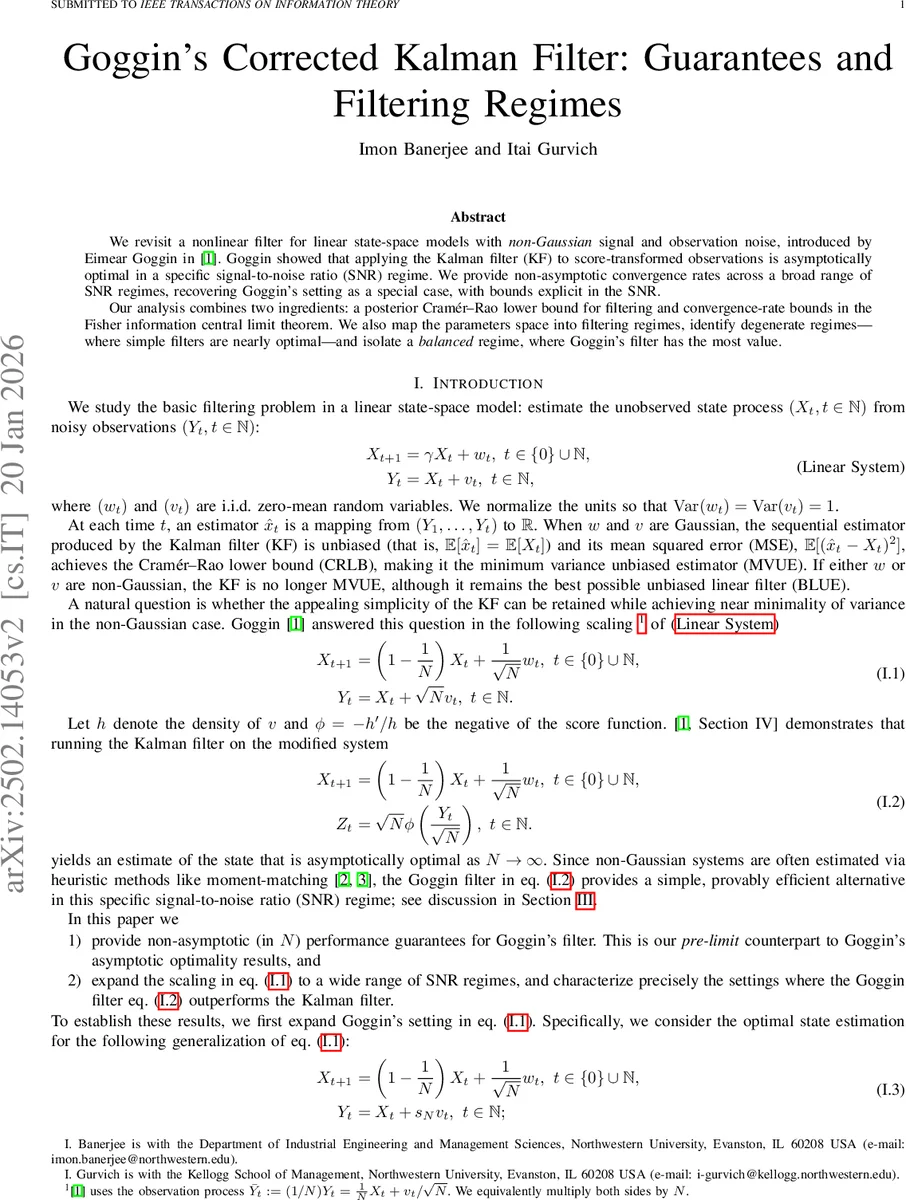
In this paper we revisit a non-linear filter for {\em non-Gaussian} noises that was introduced in [1]. Goggin proved that transforming the observations by the score function and then applying the Kalman Filter (KF) to the transformed observations results in an asymptotically optimal filter. In the current paper, we study the convergence rate of Goggin’s filter in a pre-limit setting that allows us to study a range of signal-to-noise regimes which includes, as a special case, Goggin’s setting. Our guarantees are explicit in the level of observation noise, and unlike most other works in filtering, we do not assume Gaussianity of the noises. Our proofs build on combining simple tools from two separate literature streams. One is a general posterior Cramér-Rao lower bound for filtering. The other is convergence-rate bounds in the Fisher information central limit theorem. Along the way, we also study filtering regimes for linear state-space models, characterizing clearly degenerate regimes – where trivial filters are nearly optimal – and a {\em balanced} regime, which is where Goggin’s filter has the most value. \footnote{This work has been submitted to the IEEE for possible publication. Copyright may be transferred without notice, after which this version may no longer be accessible.
💡 Research Summary
This paper revisits the “Goggin filter,” a nonlinear filtering technique for linear state‑space models with non‑Gaussian process and observation noise. Goggin’s original contribution showed that, when the observation equation is transformed by the score function of the observation noise and the Kalman filter (KF) is applied to these transformed observations, the resulting estimator is asymptotically optimal as the scaling parameter N tends to infinity. The present work moves beyond this asymptotic regime and provides explicit, non‑asymptotic convergence‑rate guarantees for the Goggin filter across a broad spectrum of signal‑to‑noise ratios (SNR).
The authors first formalize a generalized scaling of the observation noise: the observation equation becomes Yₜ = Xₜ + s_N vₜ, where s_N can grow or shrink with N. By varying s_N relative to √N, three distinct SNR regimes emerge: (i) Negligible SNR (s_N ≫ √N), where observation noise dominates; (ii) Large SNR (s_N ≪ 1/√N), where observations are almost noise‑free; and (iii) Balanced SNR (1/√N ≲ s_N ≲ √N), where signal and observation noise are comparable.
In the negligible‑SNR regime the paper proves (Lemma 1) that the optimal steady‑state mean‑squared error (MSE*) is bounded below by a constant (≈½) and that the trivial estimator ˆxₜ = E
Comments & Academic Discussion
Loading comments...
Leave a Comment