Synthesizing the Virtual Advocate: A Multi-Persona Speech Generation Framework for Diverse Linguistic Jurisdictions in Indic Languages
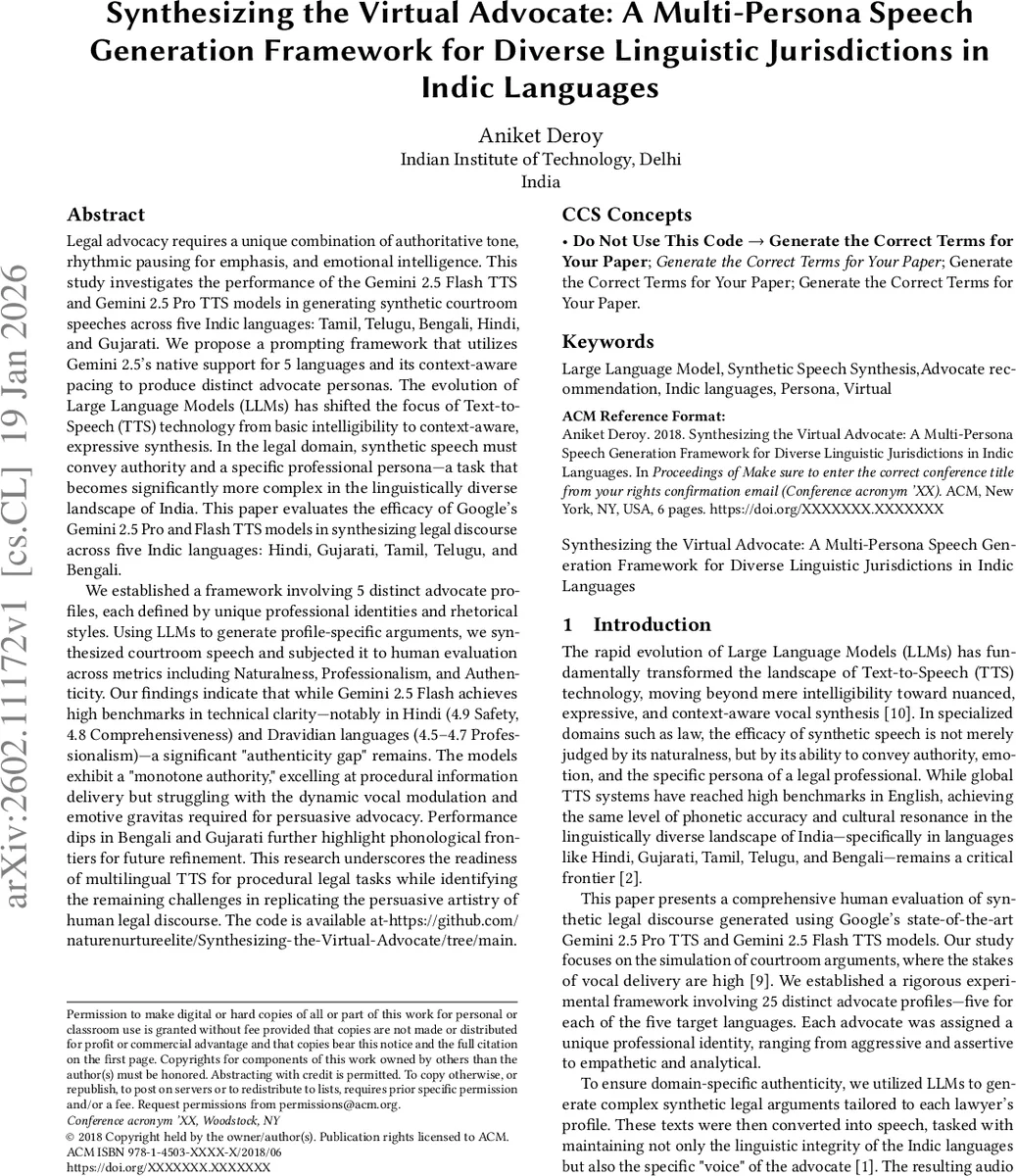
Legal advocacy requires a unique combination of authoritative tone, rhythmic pausing for emphasis, and emotional intelligence. This study investigates the performance of the Gemini 2.5 Flash TTS and Gemini 2.5 Pro TTS models in generating synthetic courtroom speeches across five Indic languages: Tamil, Telugu, Bengali, Hindi, and Gujarati. We propose a prompting framework that utilizes Gemini 2.5s native support for 5 languages and its context-aware pacing to produce distinct advocate personas. The evolution of Large Language Models (LLMs) has shifted the focus of TexttoSpeech (TTS) technology from basic intelligibility to context-aware, expressive synthesis. In the legal domain, synthetic speech must convey authority and a specific professional persona a task that becomes significantly more complex in the linguistically diverse landscape of India. The models exhibit a “monotone authority,” excelling at procedural information delivery but struggling with the dynamic vocal modulation and emotive gravitas required for persuasive advocacy. Performance dips in Bengali and Gujarati further highlight phonological frontiers for future refinement. This research underscores the readiness of multilingual TTS for procedural legal tasks while identifying the remaining challenges in replicating the persuasive artistry of human legal discourse. The code is available at-https://github.com/naturenurtureelite/Synthesizing-the-Virtual-Advocate/tree/main
💡 Research Summary
The paper “Synthesizing the Virtual Advocate: A Multi‑Persona Speech Generation Framework for Diverse Linguistic Jurisdictions in Indic Languages” investigates how well Google’s Gemini 2.5 Flash and Gemini 2.5 Pro text‑to‑speech (TTS) models can generate courtroom‑style speeches in five major Indian languages—Hindi, Tamil, Telugu, Bengali, and Gujarati—while embodying distinct advocate personas.
Research Motivation and Context
Legal advocacy demands not only intelligibility but also authority, rhythmic pausing, and emotional nuance. Existing multilingual TTS systems have achieved high naturalness in English, yet replicating the persuasive voice of a lawyer across India’s linguistically heterogeneous landscape remains an open challenge. The authors therefore aim to evaluate whether state‑of‑the‑art TTS can meet the dual requirements of procedural accuracy and persona‑driven expressiveness.
Methodology Overview
- Persona Definition – For each language, five advocate personas are crafted, varying along three dimensions: language (L), area of expertise (A), and rhetorical style (S). Examples include an aggressive senior counsel, an empathetic analyst, and a methodical strategist.
- Text Generation – Using a large language model (LLM), the authors feed each persona vector together with a legal case brief (C) to produce a tailored argument text T_i = f_LLM(p_i, C).
- TTS Mapping – The text is fed into either the Flash or Pro Gemini model. The transformation is formalized as S_audio = Φ_M(T_i, θ_i, σ_i), where θ_i encodes prosodic steering parameters (pitch, pacing, stress) derived from the persona, and σ_i is a language‑specific embedding. This mathematical framing clarifies how persona attributes are intended to influence acoustic output.
- Human Evaluation – A panel of legal and linguistic experts rates each generated audio sample on five Likert‑scale dimensions (1–5): Naturalness, Professionalism, Authenticity, Safety, and Comprehensiveness. Scores are averaged across evaluators to obtain expected metric values.
Key Findings
- Hindi consistently achieves the highest scores (Safety 4.9, Comprehensiveness 4.8), indicating that the model’s phonetic training is most robust for this language.
- Tamil and Telugu (the Dravidian group) show stable performance, with Professionalism and Directiveness ranging between 4.5 and 4.7. The models capture an “authoritative advocate voice” reasonably well.
- Bengali and Gujarati suffer a pronounced “authenticity gap.” Scores for Authenticity and Expressiveness drop to around 3.2, and evaluators note a “monotone authority”—the speech is clear and procedural but lacks dynamic pitch modulation, emotional gravitas, and rhetorical pauses essential for persuasive advocacy.
- Across all languages, the models excel at delivering factual, procedural content (e.g., reading statutes) but struggle with the nuanced vocal dynamics that human lawyers employ to sway judges and juries.
Analysis and Implications
The study reveals that current multilingual TTS can be reliably deployed for low‑stakes legal tasks such as automated reading of court orders or procedural announcements. However, for high‑stakes advocacy—where tone, emphasis, and emotional resonance are decisive—the technology remains insufficient. The performance dip in Bengali and Gujarati highlights phonological frontiers: complex consonant clusters, tonal variations, and language‑specific intonation patterns are not yet fully captured by the training data.
The authors propose three avenues for future work:
- Data Expansion – Curate large, high‑quality, multi‑speaker corpora for under‑represented Indic languages, especially Bengali and Gujarati.
- Prosody‑Control Enhancements – Develop multi‑speaker prosody models with fine‑grained emotional labeling to enable controlled pitch contours, stress patterns, and pause insertion aligned with persona specifications.
- Domain‑Specific Fine‑Tuning – Perform targeted fine‑tuning of the TTS pipeline on legal‑domain speech (courtroom recordings, lawyer interviews) to better internalize domain‑specific diction and rhetorical devices.
Conclusion
By integrating persona‑driven LLM text generation with advanced TTS, the paper demonstrates that multilingual speech synthesis is ready for procedural legal applications across India’s major languages. Nevertheless, replicating the full persuasive artistry of human advocates—especially the emotive modulation and cultural nuance—requires further research in data collection, prosodic modeling, and domain adaptation. The work sets a solid benchmark and outlines a clear roadmap for advancing AI‑driven legal advocacy toward truly expressive, multilingual virtual advocates.
Comments & Academic Discussion
Loading comments...
Leave a Comment