Enhancing few-shot time series forecasting with LLM-guided diffusion
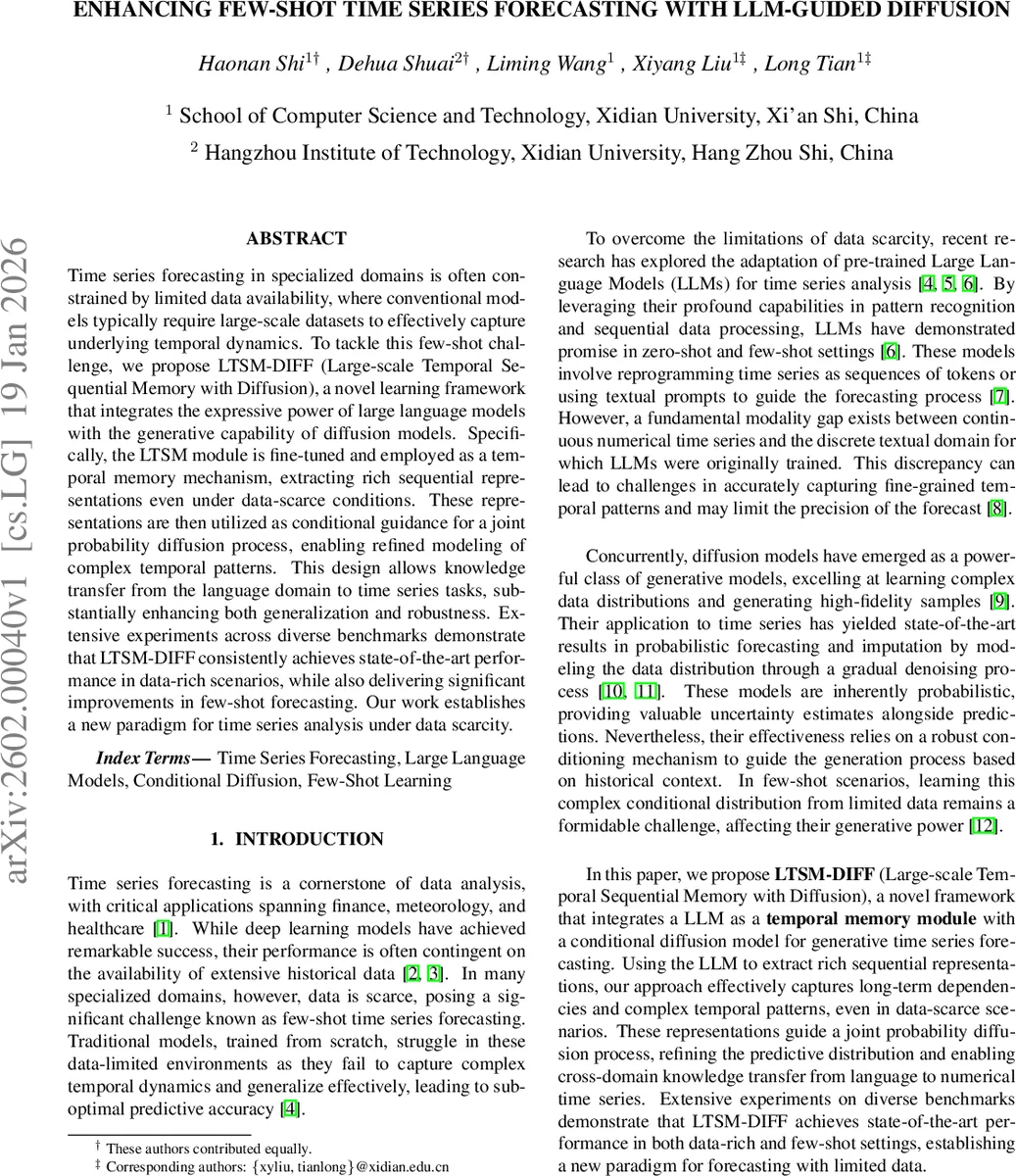
Time series forecasting in specialized domains is often constrained by limited data availability, where conventional models typically require large-scale datasets to effectively capture underlying temporal dynamics. To tackle this few-shot challenge, we propose LTSM-DIFF (Large-scale Temporal Sequential Memory with Diffusion), a novel learning framework that integrates the expressive power of large language models with the generative capability of diffusion models. Specifically, the LTSM module is fine-tuned and employed as a temporal memory mechanism, extracting rich sequential representations even under data-scarce conditions. These representations are then utilized as conditional guidance for a joint probability diffusion process, enabling refined modeling of complex temporal patterns. This design allows knowledge transfer from the language domain to time series tasks, substantially enhancing both generalization and robustness. Extensive experiments across diverse benchmarks demonstrate that LTSM-DIFF consistently achieves state-of-the-art performance in data-rich scenarios, while also delivering significant improvements in few-shot forecasting. Our work establishes a new paradigm for time series analysis under data scarcity.
💡 Research Summary
The paper introduces LTSM‑DIFF, a novel framework that tackles the few‑shot time‑series forecasting problem by marrying the representational power of large language models (LLMs) with the generative flexibility of diffusion models. The authors observe that conventional forecasting methods require abundant historical data, which is often unavailable in specialized domains such as finance, meteorology, or healthcare. While recent work has begun to repurpose pre‑trained LLMs for time‑series tasks, a modality gap remains because LLMs are trained on discrete textual tokens, whereas time‑series data are continuous numeric sequences. Conversely, diffusion models have shown promise for probabilistic forecasting but rely heavily on robust conditioning signals that are difficult to learn from scarce data.
LTSM‑DIFF addresses these issues with two tightly coupled components. First, a “temporal memory” module is built by fine‑tuning the first six transformer blocks of a pre‑trained GPT‑2 model using Low‑Rank Adaptation (LoRA). Input series are linearly embedded, passed through a lightweight transformer encoder, and then fed into the LoRA‑augmented GPT‑2 blocks. This design keeps the number of trainable parameters low while enabling the LLM to learn domain‑specific temporal patterns. The output hidden states constitute a rich, high‑dimensional representation (x_0) of the historical window.
Second, the conditional diffusion module (named UViT) replaces conventional convolutional U‑Nets with transformer‑based blocks. Unlike standard conditional diffusion that only adds noise to the target trajectory, LTSM‑DIFF injects noise into both the condition (x_0) and the future (y_0). The forward processes follow the usual Gaussian schedule, and the network is trained to predict the injected noises (
Comments & Academic Discussion
Loading comments...
Leave a Comment