Quantum State Preparation of Ferromagnetic Magnons by Parametric Driving
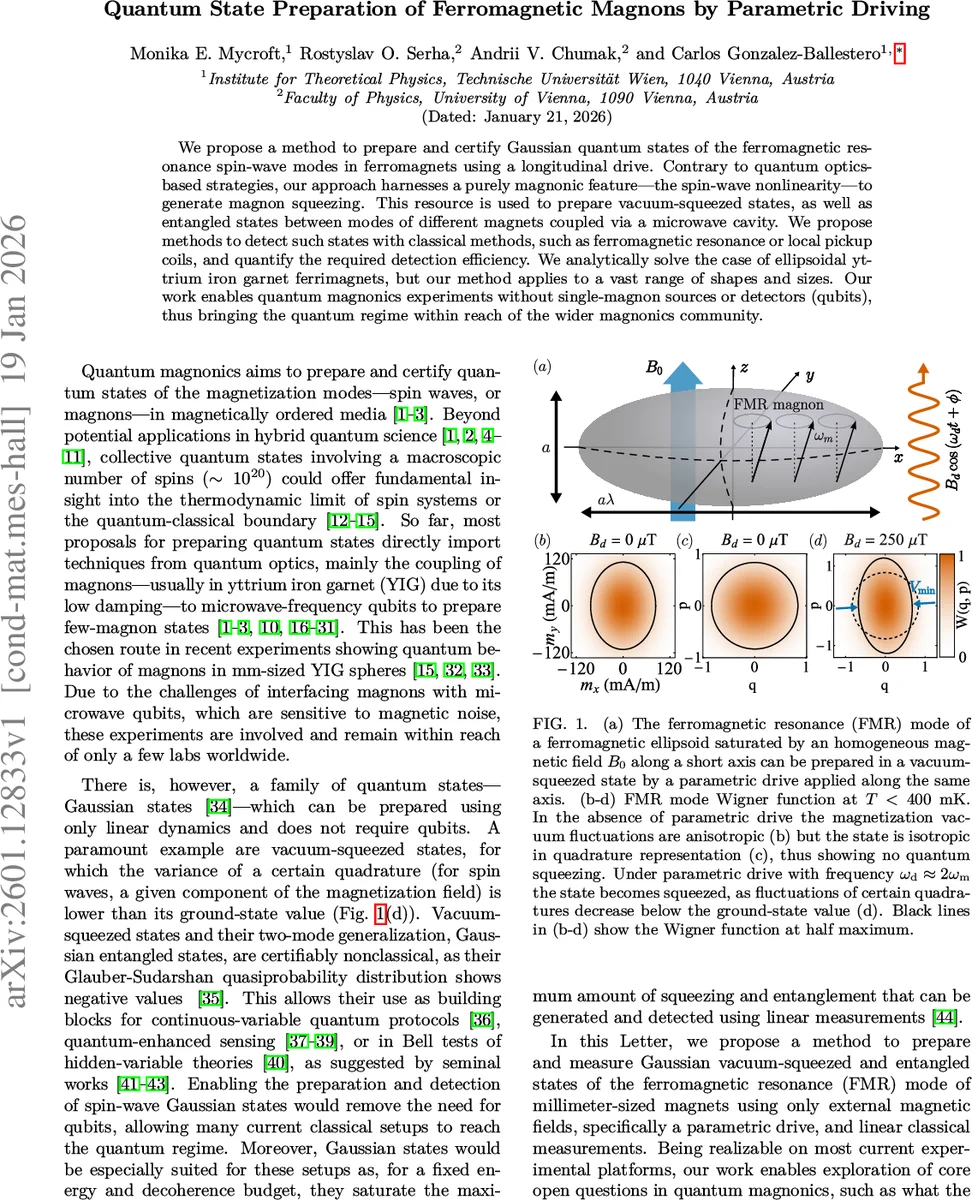
We propose a method to prepare and certify Gaussian quantum states of the ferromagnetic resonance spin-wave modes in ferromagnets using a longitudinal drive. Contrary to quantum optics-based strategies, our approach harnesses a purely magnonic feature - the spin-wave nonlinearity - to generate magnon squeezing. This resource is used to prepare vacuum-squeezed states, as well as entangled states between modes of different magnets coupled via a microwave cavity. We propose methods to detect such states with classical methods, such as ferromagnetic resonance or local pickup coils, and quantify the required detection efficiency. We analytically solve the case of ellipsoidal yttrium iron garnet ferrimagnets, but our method applies to a vast range of shapes and sizes. Our work enables quantum magnonics experiments without single-magnon sources or detectors (qubits), thus bringing the quantum regime within reach of the wider magnonics community.
💡 Research Summary
The manuscript presents a fully magnetic‑only route to generate and certify Gaussian quantum states of ferromagnetic resonance (FMR) magnons. By applying a homogeneous longitudinal parametric drive (a magnetic field oscillating at frequency ωd≈2 ωm) along the same axis that defines the static bias field, the authors exploit the intrinsic spin‑wave non‑linearity (the m² term in the Zeeman energy) to produce a squeezing interaction of the form ℏ r (e^{iφ}ŝ² + h.c.). The squeezing rate r scales with the drive amplitude Bd and with the geometric asymmetry factor (1/√ξ − √ξ), vanishing for a spherical sample (ξ = 1) and therefore highlighting the importance of ellipsoidal shapes.
Within a Lindblad master‑equation framework that includes Gilbert damping γm, the steady‑state quadrature variance is derived analytically as Vmin = ½
Comments & Academic Discussion
Loading comments...
Leave a Comment